Report Highlights Climate Risks to Rajasthan Renewable Assets
Source:et-energyworld ↗
Why It Matters
This analysis sheds light on the significant atmospheric, geographical, and physical climate risks confronting India's green energy infrastructure, offering essential data on the regional vulnerabilities of key states like Rajasthan and Gujarat.
Summary
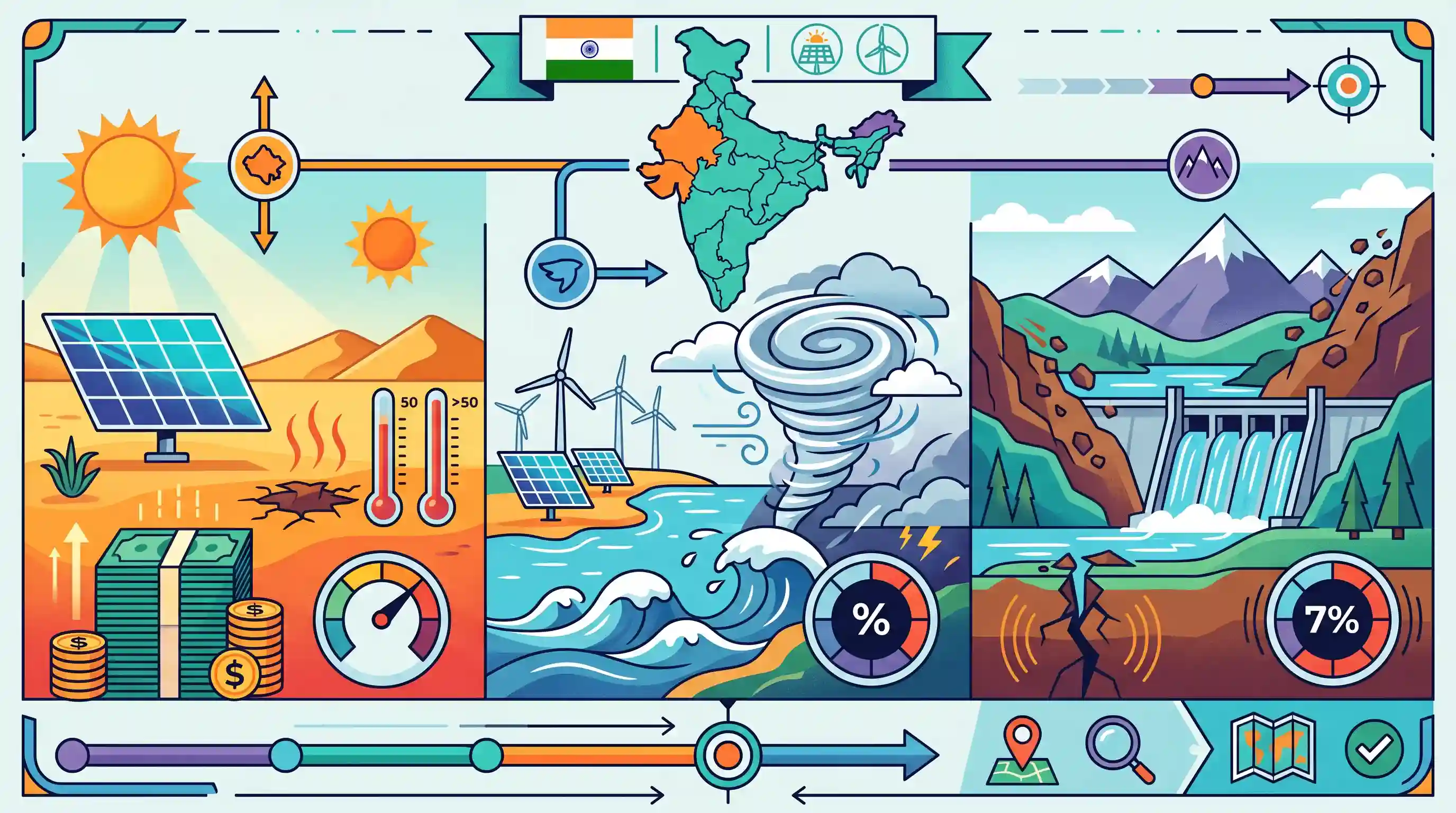
According to Zurich's portfolio analysis, Rajasthan, Gujarat, and Arunachal Pradesh are at the heart of India's renewable energy risk map by 2030. Rajasthan, crucial for India's 500 GW non-fossil goal, holds the highest absolute Value at Risk (VaR) of USD 16.4 billion, with 85% of its planned solar-heavy capacity exposed to extreme temperatures over 50°C. Gujarat's wind and solar capacity faces a compound threat of cyclones and storm surges (90% of assets in critical categories). Meanwhile, Arunachal Pradesh's eastern Himalayan hydropower assets present severe seismic and landslide risks (96% in critical categories). The report recommends integrating proactive, forward-looking climate screening into site selection and project approvals to safeguard India's renewable transition.
Key Points
- Zurich's climate exposure portfolio analysis highlights that Rajasthan, Gujarat, and Arunachal Pradesh carry the highest absolute Value at Risk (VaR) and the largest share of assets in critical risk categories by 2030.
- Rajasthan is central to India's 500 GW non-fossil target with 272 assessed sites (82,149 MW of planned capacity); it carries the highest absolute VaR at USD 16.4 billion, with 85% of assets in critical risk categories (4 or 5) where extreme heat exceeding 50°C stresses solar panels.
- Gujarat's solar and wind assets (172 sites, 47,530 MW) carry USD 8.6 billion VaR, with 90% of assets in critical risk categories due to a complex hazard profile of hail, tornadoes, cyclones, and coastal storm surges.
- Arunachal Pradesh presents a highly concentrated risk profile where 30 assessed hydropower sites carry USD 13.1 billion VaR, placing 96% of its renewable assets in critical categories due to Himalayan slope instability, high precipitation, and seismic risks.
- Uttarakhand has 94% of assets in highest risk categories due to changing Himalayan hydrology, while Uttar Pradesh has 78% due to Ganga floods and extreme heat; in contrast, Karnataka has the lowest risk at just 5%.
- The report emphasizes the need for forward-looking climate screening in site selection and project permitting, along with multi-hazard stress-testing to reduce the gap between estimated risk and actual operational losses.
Important Terms
India's 500 GW Non-Fossil Fuel Target

A national commitment made at COP26 to install 500 gigawatts of non-fossil fuel-based power capacity by 2030, forming a key pillar of India's climate actions.
UPSC context
GS Paper III (Energy, Infrastructure, Environment); tests knowledge of clean energy transition goals, grid integration issues, and climate commitments.
PM-KUSUM Scheme
A central initiative launched in 2019 to provide water and energy security to farmers by solarising agriculture, including installing standalone solar pumps and solarising grid-connected pumps.
UPSC context
GS Paper III (Agriculture, Renewable Energy, Government Schemes); tests understanding of rural power systems, farmer income diversification, and irrigation.
Rajasthan Solar Energy Policy 2019
A state policy implemented in late 2019 to achieve 30,000 MW (30 GW) of solar capacity by 2024–25 through utility-scale parks, decentralized projects, and solar rooftop systems.
UPSC context
GS Paper III (Energy and State Policies); tests awareness of sub-national strategies, investment incentives, and land-allotment frameworks for clean energy.
Rajasthan Renewable Energy Corporation Limited (RRECL)
The state-owned public enterprise acting as the nodal agency for promoting, registering, and developing renewable energy, energy conservation, and solar power parks in Rajasthan.
UPSC context
GS Paper III (Institutional Frameworks and Energy); tests knowledge of state-level implementation bodies managing green energy infrastructure.
Prelims Trap
Extreme desert heat waves exceeding 50°C maximize the electricity output of crystalline silicon solar PV panels due to peak solar irradiance.
Photovoltaic panels operate optimally at 25°C. Every 1°C increase above this threshold reduces efficiency by 0.3% to 0.5% due to rising thermal resistance, meaning peak heat waves degrade power generation.
Static Concepts Connected
Why does extreme atmospheric heat degrade solar PV cell efficiency?
- Standard Test Conditions: Standard solar panels are rated at 25°C; temperatures beyond this increase internal thermal resistance.
- Bandgap Narrowing: As heat rises, the semiconductor's bandgap narrows, reducing the open-circuit voltage significantly while slightly increasing current, causing a net power output drop.
- Temperature Coefficient: Crystalline silicon panels degrade by 0.3% to 0.5% in conversion efficiency for every 1°C rise above the 25°C baseline.
What is the Coalition for Disaster Resilient Infrastructure (CDRI)?
- Origin & Headquarters: Launched by India at the 2019 UN Climate Action Summit, headquartered in New Delhi, focusing on infrastructure resilience against climate hazards.
- Legal Status: The Union Cabinet recognized CDRI as an 'International Organization' in 2022, granting it charter privileges under the UN (Privileges and Immunities) Act, 1947.
- Global Alignment: Directly supports the UN Sendai Framework for Disaster Risk Reduction by safeguarding critical energy, transport, and digital networks.
Cross-Topic Patterns
Himalayan Hydropower vs Geohazards
Arunachal and Uttarakhand's hydropower assets face dual pressures of seismic activity and climate-induced GLOFs, illustrating how GS-1 physical geography hazards directly compromise GS-3 clean energy goals.
Climate Finance and Asset Vulnerability
High Value at Risk (VaR) in states like Rajasthan highlights why climate finance must pivot from merely funding raw capacity to subsidizing climate-resilient engineering and asset insurance.

The thermal limits of solar PV efficiency combined with CDRI's disaster-resilient grid mandates will likely debut in 2026 GS-3.
Linked PYQs · 2
Linked PYQs · 2
- 2021RPSC_PRELIMSGS1
In which year was the Rajasthan Solar Energy Policy announced?
- 2023RPSC_PRELIMSGS1
Which agency has been given the responsibility of implementing the PM-KUSUM scheme (Component A) in Rajasthan, which involves the establishment of solar power plants with a capacity of 0.5 MW to 2 MW?
