Rajasthan Grade III Teachers Protest Exposes Transfer Policy Delays
Source:ommcomnews ↗
Why It Matters
The issue highlights administrative challenges in establishing clear human resource policies for state government employees (transfers) and demonstrates the practical exercise of the Fundamental Right to freedom of speech and peaceful assembly (Article 19).
Summary
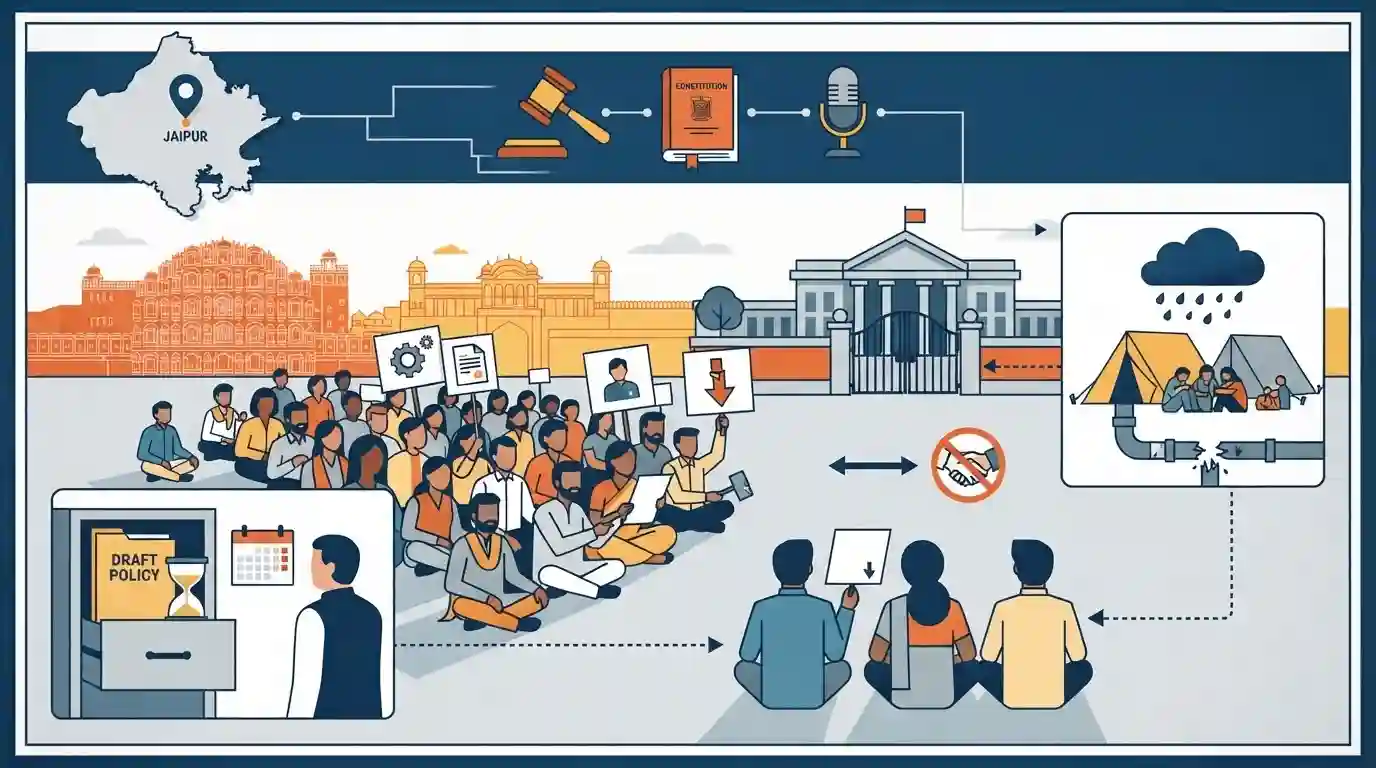
Thousands of Grade-III teachers in Rajasthan are continuing their sit-in protest at Shaheed Smarak in Jaipur, demanding a formal transfer policy and the resignation of Education Minister Madan Dilawar. The teachers, who have not seen transfers since 2018, are refusing to end their agitation until they can hold direct negotiations with Chief Minister Bhajan Lal Sharma. Despite the state government claiming that a draft policy is awaiting cabinet approval, the protesters have persisted through difficult conditions, including the disruption of basic amenities at the protest site.
Key Points
- Grade-III teachers in Rajasthan are staging an indefinite protest at Jaipur's Shaheed Smarak demanding the implementation of a comprehensive transfer policy.
- Protestors are demanding the resignation of State Education Minister Madan Dilawar over his alleged derogatory remarks and insistence on holding direct talks with Chief Minister Bhajan Lal Sharma.
- Grade-III teachers have not been granted transfers since 2018, causing significant unrest and dissatisfaction among the cadre.
- The state government claims a transfer policy has been drafted but requires approval from the Chief Minister and the Cabinet.
- Despite facing disruptions in basic facilities like water and electricity at the protest site, the teachers are continuing their peaceful assembly.
Important Terms
Rajasthan Education Department

The state administrative body in Rajasthan responsible for overseeing school education, recruiting teaching staff, managing their postings, and enforcing administrative policies.
UPSC context
GS Paper 2 (Governance). Highlights the role of state departments in human resource management, service delivery, and public employee grievance redressal.
State Government of Rajasthan
The executive authority of Rajasthan, headed by the Chief Minister and the Cabinet, responsible for drafting, approving, and executing state-specific public policies and administering state cadres.
UPSC context
GS Paper 2 (Polity & Governance). Tests understanding of state executive powers, cabinet decision-making, and public administration under the Indian Constitution.
Right to Protest (Article 19)
A democratic right implicitly protected under Article 19(1)(a) (freedom of speech) and 19(1)(b) (peaceful assembly) of the Indian Constitution, subject to reasonable restrictions like public order.
UPSC context
GS Paper 2 (Indian Constitution). Essential for evaluating fundamental rights, democratic dissent, and the state's power to impose reasonable restrictions.
Public Policy Formulation
The executive process of designing, deliberating, and implementing formal guidelines—such as a transfer policy—to resolve administrative issues and ensure transparent governance.
UPSC context
GS Paper 2 (Governance). Focuses on policy formulation, executive accountability, and transparency in addressing citizen and public servant grievances.
Prelims Trap
The Constitution guarantees civil servants the fundamental right to strike as a natural extension of the right to form associations.
While Article 19(1)(b) ensures peaceful assembly, the Supreme Court (e.g., T.K. Rangarajan case) explicitly ruled that government employees have no fundamental, statutory, or moral right to strike.
Static Concepts Connected
What are the constitutional provisions and judicial rulings regarding strikes by civil servants?
- Peaceful Assembly: Article 19(1)(b) grants the right to assemble peaceably without arms, but this does not cover striking.
- No Right to Strike: In the T.K. Rangarajan case (2003), the Supreme Court ruled that government employees hold no fundamental or statutory right to go on strike.
- Reasonable Restrictions: Protests and assemblies are subject to reasonable restrictions under Article 19(3) in the interest of India's sovereignty, integrity, and public order.
What were the key directives in the T.S.R. Subramanian case (2013) regarding civil service transfers?
- Civil Services Board (CSB): The Supreme Court directed the creation of CSBs at the Centre and States to guide postings and transfers, minimizing arbitrary political decisions.
- Fixed Minimum Tenure: The Court recommended a minimum fixed tenure for bureaucrats to ensure they are insulated from sudden, politically motivated transfers.
- Written Directives: Civil servants were directed to record all instructions and transfer orders in writing to uphold administrative transparency.
Cross-Topic Patterns
Civil service transfers and administrative ethics
The lack of transparent transfer policies links to 2nd ARC recommendations and often appears in GS-IV case studies exploring political interference, administrative efficiency, and civil servant neutrality.
Assembly rights versus public order policing
Recurrent civil agitation tests the boundaries between fundamental assembly rights under Article 19(1)(b) and executive policing powers using prohibitive orders (formerly Section 144 CrPC, now BNSS).

Expect a Prelims statement testing the difference between the fundamental right to peaceful assembly and the non-existent right to strike.
Linked PYQs · 2
Linked PYQs · 2
- 2024RPSC_PRELIMSGS1
Fundamental Rights provided by which of the following groups of Articles are granted only to 'Citizens' of India?
- 2023RPSC_PRELIMSGS1
The post of Tehsildar is appointed by:
