Rajasthan government appoints new Udaipur divisional commissioner
Source:udaipurtimes ↗
Why It Matters
Understanding bureaucratic transfers and key appointments (like Divisional Commissioner and TAD Commissioner) is important for keeping abreast of state administration and governance mechanisms in Rajasthan, directly relevant for RPSC RAS exams.
Summary
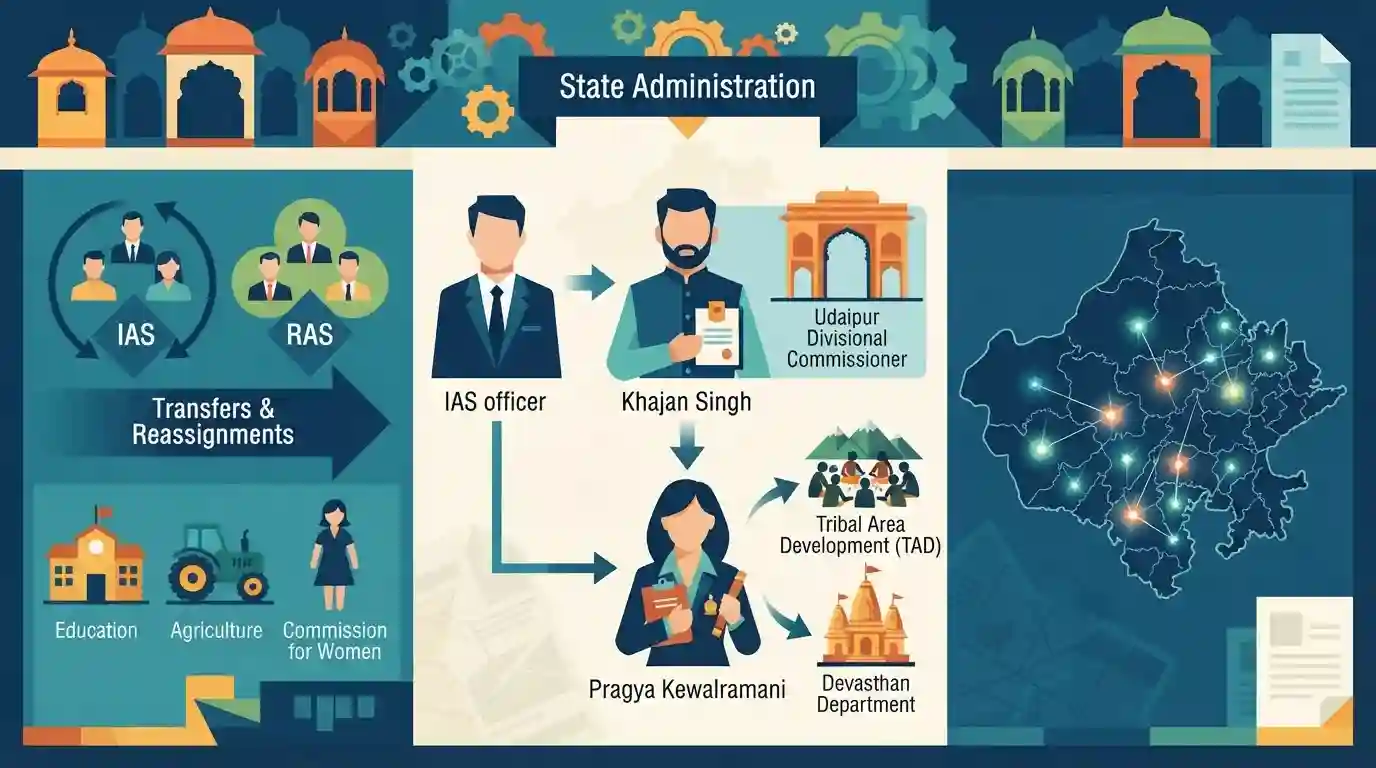
The Rajasthan government has announced a bureaucratic reshuffle involving the transfer of 6 IAS and 7 RAS officers. Key among these changes is the appointment of IAS Khajan Singh as the new Divisional Commissioner of Udaipur. He replaces IAS Pragya Kewalramani, who has now been assigned the dual responsibilities of Commissioner of Tribal Area Development (TAD) and the Devasthan Department. The transfers also encompass crucial postings in various state departments, including Agriculture, Education, and the Rajasthan State Commission for Women, affecting multiple districts.
Key Points
- The Rajasthan government enacted administrative transfers affecting 6 IAS and 7 RAS officers.
- IAS Khajan Singh appointed as the new Divisional Commissioner of Udaipur Division.
- Outgoing Divisional Commissioner IAS Pragya Kewalramani assumes dual charge as Commissioner of Tribal Area Development (TAD) and the Devasthan Department.
- Other notable transfers include appointments to the Centre for Good Governance HCM-RIPA, Rajasthan State Commission for Women, and Food Safety Commission.
Important Terms
Tribal Area Development (TAD) Department

The Rajasthan government department responsible for the socio-economic development, welfare schemes, and implementation of constitutional safeguards (like Fifth Schedule provisions) for Scheduled Tribes across the state.
UPSC context
Highly relevant for RAS Paper III (Public Administration & Polity), focusing on the administration of Scheduled Areas and tribal welfare.
Devasthan Department
A specialized state government body in Rajasthan that regulates, manages, and funds state-owned temples, public religious trusts, charitable endowments, and organizes state-sponsored pilgrimage schemes.
UPSC context
Important for RAS Paper I & III, testing the state's role in cultural preservation, religious endowments, and local tourism initiatives.
Rajasthan State Commission for Women
A statutory body formed in 1999 with quasi-judicial powers to safeguard women's rights, redress harassment grievances, and advise the Rajasthan government on legislative measures for gender equality.
UPSC context
Crucial for RAS Paper III (Polity & Social Justice), covering the structure, functions, and statutory powers of state-level welfare commissions.
Centre for Good Governance, HCM-RIPA
A specialized hub within the Harish Chandra Mathur Rajasthan State Institute of Public Administration (HCM-RIPA) dedicated to supporting governance reforms, policy action-research, and civil servant capacity building.
UPSC context
Relevant for RAS Paper III (Public Administration), testing institutional mechanisms for civil service training and administrative reforms in Rajasthan.
Prelims Trap
"The headquarters of the Devasthan Department and Tribal Area Development (TAD) are located in Jaipur."
While most major state directorates and departments sit in the capital, the Devasthan Department and the TAD Commissionerate are strategically headquartered in Udaipur.
Static Concepts Connected
What is the historical evolution of the Divisional Commissioner system in Rajasthan?
- Abolition (1962): The system was abolished by the Mohan Lal Sukhadia government to streamline administration and empower Panchayati Raj institutions.
- Revival (1987): It was reintroduced by the Harideo Joshi government to improve administrative coordination between districts and the state capital.
- Current Setup: Rajasthan is currently organized into 10 administrative divisions, each headed by a senior IAS officer serving as the Divisional Commissioner.
What are the key facts regarding the Rajasthan State Commission for Women?
- Statutory Status: It is a statutory body, not a constitutional one, enacted under the Rajasthan State Commission for Women Act, 1999.
- Establishment Date: It was officially constituted on May 15, 1999, to safeguard women's rights and advise the government on policy.
- Quasi-Judicial Powers: The commission acts as a civil court while investigating specific complaints of atrocities or discrimination against women in the state.
Cross-Topic Patterns
Tribal Sub-Plan (TSP) & 5th Schedule
The TAD Commissioner oversees the administration of Rajasthan's fully tribal districts (Banswara, Dungarpur, Pratapgarh) mapped under the 5th Schedule and the Tribal Sub-Plan (TSP).
Cultural Governance via Devasthan Department
The Devasthan Department links state administration directly to cultural preservation, managing registered public trusts, state-funded temples, and state-sponsored pilgrimage schemes.

Expect matching questions pairing key state bodies (Devasthan, HCM-RIPA, Women's Commission) with their headquarters or foundation years.
Linked PYQs · 4
Linked PYQs · 4
- 2025RPSC_PRELIMSGS1
Who becomes the Chairman of the District Planning Committee in Rajasthan?
- 2024RPSC_PRELIMSGS1
Who is the Chairperson of District Planning Committee in Rajasthan?
- 2025RPSC_PRELIMSGS1
What has been formed in place of the Chief Minister Rajasthan Economic Reforms Advisory Council (CMRETAC)?
- 2021RPSC_PRELIMSGS1
Which department has been declared as the nodal department for the effective implementation of Sustainable Development Goals in Rajasthan?
