Rajasthan Administrative Service Officers Bureaucratic Reshuffle
Source:first-india ↗
Why It Matters
Administrative reshuffles highlight the operational mechanics of the state government's personnel administration. For RPSC RAS candidates, understanding the roles, appointments, and transfer mechanisms of state civil services like the RAS is crucial for topics covering Rajasthan's administrative and governance framework.
Summary
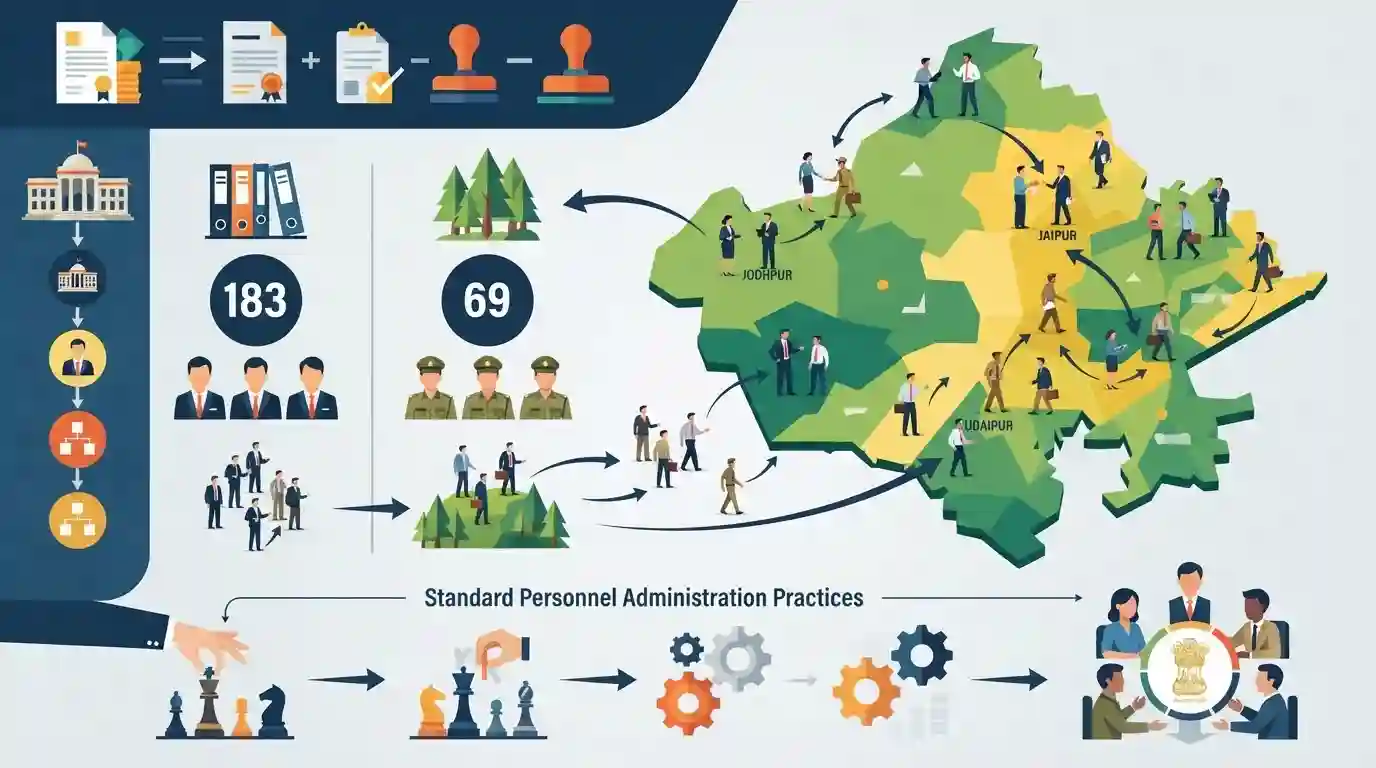
The Rajasthan government has executed a significant administrative reorganization by transferring 183 Rajasthan Administrative Service (RAS) officers. This reshuffle came immediately after the transfer of 69 Indian Forest Service (IFS) officers. The move reflects standard personnel administration practices aimed at managing state bureaucracy and ensuring effective governance across various districts and departments.
Key Points
- The Government of Rajasthan issued transfer orders for 183 Rajasthan Administrative Service (RAS) officers in a major bureaucratic reshuffle.
- This large-scale administrative reorganization closely followed the transfer of 69 Indian Forest Service (IFS) officers a day earlier.
- Such administrative exercises are part of the state's personnel management and governance mechanisms to optimize bureaucratic efficiency.
Important Terms
Rajasthan Administrative Service (RAS)

The premier provincial civil service of Rajasthan. Officers are recruited via state exams to execute state policies, manage revenue, and oversee district administration before potential promotion to the IAS.
UPSC context
GS Paper 2 (State Administration). Illustrates the functioning of state-level bureaucracy and the division between state and central civil services.
Indian Forest Service (IFoS / IFS)
One of India's three All India Services. Officers are recruited centrally by the UPSC to administer forests, wildlife, and ecological resources, serving both the Union and their allocated state cadres.
UPSC context
GS Paper 2 (All India Services) & GS Paper 3 (Environment). Highlights ecological governance, federalism, and the All India Service structure.
Transfer of Civil Servants
The reassignment of government officials to different administrative posts. While intended for governance efficiency, frequent or politically motivated transfers undermine policy continuity, bureaucratic neutrality, and effective public service delivery.
UPSC context
GS Paper 2 (Role of Civil Services) & GS Paper 4. Tests topics like fixed tenure, political interference, and civil service reforms.
Personnel Administration
The management of human resources within public administration. It encompasses the recruitment, training, promotion, and deployment of civil servants to ensure a competent, impartial, and efficient government bureaucracy.
UPSC context
GS Paper 2 (Governance). Crucial for understanding institutional capacity, bureaucratic efficiency, and recommendations by administrative reform commissions.
Prelims Trap
"State governments possess ultimate disciplinary control over All India Service (AIS) officers serving in their respective states."
While states have immediate control over postings and transfers, ultimate disciplinary authority (e.g., dismissal or removal) over AIS officers remains exclusively with the Central Government.
Static Concepts Connected
Who controls the All India Services (AIS) under the Indian federal structure?
- Immediate Control: Rests with the respective State Government where the officer is serving, which independently manages their routine transfers and postings.
- Ultimate Control: Rests with the Central Government (e.g., DoPT for IAS, MoEFCC for IFS), which holds the power of dismissal or removal.
- Article 312: Grants Parliament the power to create new All India Services if the Rajya Sabha passes a resolution supported by a 2/3rd majority.
How does Article 311 protect civil servants from arbitrary dismissal?
- Appointing Authority Clause: No member of a civil service shall be dismissed or removed by an authority subordinate to the one by which they were appointed.
- Reasonable Opportunity: A civil servant must be given a reasonable opportunity of being heard in respect of the charges framed against them (Right to be heard).
Cross-Topic Patterns
Federal friction over Central Deputation
Routine state-level reshuffles contrast with ongoing federal frictions regarding the Centre's proposed amendments to IAS/IPS cadre deputation rules, highlighting tension over bureaucratic availability.
2nd ARC on fixed tenures
Large-scale bureaucratic reshuffles highlight the Second Administrative Reforms Commission (ARC) recommendations for fixed minimum civil service tenures to ensure policy continuity and curb politicization.

Expect Prelims questions testing the subtle differences in disciplinary jurisdiction and cadre control between State vs All India Services.
Linked PYQs · 3
Linked PYQs · 3
- 2023RPSC_PRELIMSGS1
The post of Tehsildar is appointed by:
- 2025RPSC_PRELIMSGS1
Under which article of the Constitution is there a mandatory consultation provision with the Rajasthan Public Service Commission in disciplinary cases affecting serving personnel under the Government of Rajasthan?
- 2025RPSC_PRELIMSGS1
What has been formed in place of the Chief Minister Rajasthan Economic Reforms Advisory Council (CMRETAC)?
