Rajasthan Partners With International Solar Alliance For Clean Energy
Source:knnindia ↗
Why It Matters
Rajasthan is India's solar leader. This landmark sub-national framework agreement with the ISA, combined with advanced digital technologies like digital twin modeling and ambitious targets of 125 GW under its Integrated Clean Energy Policy, represents a significant development in state-level infrastructure, international cooperation, and technology-driven governance relevant to both Prelims and Mains.
Summary
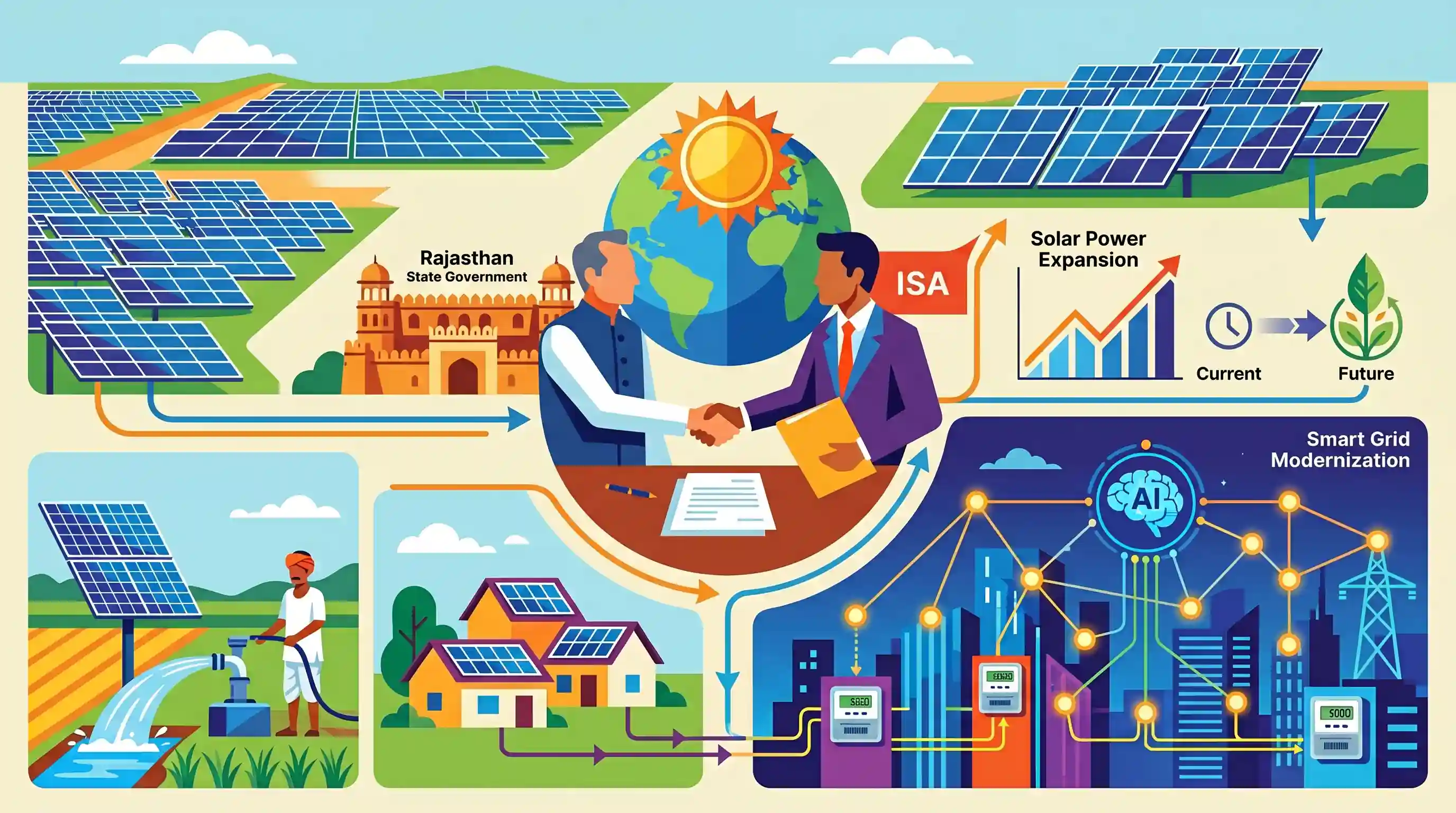
The Rajasthan government has signed a historic framework agreement with the International Solar Alliance (ISA) to accelerate solar power expansion and grid modernization, making it the first Indian state to directly partner with the 128-member international body. Signed by Energy Secretary Aarti Dogra and ISA Director General Ashish Khanna in the presence of Chief Minister Bhajan Lal Sharma, the agreement focuses on long-term goals including a 2030-35 energy transition plan and policy reforms. The collaboration will introduce an AI-based digital twin technology pilot in Ajmer Vidyut Vitran Nigam for demand forecasting. Additionally, it bolsters Rajasthan\'s target of achieving 125 GW clean energy capacity under its Integrated Clean Energy Policy, alongside expanding existing initiatives like PM-KUSUM and PM Surya Ghar: Muft Bijli Yojana.
Key Points
- Rajasthan has become the first state in India to sign a direct clean energy framework agreement with the 128-member International Solar Alliance (ISA).
- The partnership will outline a detailed roadmap for expanding solar power, grid modernization, energy storage, energy modeling, and capacity building.
- An energy transition plan specifically targeting the period 2030–2035 will be developed under this alliance.
- The agreement incorporates cutting-edge technology, including a pilot project using AI-based 'digital twin technology' at Ajmer Vidyut Vitran Nigam to optimize demand forecasting and network planning.
- The agreement supports Rajasthan\'s Integrated Clean Energy Policy target of 125 GW clean energy capacity and aligns with national programs like PM-KUSUM (which already generates over 4 GW for daytime farm power in 26 districts) and PM Surya Ghar: Muft Bijli Yojana.
Important Terms
International Solar Alliance (ISA)

A treaty-based intergovernmental organization launched in 2015 by India and France, headquartered in Gurugram, India, to accelerate global solar energy deployment, reduce fossil fuel reliance, and mobilize solar finance.
UPSC context
GS Paper II & III (Environment). Tests global climate agreements, India's leadership, and renewable energy transitions.
PM-KUSUM Scheme
A flagship initiative of the Ministry of New and Renewable Energy launched in 2019 to promote decentralized solar power production, install standalone solar agricultural pumps, and solarize grid-connected irrigation feeders.
UPSC context
GS Paper III (Agriculture & Infrastructure). Tests decentralized solar deployment, agrarian economic support, and farm sector decarbonization.
PM Surya Ghar: Muft Bijli Yojana
A central rooftop solar scheme launched in February 2024, providing up to 300 units of free monthly electricity and substantial subsidies to one crore residential households in India.
UPSC context
GS Paper III (Infrastructure & Energy). Tests decentralized rooftop solar targets, clean energy access, and household carbon reductions.
Rajasthan's Integrated Clean Energy Policy
A comprehensive 2024 policy enacted by Rajasthan targeting 125 GW of renewable energy by 2030, integrating solar, wind, hybrid power, battery storage, and green hydrogen under a single-window system.
UPSC context
GS Paper III (Renewable Energy). Tests sub-national climate strategies, state-level infrastructure promotion, and green hydrogen targets.
ISA-Rajasthan Clean Energy Framework Agreement
A landmark July 2026 pact making Rajasthan the first Indian state to directly partner with the ISA, aiming to formulate a 2030-35 energy transition roadmap and pilot AI-based digital twin grid solutions.
UPSC context
GS Paper III (Grid Modernization & Tech). Tests sub-national climate diplomacy, global-state cooperative frameworks, and AI integration.
Prelims Trap
Rajasthan's direct agreement with the ISA grants it independent observer or associate membership status within the International Solar Alliance.
Sub-national entities cannot become sovereign members of treaty-based international bodies. The partnership is a technical collaboration, not a formal treaty accession which is exclusive to sovereign nations.
Static Concepts Connected
What is the structural framework of the International Solar Alliance (ISA)?
- Genesis: Launched jointly by India and France at COP21 in Paris (2015) to aggregate demand for solar energy.
- Membership: Open to all UN member states, moving beyond the original restriction of countries located between the Tropics.
- Headquarters: Located in Gurugram, India, making it the first treaty-based international organization headquartered in the country.
How does the Indian Constitution govern state-level international engagements (paradiplomacy)?
- Union List: Entry 10 (Foreign Affairs) and Entry 14 (Treaties) of the Seventh Schedule reserve treaty-making powers exclusively to the Union.
- State Role: States can sign commercial or technical MoUs with international entities, but require prior clearance from the Ministry of External Affairs.
Cross-Topic Patterns
Paradiplomacy and Cooperative Federalism
State-level international pacts show how Indian federalism is evolving, where states act as direct climate actors while navigating the Union's exclusive constitutional control over foreign affairs.
AI and Smart Grid Modernization
Integrating AI 'digital twins' in discoms connects GS-3 Infrastructure with Science & Tech, highlighting how machine learning is key to solving India's legacy power sector transmission losses.

Constitutional boundaries of state-level paradiplomacy and AI 'digital twins' in discoms will likely feature in 2026 GS-2 and GS-3 papers.
Linked PYQs · 3
Linked PYQs · 3
- 2023RPSC_PRELIMSGS1
Which agency has been given the responsibility of implementing the PM-KUSUM scheme (Component A) in Rajasthan, which involves the establishment of solar power plants with a capacity of 0.5 MW to 2 MW?
- 2021RPSC_PRELIMSGS1
In which year was the Rajasthan Solar Energy Policy announced?
- 2025RPSC_PRELIMSGS1
Which of the following statements are correct with respect to the PM Surya Ghar Free Electricity Scheme? (i) Under this scheme, solar plants will be installed on one crore houses to provide free electricity up to 300 units per month. (ii) Provision of 30% subsidy for installing rooftop solar plants (iii) 100% online system for registration, application, approval and grant (iv) Provision of lending to each applicant at a bank interest rate of 4%
