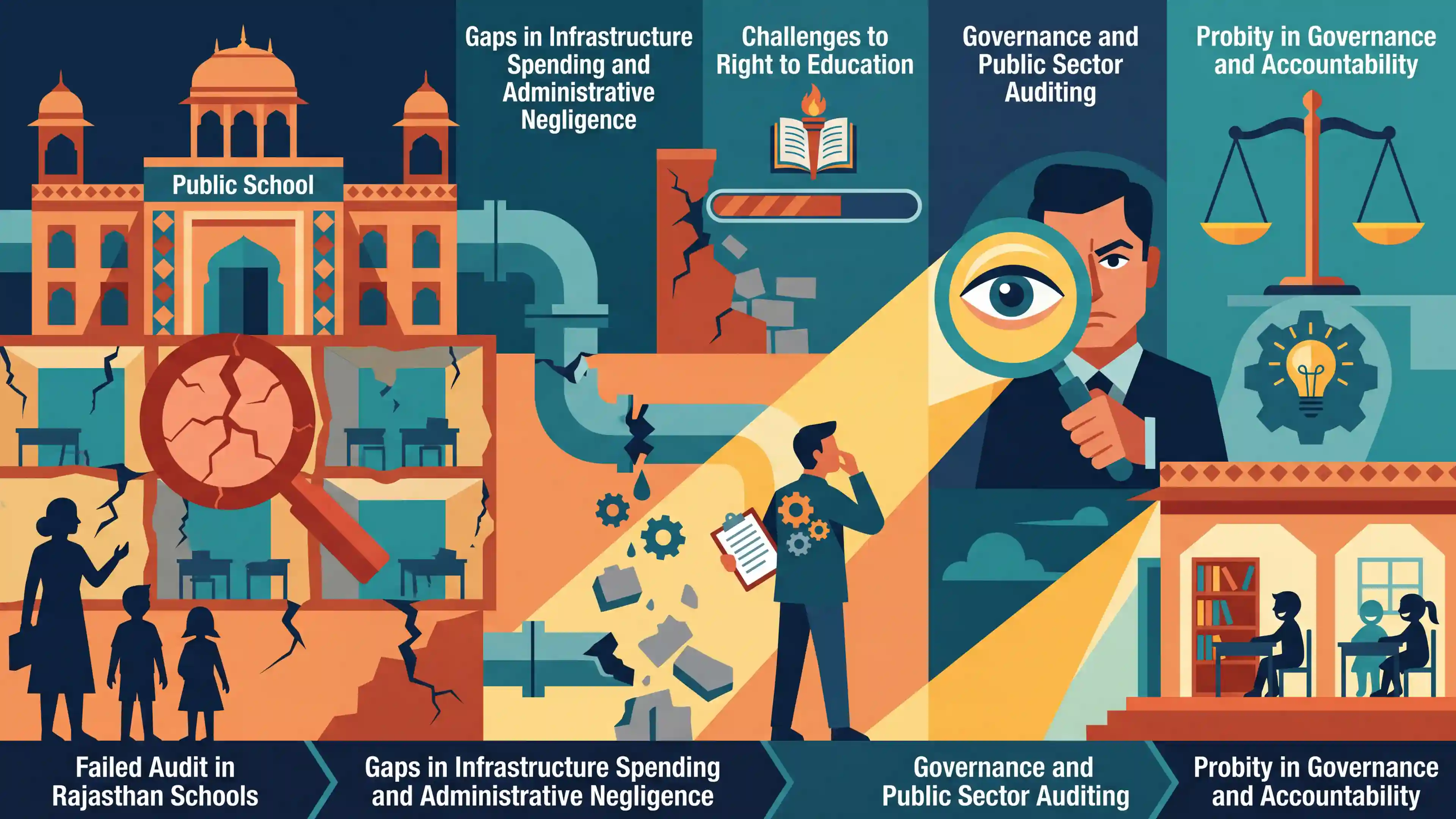
Rajasthan government school infrastructure audit findings
Source:Indian Express ↗
Why It Matters
The article serves as a powerful case study for GS-2 (Governance and Social Justice) and GS-4 (Probity in Governance). It illustrates the real-world impact of administrative apathy on the Right to Education and highlights why rigorous audits are essential to ensure the propriety and effectiveness of public expenditure.
Summary
A recent audit of government schools in Rajasthan revealed that several classrooms failed to meet required safety and quality standards. This highlights critical gaps in public infrastructure spending, exposing poor construction quality and administrative negligence. It underscores the ongoing challenges in fulfilling the Right to Education (RTE) Act's physical infrastructure mandates. Furthermore, the incident raises broader governance questions regarding the propriety of government expenditure, potential corruption in public works, and the urgent need for stringent auditing and accountability mechanisms to ensure that public funds translate into safe, high-quality educational assets.
Key Points
- An audit in Rajasthan revealed that numerous government school classrooms failed to meet requisite quality and safety standards.
- The findings highlight systemic gaps in the execution of public infrastructure projects and potential mismanagement of public funds.
- Such infrastructure failures directly compromise the Right to Education (RTE) Act, which mandates specific physical infrastructure norms to guarantee a safe and conducive learning environment.
- The issue demonstrates the crucial role of audits in assessing not merely the legality of expenditure, but its propriety and actual ground-level impact.
- Emphasizes the urgent need for robust social audits, transparent e-governance tracking of construction, and strict accountability for contractors and officials to improve public service delivery.
Important Terms
Right to Education (RTE) Act, 2009

A statutory act mandating free, compulsory education for ages 6–14, setting specific physical infrastructure standards for all schools.
UPSC context
GS Paper 2: Social Justice and Education; tests knowledge of fundamental rights and statutory mandates.
Samagra Shiksha Abhiyan
An overarching program for school education from pre-school to Class 12, integrating infrastructure development and quality interventions.
UPSC context
GS Paper 2: Government Schemes; focuses on centralized efforts for universal education.
Comptroller and Auditor General (CAG)
The constitutional watchdog (Articles 148–151) responsible for auditing government expenditure and ensuring financial propriety.
UPSC context
GS Paper 2: Constitutional Bodies; essential for understanding public financial accountability.
Social Audit
A participatory monitoring mechanism where beneficiaries and communities evaluate government program implementation and resource utilization.
UPSC context
GS Paper 2: Governance and Accountability; tests mechanisms for citizen-led transparency.
Probity in Governance
The quality of having strong moral principles and strict adherence to ethical standards in public administration.
UPSC context
GS Paper 4: Ethics and Integrity; a core concept for the transparency and accountability syllabus.
Performance Audit
An audit evaluating the effectiveness, economy, and efficiency of government programs in achieving their stated goals.
UPSC context
GS Paper 2: Governance; focuses on the qualitative assessment of government performance.
Prelims Trap
"Propriety audits are a constitutionally mandated, compulsory function of the CAG for all public expenditures."
Under the CAG Act 1971, compliance/regulatory auditing is mandatory, but propriety auditing (checking the 'wisdom and economy' of expenditure) is strictly discretionary.
Static Concepts Connected
What are the main types of audits conducted by the CAG?
- Regulatory Audit: Mandatory check to ensure funds were spent legally on intended purposes with proper authority and documentation.
- Propriety Audit: Discretionary check to assess the wisdom, faithfulness, and economy of public expenditure, ensuring funds aren't wasted.
- Performance Audit: Evaluates the '3Es' (Economy, Efficiency, and Effectiveness) of government schemes, programs, and infrastructure projects.
What are the statutory mandates for School Management Committees (SMCs) under the RTE Act?
- Mandatory Composition: Must be formed in every government/aided school, comprising 75% parents or guardians, with a strict 50% representation reserved for women.
- Core Functions: Tasked with monitoring the working of the school, preparing school development plans, and overseeing the utilization of government grants.
Cross-Topic Patterns
CAG Performance Audits + Social Welfare
UPSC often requires linking CAG audit findings (like infrastructure or scheme failures) to evaluate the effectiveness of social sector policies in GS Paper 2 governance answers.
Decentralization + RTE Implementation
Infrastructure failures highlight a breakdown in local governance, testing the synergy between Panchayati Raj Institutions, community social audits, and School Management Committees (SMCs).

Expect a 2026 Prelims multi-statement question on RTE Act nuances: specifically testing SMC composition, infrastructure norms & audit roles.
Linked PYQs · 3
Linked PYQs · 3
- 2024MainsGS2
“The duty of the Comptroller and Auditor General is not merely to ensure the legality of expenditure but also its propriety.” Comment.
- 2018PrelimsGS1
Consider the following statements: 1. As per the Right to Education (RTE) Act, to be eligible for appointment as a teacher in a State, a person would be required to possess the minimum qualification laid down by the concerned State Council of Teacher Education. 2. As per the RTE Act, for teaching primary classes, a candidate is required to pass a Teacher Eligibility Test conducted in accordance with the National Council of Teacher Education guidelines. 3. In India, more than 90% of teacher education institutions are directly under the State Governments. Which of the statements given above is/are correct?
- 2023MainsGS2
e-governance, as a critical tool of governance, has ushered in effectiveness, transparency and accountability in governments. What inadequacies hamper the enhancement of these features ?
