Rajasthan Rolls Out AI Education Pilot Project in Schools
Source:freepressjournal ↗
Why It Matters
This represents a significant state-level intervention blending emerging technology (AI) with education policy to improve governance and public service delivery. Such initiatives are prime targets for RPSC RAS Prelims questions concerning specific state policies (like the AI-ML Policy-2026) and IT capacity building.
Summary
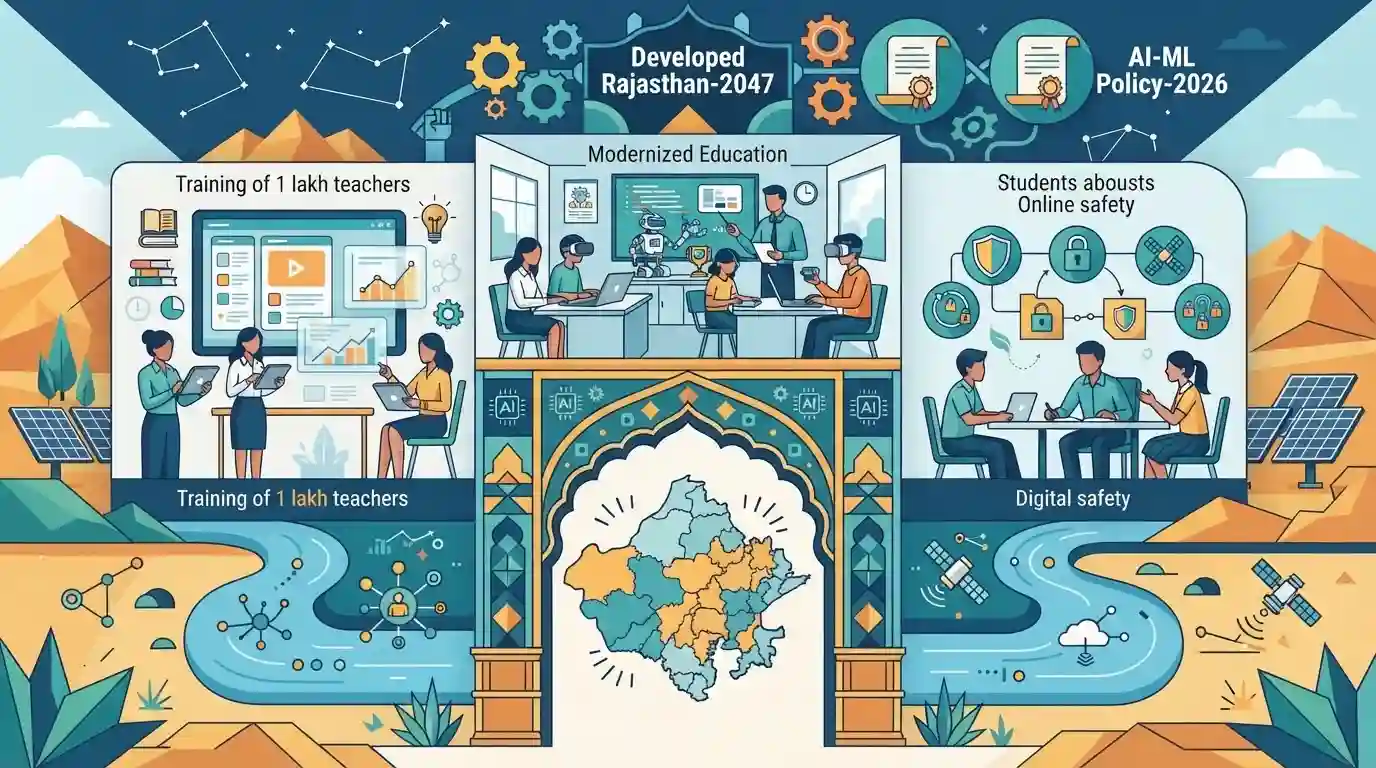
The Rajasthan government has initiated a pilot project across 10 districts to integrate Artificial Intelligence into government school education. Spearheaded by the Rajasthan State Council of Educational Research and Training (RSCERT) and the Education Department, the program plans to train 1 lakh teachers to utilize AI for enhanced pedagogy, including lesson planning and student assessment. The initiative supports the National Education Policy (NEP) and aligns with the state's AI-ML Policy-2026 and 'Developed Rajasthan-2047' vision, focusing on modernizing classrooms and educating students about digital safety and AI functionality.
Key Points
- The Rajasthan government has launched a pilot project across 10 districts to introduce AI-based education in state-run schools.
- The initiative aims to train 1 lakh teachers in using AI for creating lesson plans, preparing assessments, and analyzing student needs.
- The project is aligned with the National Education Policy (NEP), the state's AI-ML Policy-2026, and the 'Developed Rajasthan-2047' vision.
- Students will gain knowledge on how AI works, its limitations, and essential skills related to digital and cyber security.
Important Terms
National Education Policy (NEP)

India's overarching framework to modernize education, promoting holistic, multidisciplinary learning, technology integration, and 21st-century skills across both school and higher education systems.
UPSC context
Crucial for GS-2 (Education Policy); tests understanding of systemic reforms, pedagogical shifts, and digital technology integration in classrooms.
Viksit Rajasthan 2047
A vision document launched by the Rajasthan government aiming to build a $4.3 trillion state economy by 2047, focusing on inclusive growth, decentralized governance, technological transformation, and sustainable rural development.
UPSC context
Relevant for GS-2 and State PCS; tests knowledge of long-term state governance models, economic development targets, and public welfare strategies.
Rajasthan AI-ML Policy 2026
A state framework approved to integrate AI and Machine Learning responsibly. It focuses on transparent e-governance, AI-driven public service delivery, AI education in schools, and establishing Centers of Excellence.
UPSC context
Important for GS-2 (E-governance) and GS-3 (Science & Technology); highlights state-level adoption of emerging technologies and ethical, data-driven administration.
Rajasthan State Council of Educational Research and Training (RSCERT)
The apex academic body in Rajasthan responsible for school curriculum development, textbook preparation, educational research, and conducting teacher capacity-building training aligned with NEP guidelines.
UPSC context
Key for GS-2 (Education); highlights institutional frameworks responsible for executing pedagogical reforms and teacher capacity-building at the state level.
Prelims Trap
The NEP limits AI integration to student-centric coding classes and curriculum delivery.
UPSC often tricks candidates into thinking AI in education only targets student coding skills. Under NEP, AI is heavily pushed for teacher capacity building and pedagogy.
Static Concepts Connected
How does the NEP 2020 envision the role of Artificial Intelligence in education?
- NETF Setup: Proposes the National Educational Technology Forum (NETF) to facilitate decision-making on the induction, deployment, and use of technology.
- Personalized Learning: Advocates using AI-based software to track student progress, map learning pathways, and enable personalized assessments.
- Teacher Empowerment: Emphasizes continuous professional development for teachers using AI-enabled platforms (like DIKSHA) to improve lesson planning.
Under the 7th Schedule, how are Education and Technology governed constitutionally?
- Concurrent List: Education was moved to the Concurrent List via the 42nd Amendment, enabling states to execute independent pedagogy initiatives like AI integration.
- Union List: While education is shared, core telecommunications, national cybersecurity standards, and critical digital infrastructure remain firmly in the Union's domain.
Cross-Topic Patterns
Competitive Federalism in AI Tech
Rajasthan’s independent AI-ML Policy reflects a shift from Union-centric (MeitY) tech governance to states actively drafting their own AI roadmaps to attract investment and modernize public services.
AI Pedagogy vs. Digital Divide
Integrating AI in government schools creates a thematic clash with ASER reports, highlighting the friction between deploying advanced tech and persistent basic infrastructure deficits in rural classrooms.

Expect a GS2 Mains question on how state-level AI policies integrate with NEP 2020 to bridge the rural-urban divide in public education.
Linked PYQs · 3
Linked PYQs · 3
- 2021RPSC_PRELIMSGS1
Rajasthan government has launched an app to provide assistance to college students with digital academic material. What is the name of this app?
- 2025RPSC_PRELIMSGS1
Identify the correct statements with respect to Artificial Intelligence (AI) with the help of the codes given below: A. Machine learning is a subset of AI. B. In supervised learning, computer systems are trained without marked input data. C. Machines learn through trial and error, and are rewarded during reinforcement learning. Code:
- 2023RPSC_PRELIMSGS1
Which company was established by the Government of Rajasthan in the 21st century with the objective of developing information technology (IT) skills?
