Rajasthan School Entry Rules for Privacy and Child Safety
Source:new-indian-express ↗
Why It Matters
The issue demonstrates the balance between the state's responsibility to protect the privacy and safety of minors in educational institutions (under constitutional rights and statutory laws like POCSO) versus the need for transparency and political accountability in government facilities.
Summary
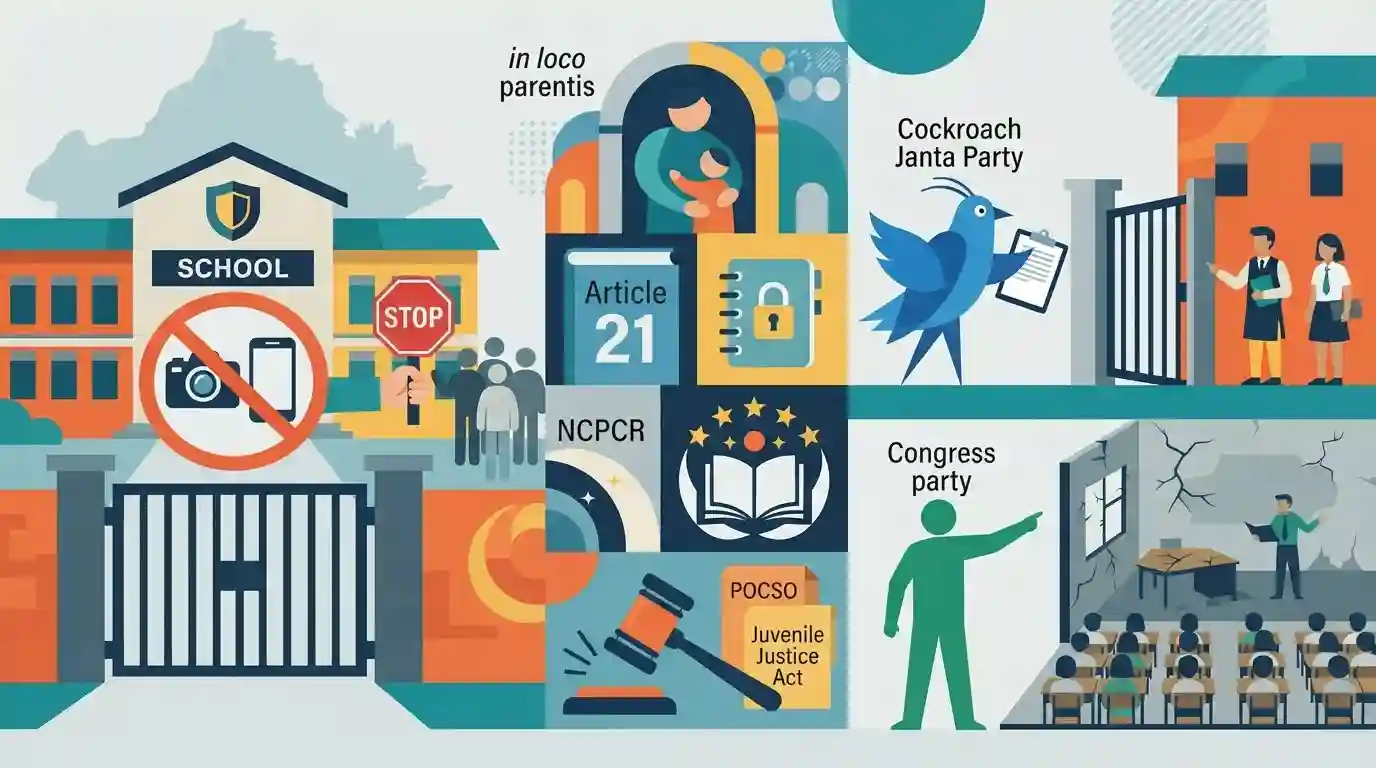
The Rajasthan Secondary Education department has issued strict guidelines restricting the entry of outsiders and prohibiting unapproved photography and videography in government schools. Citing the principle of ‘in loco parentis’, the Right to Privacy under Article 21, and NCPCR guidelines, the government aims to ensure a safe environment for students. Violators face legal action under acts such as POCSO and the Juvenile Justice Act. The directive follows an announcement by the Cockroach Janta Party to inspect these schools, drawing criticism from the Congress party, which views the order as an attempt to hide the inadequate state of the schools' infrastructure and staffing.
Key Points
- The Rajasthan government has restricted the entry of unauthorized individuals into government schools to protect students' physical and mental well-being.
- Unapproved photography and videography within school premises are banned, citing the 'in loco parentis' principle and students' Right to Privacy under Article 21.
- The order enforces NCPCR guidelines and warns of strict action under the Bharatiya Nyaya Sanhita, POCSO Act, Juvenile Justice Act, and IT Act.
- The directive was issued shortly after the Cockroach Janta Party (CJP) announced its intent to conduct inspections in state-run schools.
- The opposition Congress criticized the move, claiming it is a cover-up for infrastructural and staffing shortcomings in government schools.
Important Terms
Article 21

A fundamental right in the Constitution ensuring no person is deprived of life or personal liberty except via legally established procedures. The Supreme Court has expanded it to include the right to privacy and dignity.
UPSC context
Crucial for RPSC Polity (Paper III). Tests understanding of Fundamental Rights, judicial interpretation, and the Right to Privacy.
Protection of Children from Sexual Offences (POCSO) Act
A gender-neutral 2012 law designed to protect children under 18 from sexual assault, harassment, and pornography. It mandates strict reporting and establishes special courts for speedy, child-friendly trials.
UPSC context
Highly relevant for RPSC Mains Paper I (Social Issues). Tests knowledge of legal mechanisms for vulnerable sections and child rights.
Juvenile Justice (Care and Protection of Children) Act
A 2015 law focusing on rehabilitating children in conflict with the law and aiding those needing care. It uniquely allows minors aged 16–18 to be tried as adults for heinous crimes.
UPSC context
Important for RPSC Mains Paper III (Law). Tests understanding of restorative justice, child protection, and juvenile delinquency frameworks.
National Commission for Protection of Child Rights (NCPCR)
An apex statutory body established in 2007 under the CPCR Act. It monitors child rights violations, ensures compliance with constitutional safeguards, and issues safety guidelines for child-centric institutions like schools.
UPSC context
Essential for RPSC Polity and Public Administration. Tests knowledge of statutory bodies protecting vulnerable groups and their mandates.
Bharatiya Nyaya Sanhita (BNS)
India's new criminal code introduced in 2023 to replace the colonial-era Indian Penal Code (IPC). It modernizes definitions of criminal offenses, establishes corresponding punishments, and aims for citizen-centric justice.
UPSC context
Key topic in RPSC Paper III (Law). Evaluates awareness of contemporary legislative reforms replacing colonial criminal frameworks.
Information Technology (IT) Act
India's primary law enacted in 2000 dealing with cybercrime and electronic commerce. It regulates digital data, penalizes unauthorized digital access, and provides legal frameworks for electronic governance and privacy.
UPSC context
Relevant for RPSC Paper II (Technology) and Paper III (Law). Tests understanding of digital rights, cyber laws, and online safety.
Prelims Trap
The Right to Privacy for school students is explicitly provided under the Right to Education (RTE) Act.
Privacy for minors is a Fundamental Right derived from Article 21 (Puttaswamy judgment), not an explicit statutory provision formulated under the RTE Act.
Static Concepts Connected
What is the statutory mandate of the National Commission for Protection of Child Rights (NCPCR)?
- Statutory origin: Established in 2007 under the Commissions for Protection of Child Rights Act, 2005. It is not a Constitutional body.
- Nodal Ministry: It functions under the administrative control of the Ministry of Women and Child Development.
- RTE monitoring: It is the designated statutory authority to monitor the implementation and inquire into complaints regarding the Right to Education (RTE) Act, 2009.
What does the legal doctrine of 'In Loco Parentis' signify in institutional care?
- Definition: A Latin legal term meaning "in the place of a parent." It authorizes individuals or institutions to assume legal duties towards a minor.
- Application to Schools: Teachers and administrators assume this role in schools, bearing a fiduciary duty of care to ensure the physical, mental, and privacy rights of students.
Cross-Topic Patterns
Privacy vs. Public Accountability
Using Article 21 to bar unauthorized school inspections highlights the complex constitutional tension between protecting child privacy and ensuring transparent governance of state-funded institutions.
Digital privacy and child protection laws
Unauthorized videography in schools invokes both the IT Act (digital transmission) and POCSO/JJ Act (child exploitation), reflecting a growing regulatory focus on cyber-jurisprudence and digital child rights.

Expect a multi-statement question linking NCPCR's statutory powers, POCSO applicability, and the Right to Privacy (Article 21) for minors.
Linked PYQs · 3
Linked PYQs · 3
- 2024RPSC_PRELIMSGS1
Fundamental Rights provided by which of the following groups of Articles are granted only to 'Citizens' of India?
- 2025RPSC_PRELIMSGS1
Which group of fundamental rights, provided by the articles, are exclusively conferred upon ‘citizens’ of India?
- 2025RPSC_PRELIMSGS1
Under Section 7 of the Rajasthan Lokayukta and Upa-Lokayukta Act, 1973, the Lokayukta has the power to investigate charges against ministers and public servants in certain cases. Which of the following is not part of those investigations?
