Rajasthan Devsthan Department Statewide Temple Prayers
Source:free-press-journal ↗
Why It Matters
This development is highly relevant for RPSC RAS aspirants as it touches upon the unique administrative structure of the Devsthan Department of Rajasthan (managing over 50,000 temples), the executive role of District Collectors in state-level directives, and the convergence of state-backed cultural initiatives with national developmental agendas like 'Viksit Bharat'. It also links to static questions on the history of temple administration and religious heritage in Rajasthan.
Summary
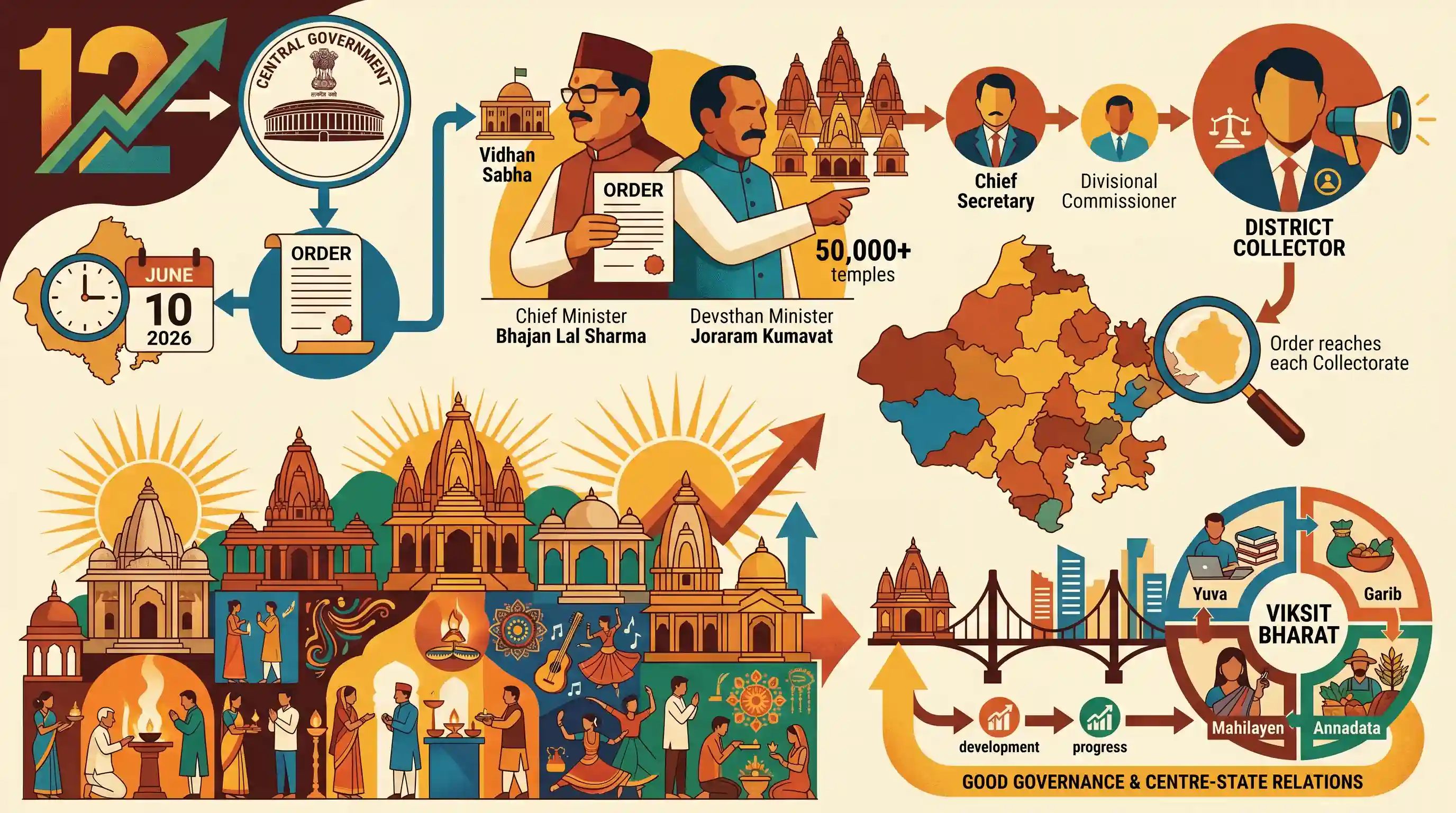
The Rajasthan government's Devsthan Department ordered statewide special prayers and rituals across its over 50,000 jurisdiction temples on June 10, 2026, to celebrate 12 years of the central government. Led by Chief Minister Bhajan Lal Sharma and Devsthan Minister Joraram Kumavat, the initiative utilized the state's local administrative machinery, specifically directing District Collectors to supervise the ceremonies, linking religious heritage with the developmental vision of 'Viksit Bharat'.
Key Points
- The Devsthan Department of the Government of Rajasthan organized statewide special prayers (puja and anushthans) in temples across the state on June 10, 2026.
- The events were organized to mark and celebrate the 12th anniversary of the Central Government (Narendra Modi-led NDA administration, which assumed office in May 2014) representing 'service, good governance, and welfare of the poor'.
- The Devsthan Department, which oversees more than 50,000 temples inside and outside the state of Rajasthan, directed all District Collectors to supervise these religious ceremonies locally.
- Chief Minister Bhajan Lal Sharma emphasized that the initiative serves as a medium to transform the national resolution for a 'Viksit Bharat' (Developed India) into a mass public movement.
- Devsthan Minister Joraram Kumavat highlighted the administrative and developmental significance of the event as a reflection of state-center synergy in welfare.
Important Terms
Viksit Bharat

A strategic vision of the Government of India aiming to transform the country into a developed, high-income nation by 2047, focusing on structural reforms, economic prosperity, social inclusivity, and technological advancement.
UPSC context
GS Paper III (Economic Development) and GS Paper II (Governance); tests understanding of long-term national growth strategies and development models.
Devsthan Department, Government of Rajasthan
A specialized administrative department in Rajasthan responsible for regulating, maintaining, and managing public temples, state-funded religious trusts, and associated properties, alongside implementing spiritual welfare initiatives like senior citizen pilgrimages.
UPSC context
GS Paper II (State Administration & Governance) and GS Paper I (Art and Culture); tests knowledge of state-led temple management and public endowment regulation.
District Collector
An Indian Administrative Service (IAS) officer acting as the administrative head of a district, responsible for land revenue management, implementing state and central welfare policies, and coordinating cross-departmental development efforts.
UPSC context
GS Paper II (Polity & Public Administration); tests understanding of decentralised governance, executive machinery, and the evolving role of civil servants.
Prelims Trap
A State Government's Devasthan Department has regulatory and administrative jurisdiction strictly confined within that specific state's geographical boundaries.
The Rajasthan Devasthan Department possesses unique extra-territorial jurisdiction, managing over 150 historic properties outside the state (e.g., Varanasi, Haridwar) built by erstwhile princely states.
Static Concepts Connected
What is the constitutional mandate on the size of the State Council of Ministers under Article 164(1A)?
- Origin: Introduced by the 91st Constitutional Amendment Act (2003) to prevent oversized cabinets and political horse-trading.
- Upper Limit: The total number of ministers, including the Chief Minister, in a State cannot exceed 15% of the total strength of the Legislative Assembly.
- Minimum Floor: The number of ministers (including the Chief Minister) in a State shall not be less than 12, ensuring administrative viability in smaller states.
What are 'Doli/Muafi' lands and how did post-independence Land Reforms affect them?
- Definition: These refer to tax-free agricultural lands historically gifted by princely rulers to temples, priests, or monasteries for their sustenance.
- State Resumption: Under the Land Reforms and Resumption of Jagirs Acts of the 1950s, the state resumed these intermediary lands to directly empower tenant farmers.
- Grant of Annuity: To prevent the financial collapse of affected religious institutions, states instituted a perpetual annual financial compensation known as the 'Grant of Annuity'.
Cross-Topic Patterns
Secularism and State-Run Endowments
Connects GS-2 Indian secularism with GS-1 temple administration, highlighting how Indian states actively manage religious public trusts, unlike the rigid separation model of Western secularism.
Land Reforms and Temple Assets
Links GS-3 land reforms (Jagir abolition) with GS-1 cultural heritage, demonstrating how the state replaced traditional land-based temple endowments with perpetual financial annuity grants.

State-level temple land compensation (Muafi) and the minimum strength of State Councils of Ministers (Art 164(1A)) are high-yield 2026 targets.
Linked PYQs · 2
Linked PYQs · 2
- 2016RPSC_PRELIMSGS1
Choose the temples built during the Gurjara-Pratihara period from the following temples of Rajasthan: 1. Adiwara Temple of Ahad. 2. Harshat Mata Temple of Abhaneri. 3. Neelkanth Temple of Rajorgarh. 4. Harihar Temple of Osian. Code:
- 2023RPSC_PRELIMSGS1
What is the minimum number of members in the Council of Ministers of Rajasthan?
