Rajasthan Directs DISCOMs to Implement MNRE Solar Rooftop Exemptions
Source:energetica-india ↗
Why It Matters
This policy alignment eases regulatory hurdles for residential solar adoption in Rajasthan, assisting India's largest state by landmass in driving decentralised solar energy targets and integrating national energy policies at the regional level.
Summary
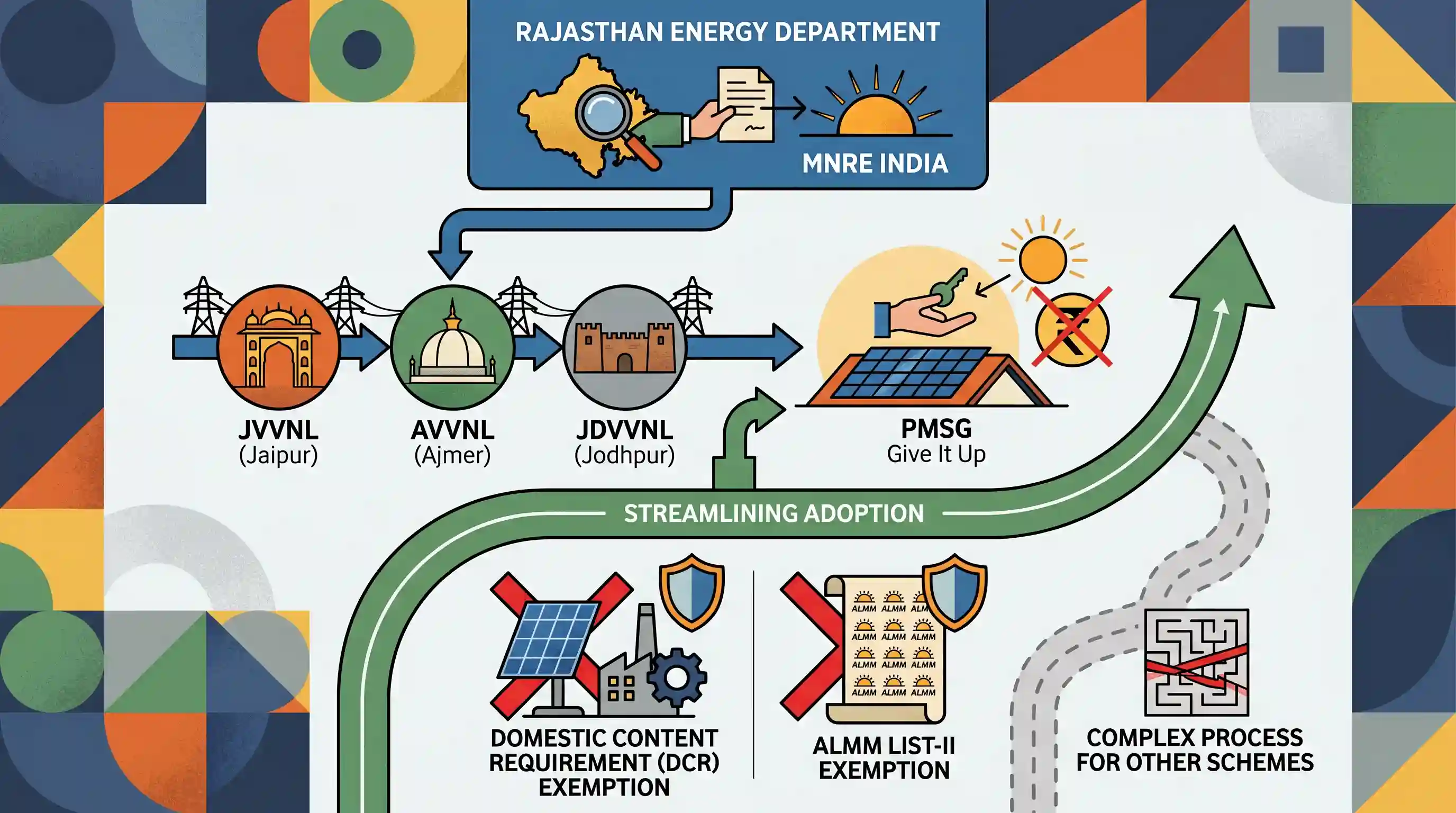
The Energy Department of Rajasthan has directed state DISCOMs (JVVNL, AVVNL, JDVVNL) to comply with MNRE's updated guidelines for the 'Give It Up' (non-subsidized) residential rooftop solar category under PM Surya Ghar: Muft Bijli Yojana. The order exempts these installations from Domestic Content Requirement (DCR) certification and Approved List of Models and Manufacturers (ALMM) List-II requirements for solar PV cells, streamlining solar adoption across the state.
Key Points
- The Rajasthan Government's Energy Department directed the three state power distribution companies (DISCOMs)—JVVNL, AVVNL, and JDVVNL—to enforce MNRE's updated exemptions for residential rooftop solar projects.
- The directive targets the 'Give It Up' category under the PM Surya Ghar: Muft Bijli Yojana, which involves non-subsidized residential rooftop solar (RTS) installations.
- Eligible solar installations in this category are officially exempted from requiring a Domestic Content Requirement (DCR) certificate.
- These projects are also exempted from adhering to the Approved List of Models and Manufacturers (ALMM) List-II guidelines specifically governing solar PV cells.
- DISCOMs have been directed to process applications on the National Portal efficiently and are prohibited from rejecting any applications solely on the grounds of missing DCR certificates or non-compliance with ALMM List-II.
Important Terms
PM Surya Ghar: Muft Bijli Yojana

A central government scheme launched in 2024 to provide up to 300 units of free monthly electricity to one crore Indian households by assisting them with subsidies to install rooftop solar systems.
UPSC context
GS Paper II (Government Schemes) & GS Paper III (Energy). Tests understanding of decentralized clean energy initiatives and public welfare subsidies.
Approved List of Models and Manufacturers (ALMM)
A regulatory registry maintained by the MNRE that approves specific solar photovoltaic models and manufacturers, ensuring BIS quality certification and mandating their use in government-supported or grid-connected projects.
UPSC context
GS Paper III (Renewable Energy). Tests knowledge of trade protectionism, industrial policies, and clean energy supply chains.
Domestic Content Requirement (DCR)
A policy mandate requiring solar projects under specified government schemes to source solar PV cells and modules manufactured domestically, aiming to build a self-reliant domestic solar manufacturing ecosystem.
UPSC context
GS Paper III (Economic Development & Energy). Tests familiarity with localized sourcing mandates, WTO compliance issues, and domestic industrial growth.
Ministry of New and Renewable Energy (MNRE)
The nodal ministry of the Government of India responsible for all matters related to new and renewable energy, formulating policies to achieve national green energy targets.
UPSC context
GS Paper II (Ministries) & GS III (Energy Security). Tests understanding of institutional frameworks driving India’s transition to clean energy.
Power Distribution Companies (DISCOMs)
Utilities responsible for purchasing electricity from generation companies and transmitting it through local distribution networks to supply end-users like households, commercial entities, and industries.
UPSC context
GS Paper III (Infrastructure & Energy). Tests understanding of structural inefficiencies, AT&C losses, and critical last-mile challenges in power reforms.
Prelims Trap
All residential rooftop solar installations under the PM Surya Ghar Yojana are exempted from Domestic Content Requirements (DCR).
Only non-subsidized ('Give It Up' category) installations are exempt. Standard subsidized installations must use DCR-compliant cells and modules to receive Central Financial Assistance.
Static Concepts Connected
What is the Approved List of Models and Manufacturers (ALMM) and its regulatory role?
- Nodal Ministry: Administered by the Ministry of New and Renewable Energy (MNRE) to ensure quality, reliability, and domestic origin of solar equipment.
- Structure: Consists of multiple lists, primarily List-I for solar PV modules and List-II for solar PV cells.
- Policy Objective: Acts as a non-tariff barrier to protect domestic manufacturers from cheap imports while scaling up local supply chains.
Cross-Topic Patterns
WTO Trade Rules vs. Green Subsidies
India's restricted use of DCR to government and residential subsidies is a direct response to a 2016 WTO ruling against its broader domestic sourcing mandates.
Federalism in Power Distribution
While PM Surya Ghar is a Central Sector Scheme, its implementation relies on State DISCOMs, highlighting coordination challenges in Concurrent List subjects.

PM Surya Ghar questions will likely test the distinction between subsidized (DCR mandatory) and 'Give It Up' (DCR exempt) solar rules.
Linked PYQs · 4
Linked PYQs · 4
- 2025RPSC_PRELIMSGS1
Which of the following statements are correct with respect to the PM Surya Ghar Free Electricity Scheme? (i) Under this scheme, solar plants will be installed on one crore houses to provide free electricity up to 300 units per month. (ii) Provision of 30% subsidy for installing rooftop solar plants (iii) 100% online system for registration, application, approval and grant (iv) Provision of lending to each applicant at a bank interest rate of 4%
- 2024RPSC_PRELIMSGS1
Which of the following statements about Rajasthan Multi Bijli Yojana is/are correct? A. Provide plants on one side to provide 100 solar plants. B. Subsidy for setting up rooftop solar panels. C. Provision of loan at book interest.
- 2021RPSC_PRELIMSGS1
In which year was the Rajasthan Solar Energy Policy announced?
- 2023RPSC_PRELIMSGS1
Which agency has been given the responsibility of implementing the PM-KUSUM scheme (Component A) in Rajasthan, which involves the establishment of solar power plants with a capacity of 0.5 MW to 2 MW?
