Rajasthan governor proposes periodic academic evaluation for teachers
Source:india-today ↗
Why It Matters
Evaluative mechanisms for teachers and curbing systemic malpractices like paper leaks and "dummy schools" are critical issues in Rajasthan's educational governance. This reflects potential policy measures aimed at improving human resource outcomes and public accountability, highly relevant for RPSC Prelims focusing on state governance, educational reforms, and social sector initiatives.
Summary
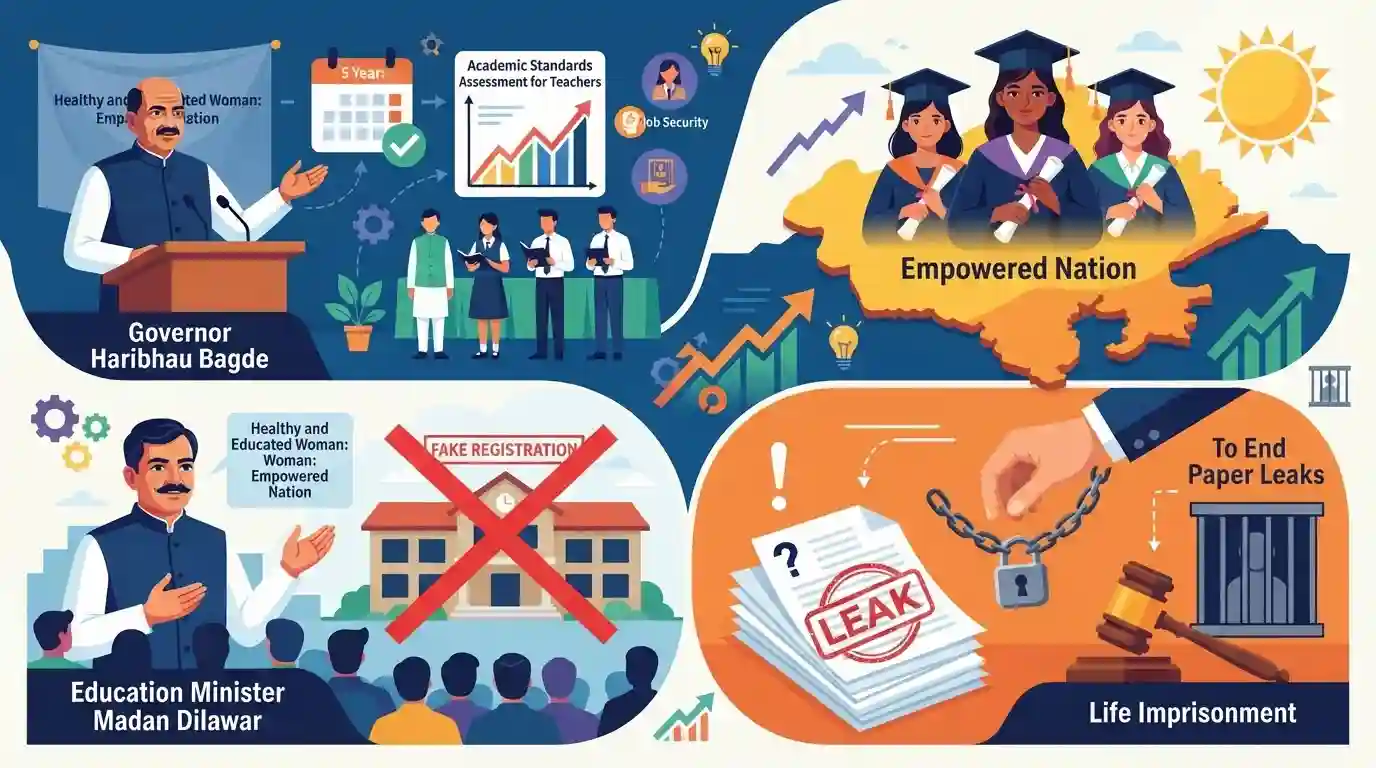
Rajasthan Governor Haribhau Bagde has advocated for the introduction of a periodic academic evaluation system for teachers every five years to enhance the quality of education. Speaking at a national workshop in Kota titled "Healthy and Educated Woman: Empowered Nation," he clarified that these assessments would focus on academic standards and would not jeopardize teachers' employment, promotions, or retirement benefits. At the same event, Education Minister Madan Dilawar addressed ongoing challenges in the education sector, vowing to eliminate "dummy schools" and promising life imprisonment for individuals involved in paper leaks. The initiatives aim to improve the state's educational ecosystem and promote empowerment through quality learning.
Key Points
- Rajasthan Governor Haribhau Bagde has proposed periodic academic evaluations for teachers every five years to ensure they stay updated with curriculum changes.
- The evaluation will focus strictly on academic standards and will not negatively impact teachers' jobs, promotions, or pensions.
- The proposal was made during a two-day national workshop in Kota titled "Healthy and Educated Woman: Empowered Nation," organized jointly by the state government and Vardhman Mahaveer Open University.
- Education Minister Madan Dilawar emphasized a zero-tolerance policy towards educational malpractices, promising life imprisonment for those involved in paper leaks.
- Dilawar also pledged to eradicate the "dummy schools" system to restore integrity and fairness to the state's educational framework.
Important Terms
Periodic academic evaluation of teachers

A proposed educational reform requiring mandatory capability assessments for teachers every five years. It focuses strictly on subject knowledge and teaching skills to improve education quality, explicitly without affecting job security or pension benefits.
UPSC context
Relates to GS Paper 2 (Education Policy) and GS Paper 4 (Public Service Accountability), highlighting performance-based evaluation in academics.
Dummy schools
Non-attending schools that enroll students solely to fulfill minimum board attendance criteria. This controversial system allows students to bypass regular classroom education and dedicate all their time to rigorous competitive exam coaching.
UPSC context
Crucial for GS Paper 2 (Education) highlighting regulatory evasion, commercialization of education, and escalating student mental health crises.
Anti-paper leak laws
Stringent legislative measures, like the Rajasthan Public Examination Act, prescribing severe penalties—including life imprisonment and hefty fines up to ₹10 crore—to deter organized syndicates from orchestrating recruitment and competitive exam paper leaks.
UPSC context
Relevant for GS Paper 2 (Governance) and GS Paper 3 (Organized Crime), illustrating rigorous state interventions to protect public trust and ensure fairness.
Healthy and Educated Woman: Empowered Nation workshop
A national workshop in Kota jointly organized by the Agriculture University and Shiksha Sanskriti Utthan Nyas. It advocated that ensuring quality education and healthcare for marginalized women is essential for inclusive national development.
UPSC context
Useful for GS Paper 1 (Role of Women) and GS Paper 2 (Social Justice), demonstrating targeted institutional initiatives for female empowerment.
Prelims Trap
NEP 2020 mandates a statutory periodic evaluation of teachers every five years to determine their employment continuation.
The 5-year evaluation is a Rajasthan state proposal focused on academics. NEP 2020 instead mandates 50 hours of annual Continuous Professional Development (CPD), not a 5-year job-jeopardizing review.
Static Concepts Connected
What is the framework for teacher evaluation under NEP 2020?
- NPST framework: Developed by the National Council for Teacher Education (NCTE) to outline essential professional and pedagogical competencies.
- Career stages: Categorizes educators into four distinct stages: Aspirant, Proficient, Expert, and Lead to drive merit-based appraisals.
- Annual CPD: Mandates teachers and school heads to undergo at least 50 hours of Continuous Professional Development annually.
How are exam paper leaks and malpractices legally addressed in India?
- Concurrent jurisdiction: Because education and criminal law fall under the Concurrent List, both the Centre and states enact specific anti-cheating legislation.
- Central Act: The Public Examinations (Prevention of Unfair Means) Act, 2024 penalizes organized cheating gangs with up to 10 years in prison and heavy fines.
- State legislation: States like Rajasthan have amended their specific recruitment laws to introduce harsher penalties, including life imprisonment for organized paper leak offenses.
Cross-Topic Patterns
Education reforms + Anti-cheating legislation
State crackdowns on paper leaks and "dummy schools" overlap with the Centre's 2024 Public Examination Act, highlighting cooperative federalism in securing academic integrity and governing the Concurrent List.
Governor's role + Higher education administration
The Governor’s academic intervention at a university workshop highlights the dual role played by Governors—acting both as constitutional heads of states and statutory Chancellors of state universities.

NEP 2020’s 50-hour annual CPD mandate and NPST career stages are highly probable targets for a multi-statement Prelims question.
Linked PYQs · 2
Linked PYQs · 2
- 2023RPSC_PRELIMSGS1
Which of the following options describes a key objective of the Indira Mahila Shakti Udan Yojana?
- 2021RPSC_PRELIMSGS1
Identify the incorrect characteristic of the 'Udan' scheme recently announced by the Rajasthan government
