Rajasthan Approves Food Park Policy to Promote Agro Industries
Source:udaipurtimes ↗
Why It Matters
State-level industrial and agricultural policies, especially regarding food parks and millets, are a staple in RPSC RAS Prelims. The specifics of subsidies, new agencies (like the Shree Anna Promotion Agency), and the focus on district-level food parks provide multiple direct factual testing points.
Summary
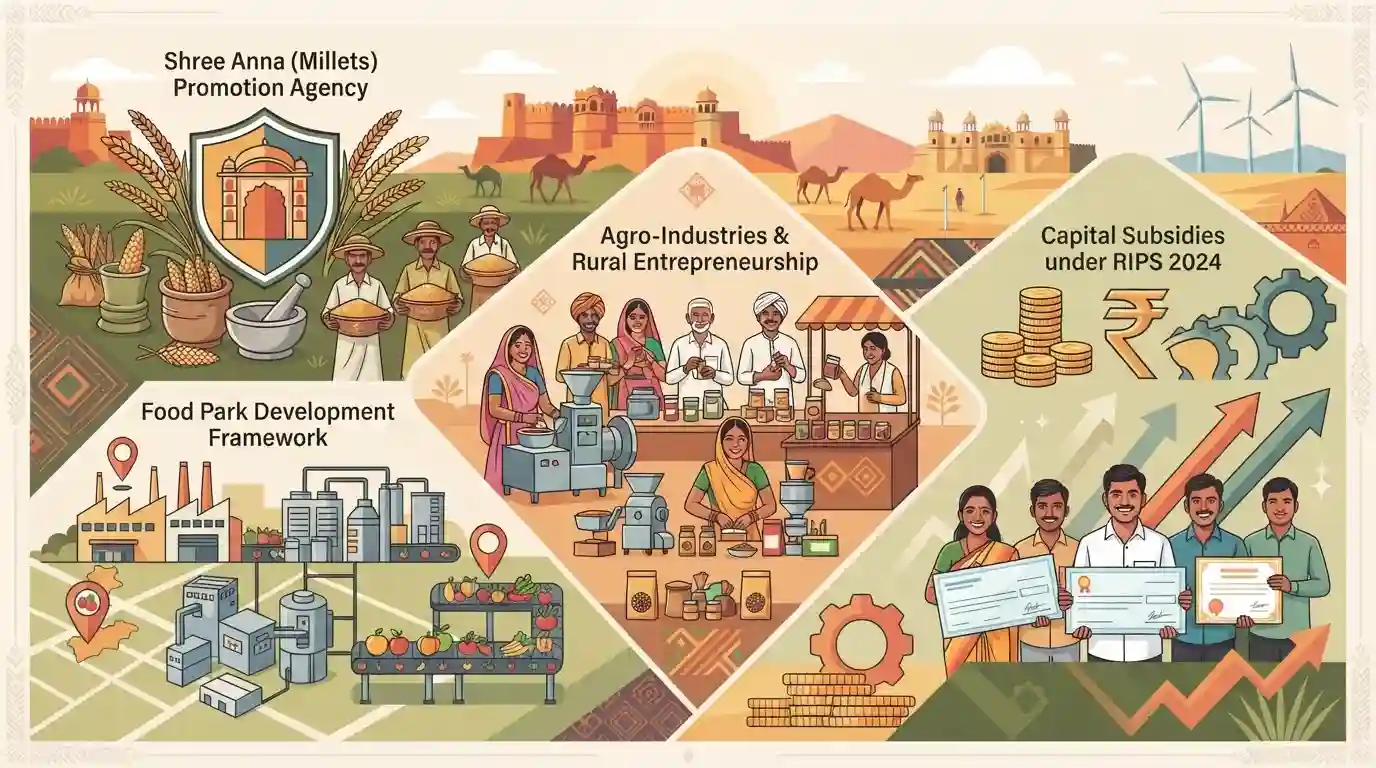
The Rajasthan government has introduced comprehensive policies for agriculture, food processing, and food park development to boost agro-industries and rural entrepreneurship. Notable initiatives include the creation of a Shree Anna (Millets) Promotion Agency, a framework to develop food parks in every district, and substantial capital subsidies under RIPS 2024 to support investors, especially from marginalized groups and FPOs.
Key Points
- The Rajasthan Cabinet approved the 'Rajasthan Agriculture and Food Processing Policy, 2026' and the 'Rajasthan Food Park Development Policy, 2026' to promote agro-industries and rural entrepreneurship.
- A 'Shree Anna (Millets) Promotion Agency' will be established to focus on millet production, processing, and consumption.
- Capital subsidies are structured by investment size: 60% up to ₹50 lakh, 50% between ₹50 lakh and ₹1 crore, and 40% above ₹1 crore up to ₹1.5 crore, with an extra 5% for FPOs, SC/ST, women, and TSP areas.
- The Food Park Development Policy aims to set up food parks in every district using a cluster-based model to strengthen the agricultural supply chain and create jobs.
Important Terms
Rajasthan Agriculture and Food Processing Policy, 2026

A 2026 state policy offering up to 60% capital subsidies to boost agro-processing and rural entrepreneurship. It focuses on value addition for fruits, dairy, and spices, aiming to improve farmers' incomes and reduce post-harvest losses.
UPSC context
GS-3 (Agriculture). Important for studying state-level strategies for food processing, doubling farmers' income, and rural supply chain infrastructure.
Rajasthan Food Park Development Policy, 2026
A framework to establish world-class, cluster-based food parks in every Rajasthan district in a phased manner. It promotes private investment through PPP models to build integrated storage, processing, and transportation facilities.
UPSC context
GS-3 (Food Processing). Tests knowledge of supply chain management, post-harvest infrastructure, and cluster-based agro-industrial development.
Rajasthan Investment Promotion Scheme (RIPS) 2024
A state initiative offering tax reimbursements, capital subsidies, and interest subventions to attract investment. It focuses on MSMEs, green growth, export promotion, and job creation to lower the cost of doing business in Rajasthan.
UPSC context
GS-3 (Economic Development). Relevant for understanding state industrial policies, MSME support mechanisms, and ease of doing business reforms.
Shree Anna (Millets) Promotion Agency
A specialized body established under the Rajasthan Agriculture and Food Processing Policy, 2026. It is dedicated to encouraging the investment, processing, and marketing of millets to boost their production and consumption.
UPSC context
GS-3 (Agriculture). Highlights climate-resilient cropping strategies, nutritional security, and institutional support for millet promotion.
Farmer Producer Organizations (FPOs)
Collectives of farmers structured as companies or cooperatives to achieve economies of scale in production and marketing. Under Rajasthan's new policies, FPOs receive an additional 5% capital subsidy for agro-processing projects.
UPSC context
GS-3 (Agriculture). Essential for topics on farm economy, agricultural marketing, and empowering small and marginal farmers.
Prelims Trap
The Shree Anna Promotion Agency is a nodal body established under the Union Ministry of Agriculture.
While 'Shree Anna' is the central government's branding for millets, this specific "Shree Anna Promotion Agency" is a state-level statutory body created by Rajasthan, not the Union Ministry.
Static Concepts Connected
What is the role of Farmer Producer Organizations (FPOs) in Indian agriculture?
- Economies of Scale: Aggregates small and marginal farmers to enhance bargaining power for securing inputs and formal market linkages.
- Value Addition: Facilitates localized primary processing, grading, and packaging, increasing the net price realization for member farmers.
- Institutional Support: Supported heavily by state policies and the central sector scheme for the 'Formation and Promotion of 10,000 FPOs'.
What are the upstream and downstream requirements of the food processing industry?
- Upstream Requirements: Requires reliable raw material supply, quality seeds, farm-level infrastructure like primary cold storage, and accessible credit.
- Downstream Requirements: Depends on efficient logistics, testing labs, advanced packaging infrastructure, organized retail networks, and export linkages.
Cross-Topic Patterns
Shree Anna and Climate Resilience
Rajasthan's push for a dedicated millet agency ties directly into climate-smart agriculture, promoting drought-resistant crops that require less water and fertilizer in arid/semi-arid regions.
Decentralizing the Agro Supply Chain
Shifting from massive central Mega Food Parks to district-level cluster models mirrors the broader UPSC theme of localizing and decentralizing agricultural supply chains to reduce post-harvest wastage.

State-led agro-processing policies linking FPOs with decentralized district food parks are prime fodder for GS3 supply chain questions.
Linked PYQs · 4
Linked PYQs · 4
- 2023RPSC_PRELIMSGS1
Which of these is a group of millets (Shree Ann) crops?
- 2012RPSC_PRELIMSGS1
RECO has developed four agro-food parks to -
- 2018RPSC_PRELIMSGS1
Consider the following statements regarding the first mega food park established in Rajasthan in March 2018: (a) It was inaugurated by the Union Minister of Food Processing Industries, Harsimrat Kaur Badal. (b) It is known as Smart Mega Food Park. (c) It is located in Rupar, Ajmer. Which of the above statements is/are correct?
- 2023RPSC_PRELIMSGS1
Which of the following facts about the Rajasthan Chief Minister Small Industry Promotion Scheme is not correct?
