Rajasthan Tourism Launches Shekhawati Haveli Conservation Scheme
Source:udaipurtimes ↗
Why It Matters
Tourism is a cornerstone of Rajasthan's economy, being the primary driver of the state's service sector. Understanding the government's current strategies—ranging from the preservation of Shekhawati's unique fresco art to the development of new religious and historical circuits—is crucial for questions related to state economic policies, cultural heritage, and regional development initiatives in the RPSC RAS examination.
Summary
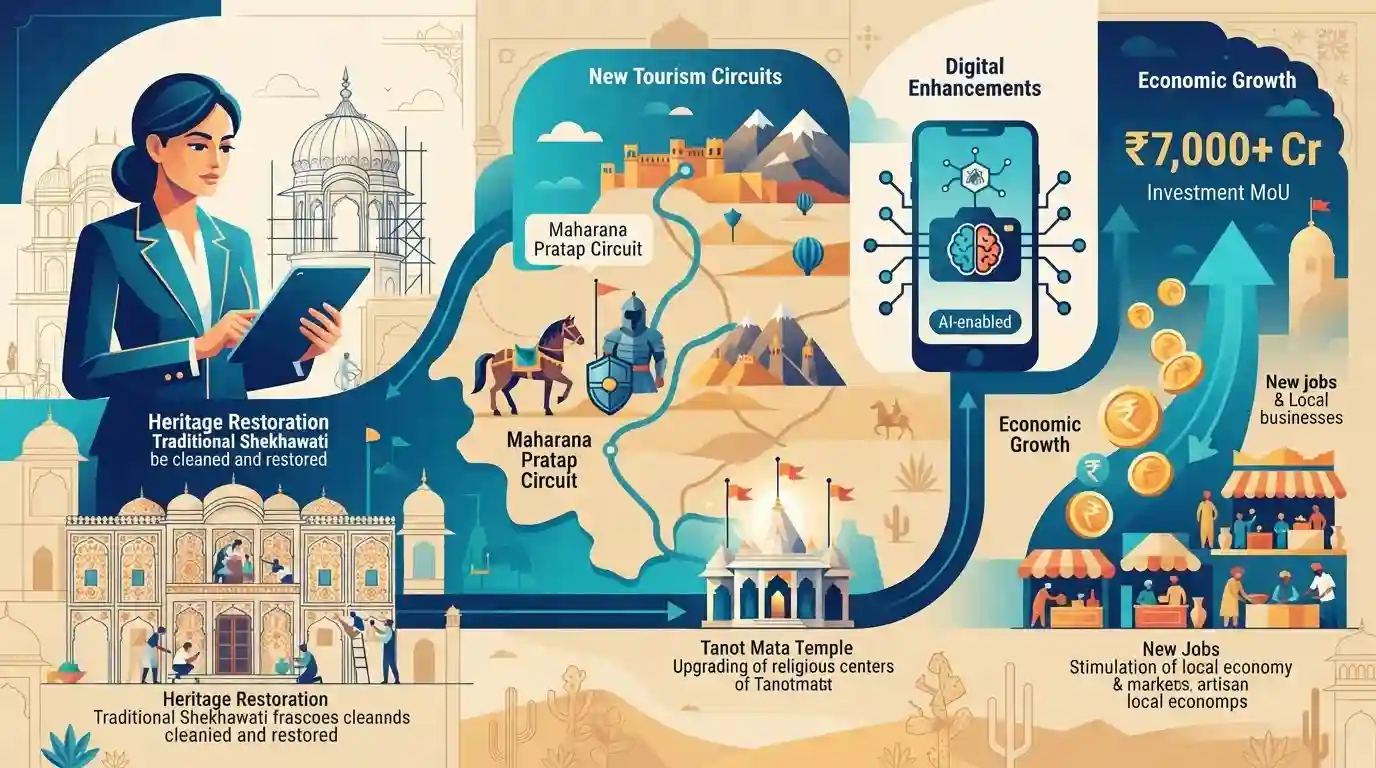
The Rajasthan Government is expediting a series of initiatives designed to elevate the state into a premier global tourist destination. Deputy Chief Minister Diya Kumari recently evaluated the progress of major projects, which span structural conservation, heritage restoration, and the development of new tourism circuits. Key interventions include the 'Shekhawati Haveli Conservation Scheme 2026' to preserve historic frescoes, massive investments in the Maharana Pratap Circuit, and the upgrading of religious centers such as the Tanot Mata Temple. Alongside physical infrastructure, the government is focusing on digital enhancements like an AI-enabled app and aggressively pursuing over ₹7,000 crore in investment MoUs to stimulate the local economy.
Key Points
- Rajasthan's Deputy CM Diya Kumari reviewed the progress of tourism development initiatives, noting significant advancement in budget announcements and investment memorandums.
- The 'Shekhawati Haveli Conservation Scheme 2026' aims to restore privately owned fresco-painted havelis, transforming the region into an 'Open Art Gallery'.
- Major heritage sites, including the Albert Hall Museum, Ravindra Manch, and Amer Fort, are slated for substantial renovation and upgraded tourist amenities.
- The ₹206.87 crore Maharana Pratap Circuit and enhancements to faith-based tourism centers like Tanot Mata and Ramdevra temples are prioritized for regional development.
- The tourism department is targeting 127 MoUs worth ₹7,247.87 crore by December 2026 to boost investment in the sector.
Important Terms
Shekhawati Haveli Conservation Scheme

A Rajasthan government initiative to preserve over 660 historic havelis across Sikar, Jhunjhunu, and Churu. It safeguards their intricate frescoes and architectural heritage, developing them into cultural centers and homestays to boost heritage tourism.
UPSC context
Relevant for GS-1 Art & Culture (regional architecture and frescoes) and GS-3 Economy (heritage tourism development).
Maharana Pratap Tourist Circuit
A major tourism project in Rajasthan linking key historical sites tied to Maharana Pratap's life, such as Haldighati, Kumbhalgarh, Chavand, and Gogunda. The initiative enhances connectivity and builds museums to celebrate his legacy.
UPSC context
Essential for GS-1 History (Rajput valor) and GS-3 Economy, demonstrating infrastructure investments for cultural tourism.
Rajasthan Tourism Development Corporation (RTDC)
A state-owned public sector agency established in 1978 to catalyze Rajasthan's tourism industry. It operates affordable accommodations, curated tour packages, and iconic luxury trains like the 'Palace on Wheels' to stimulate the local economy.
UPSC context
Important for GS-2 (State Bodies) and GS-3 (Tourism and Economic Growth), illustrating government-led sectoral promotion.
Tanot Mata Temple
A historically and spiritually significant temple in Jaisalmer near the Indo-Pak border, uniquely managed by the Border Security Force (BSF). Rajasthan is upgrading it into a world-class center for faith-based and border tourism.
UPSC context
Connects to GS-1 (Culture) and GS-3 (Border Area Development), showcasing how strategic border regions can integrate heritage tourism.
Prelims Trap
The Tanot Mata Temple is a protected heritage site managed by the Archaeological Survey of India (ASI).
While the ASI manages most historical monuments in India, the Tanot Mata Temple is uniquely managed by the Border Security Force (BSF) due to its border location and 1965 war history.
Static Concepts Connected
What are the defining features of Indo-Saracenic architecture (e.g., Albert Hall)?
- Hybrid Style: A colonial-era architectural movement that fused European Gothic structural engineering with native Indian aesthetics.
- Key Elements: Extensively features Rajput and Mughal decorative elements such as chhatris (pavilions), jharokhas (overhanging enclosed balconies), and cusped arches.
- Prominent Examples: Sir Samuel Swinton Jacob designed the Albert Hall; other examples include the Gateway of India and Victoria Memorial.
What makes the Shekhawati frescoes distinct in Indian mural art?
- Merchant Patronage: Known as the 'Open Art Gallery,' it features massive wall paintings on 18th-19th century merchant havelis, done using traditional wet plaster (fresco) techniques.
- Thematic Fusion: Uniquely blends traditional Rajput and Hindu mythological themes with distinct Victorian-era motifs, depicting novelties like trains, gramophones, and British soldiers.
Cross-Topic Patterns
Border Tourism & Security Forces
Using sites like Tanot Mata for tourism integrates security forces (BSF) into cultural diplomacy, aligning with the Centre's Vibrant Villages Programme to develop border infrastructure.
Private Ownership in Heritage Conservation
State funding for privately-owned Shekhawati havelis mirrors the national 'Adopt a Heritage' model, leveraging private/local ownership to boost public tourism revenue and regional GSVA.

Expect a 2026 multi-statement prelims question pairing Shekhawati frescoes (Victorian motifs) with Indo-Saracenic architectural features.
Linked PYQs · 5
Linked PYQs · 5
- 2021RPSC_PRELIMSGS1
Match List-I with List-II and select the correct answer using the code given below – List-I (Tourist Place) (A) Lalgarh (B) Tripura Sundari (C) Gagaron Fort (D) Nakoda List-II (Location) (i) Jhalawar (ii) Barmer (iii) Bikaner (iv) Banswara Code
- 2016RPSC_PRELIMSGS1
The phrase included in the 'logo' of the Rajasthan Tourism is:
- 2018RPSC_PRELIMSGS1
Which of the following is NOT a unique selling proposition (USP) in Rajasthan's tourism sector?
- 2023RPSC_PRELIMSGS1
In the year 2022-23, what sub-sector contributed the most to the Gross State Value Added (GSVA) of the service sector in Rajasthan, based on current values?
- 2024RPSC_PRELIMSGS1
Match List – I with List – II regarding famous painting styles and their painters of Rajasthan and select the correct option: List – I: (A) Kishangarh (B) Bikaner (C) Mewar (D) Marwar List – II: i. Sahibdeen ii. Nihalchand iii. Ali Raza iv. Shivdas
