Rajasthan Seeks Spanish Expertise for Climate-Hit Olive Plantations
Source:etvbharat ↗
Why It Matters
Horticulture development, dryland farming techniques, international collaborations (like Israel and Spain), and regional agricultural hubs (such as the Lunkaransar olive refinery) are recurring and highly significant topics in both the RPSC RAS Prelims and Mains (General Studies) examinations.
Summary
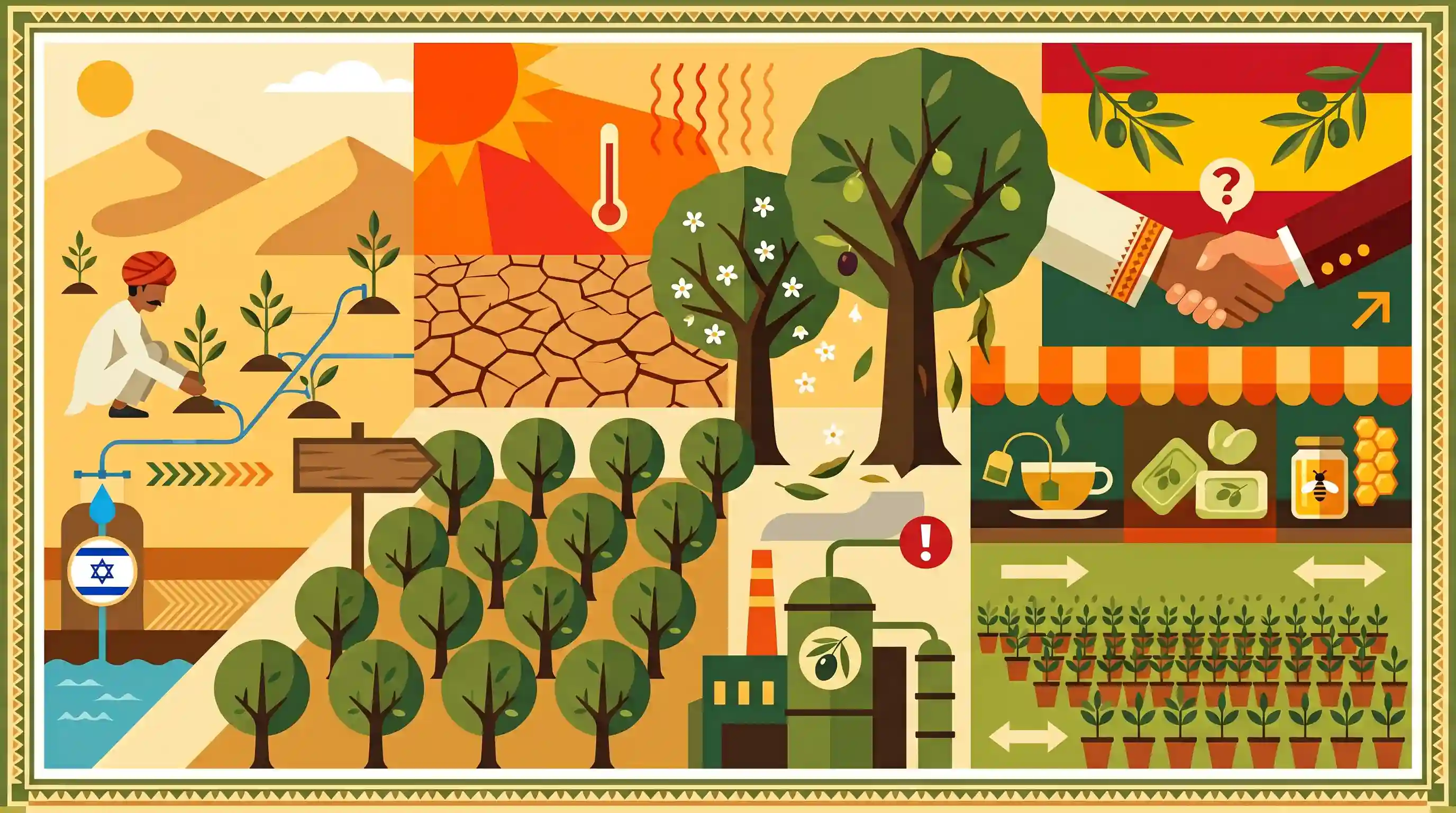
To save its ambitious olive plantations from the adverse effects of climate change and declining groundwater, the Rajasthan government has sought technical assistance from Spain, the world's leading olive producer. Initiated in 2008-09 with Israeli technology, olive cultivation is managed by Rajasthan Olive Cultivation Limited (ROCL). Despite planting over 1.12 lakh saplings across 182 hectares of government land and 1,000 hectares of private farms, the crop is suffering from premature flower-drop and lack of fruiting. While the state-of-the-art olive refinery in Lunkaransar (Bikaner) has produced high-quality oil in the past, the state is currently relying on secondary products like olive tea, soaps, and honey to support farmers, alongside raising 3 lakh new saplings for domestic and international demand.
Key Points
- The Rajasthan government is seeking expertise from Spain, the world's largest olive producer, to address declining yields and lack of fruiting in its olive plantations.
- Olive cultivation in Rajasthan was initiated in 2008-09 under Rajasthan Olive Cultivation Limited (ROCL), using Israeli dryland farming and micro-irrigation technology.
- Over 1.12 lakh olive saplings were planted across seven government gardens (covering 182 hectares) in districts such as Sri Ganganagar, Jhunjhunu, Didwana-Kuchaman, Alwar, Jalore, and Jaipur.
- A state-of-the-art olive oil extraction refinery is located in Lunkaransar, Bikaner, which has produced about 197 quintals of high-quality olive oil.
- Climate change, rising temperatures, and depleting groundwater are identified as key factors causing olive flowers to drop off without bearing fruit.
- Due to fruit-bearing challenges, the state is shifting focus to secondary products such as olive tea, olive honey, chocolates, soaps, and selling valuable olive leaves.
- The state is also cultivating 3 lakh fresh olive saplings to supply Jammu & Kashmir, the northeastern states, and Nepal.
Important Terms
Rajasthan Olive Cultivation Limited (ROCL)

A joint-venture company formed in 2007 by the Rajasthan government, Finolex Plasson Industries, and Israel's Indolive Limited to manage, promote, and implement commercial olive farming in Rajasthan using advanced micro-irrigation systems.
UPSC context
GS Paper III: Technology missions, public-private partnership models in agriculture, and high-value crop diversification under arid conditions.
Rajasthan Olive Cultivation Project
An agricultural initiative launched in 2008-09 to cultivate olives across the state's arid zones using Israeli technology, currently seeking Spanish assistance to combat climate-induced flower-drop and falling groundwater levels.
UPSC context
GS Paper III: Dryland agriculture, climate change adaptation, micro-irrigation technology, and bilateral cooperation in horticultural development.
Rajasthan Agriculture Department
The state government department responsible for agricultural policy, horticultural promotion, and resource management, actively coordinating international collaborations to mitigate climate change risks for local farmers.
UPSC context
GS Paper II & III: Public policy, institutional support in farming, and government-led climate-resilience strategies.
Embassy of India in Spain
The diplomatic mission representing India in Spain, tasked with fostering bilateral ties, trade, and economic partnerships, recently engaged by Rajasthan to facilitate technical agricultural aid for olive gardens.
UPSC context
GS Paper II: Bilateral relations, diplomatic facilitation of domestic development, and international science and technology partnerships.
Prelims Trap
Olive cultivation in India was initiated and established primarily through technological collaborations with Spain.
The olive project was initiated in 2008 with Israeli technology (not Spanish). Spain is being approached only now to solve climate-induced fruiting failures.
Static Concepts Connected
What are the primary geographical and climatic requirements for olive cultivation?
- Climatic zone: Thrives in subtropical climates; typically requires mild, wet winters and hot, dry summers.
- Vernalization requirement: Needs 200 to 1000 hours of winter chilling (below 7°C) to induce flowering and fruiting.
- Soil and drainage: Highly drought-tolerant but demands well-drained soils; extremely sensitive to root waterlogging.
How do micro-irrigation and fertigation optimize water use in dryland farming?
- Evaporation control: Drip systems deliver water directly to root zones, drastically reducing evaporation losses in hyper-arid zones.
- Nutrient efficiency: Soluble nutrients are applied directly through irrigation lines, preventing leaching and maximizing absorption.
- Salinity management: Maintains stable moisture levels in soil profiles, preventing salt accumulation near plant roots.
Cross-Topic Patterns
Climate change vs. Crop phenology
Rising winter temperatures disrupt the chilling requirements (vernalization) of Mediterranean crops, causing premature flower-drop and altering traditional horticultural zones in India.
Diplomacy + Agro-technology transfer
The project illustrates bilateral technology transfer (Israel's MASHAV), showing how diplomatic partnerships transition from basic cultivation to climate-resilience collaborations.

GS-3 may target climate-smart agriculture by contrasting Israeli micro-irrigation limits with Spanish adaptation solutions in drylands.
Linked PYQs · 2
Linked PYQs · 2
- 2013RPSC_PRELIMSGS1
The Rajasthan Agricultural Competitiveness Project was started in the year 2012-13. This project mainly emphasizes
- 2025RPSC_PRELIMSGS1
Choose the incorrect statement with respect to the Rajasthan Forestry and Biodiversity Project (Phase-2).
