Rajasthan Pradhan Mantri Awas Yojana Rural Housing Allocation
Source:gktoday ↗
Why It Matters
Changes in the eligibility criteria of a flagship scheme like PMAY-G and enhancements in initiatives like Lakhpati Didi are highly relevant for RPSC Prelims under the 'Welfare Schemes' and 'Rural Development' sections. Aspirants should note the specific numerical targets for Rajasthan and the revised eligibility parameters.
Summary
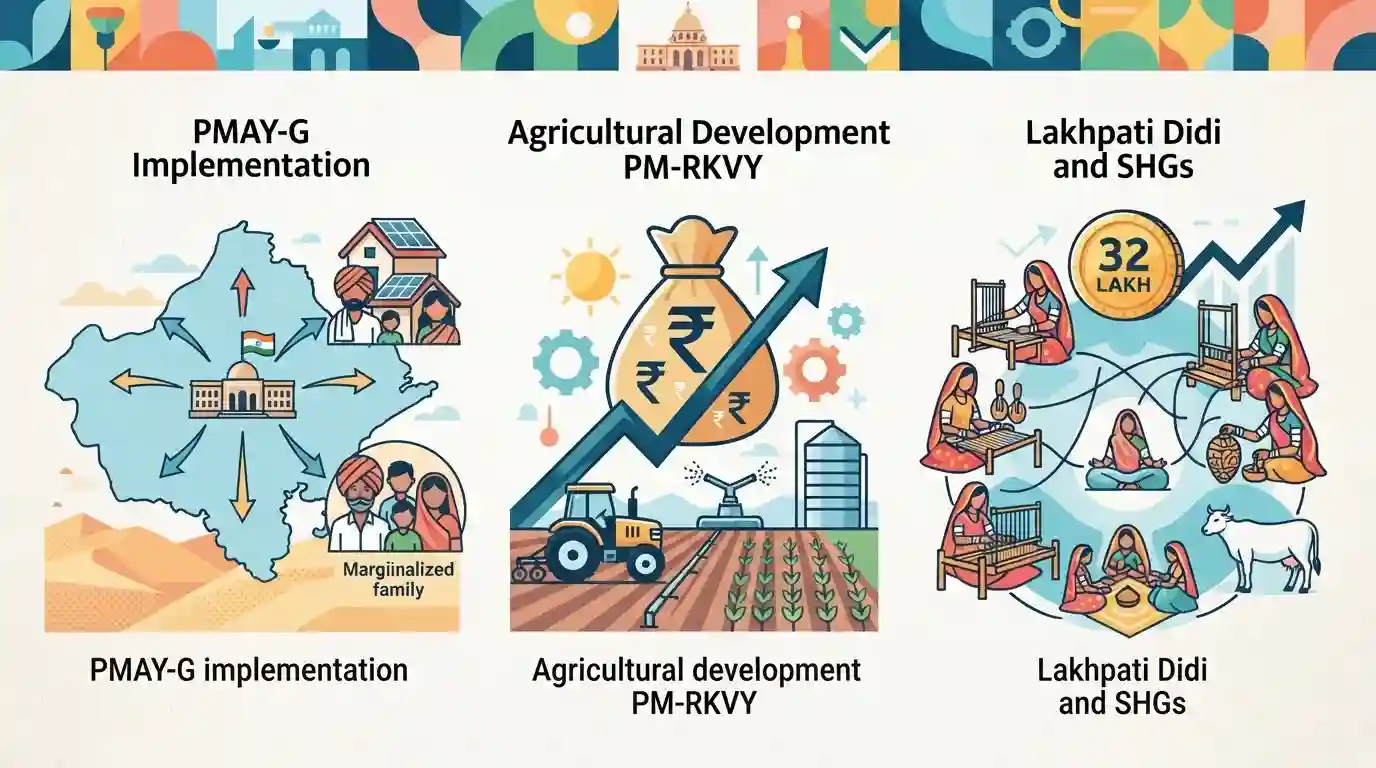
The Government of India has approved the construction of 2,89,355 pucca houses in Rajasthan under the Pradhan Mantri Awas Yojana-Gramin (PMAY-G). The state government's outreach, led by State Rural Development Minister K.K. Bishnoi, also led to relaxed PMAY-G eligibility criteria, allowing more marginalized families and small farmers to benefit. In addition to rural housing, the state received an extra ₹340.59 crore under the Pradhan Mantri Rashtriya Krishi Vikas Yojana (PM-RKVY) for agricultural development. The target for the Lakhpati Didi initiative in Rajasthan has also been increased from 16 lakh to 32 lakh, aiming to significantly boost women's empowerment and rural livelihoods through Self Help Groups (SHGs).
Key Points
- Rajasthan has received approval for 2,89,355 pucca houses under the PMAY-G scheme out of the 2 crore additional houses targeted nationally.
- Eligibility criteria for PMAY-G have been relaxed to include families owning a two-wheeler, a higher monthly income threshold (₹15,000), and small farmers with up to 5 acres of un-irrigated land.
- The state secured an additional ₹340.59 crore allocation under the PM-RKVY for agricultural infrastructure and farm development.
- The target for the Lakhpati Didi initiative in Rajasthan has been doubled, aiming to empower 32 lakh women connected to self-help groups (SHGs) to earn an annual income over ₹1 lakh.
Important Terms
Pradhan Mantri Awas Yojana-Gramin (PMAY-G)

A flagship central scheme providing financial assistance for constructing pucca houses in rural areas. Eligibility criteria in Rajasthan were recently relaxed to include two-wheeler owners and small farmers.
UPSC context
Crucial for RPSC RAS General Studies covering rural development, poverty alleviation schemes, and updated eligibility criteria.
Lakhpati Didi Initiative
A livelihood initiative empowering women in Self Help Groups (SHGs) to earn at least ₹1 lakh annually. The target for Rajasthan was recently doubled to 32 lakh beneficiaries.
UPSC context
Highly relevant for RAS Mains (Social Sector, Women Empowerment) and Prelims for tracking state-specific beneficiary targets.
Pradhan Mantri Rashtriya Krishi Vikas Yojana (PM-RKVY)
A centrally sponsored scheme aimed at holistic agricultural development and infrastructure. Rajasthan recently received a ₹340.59 crore allocation to boost state-level farm projects and productivity.
UPSC context
Important for RPSC RAS topics on Rajasthan Economy and Agriculture, specifically regarding central agricultural funding allocations.
Ministry of Rural Development
The central government ministry responsible for accelerating the socio-economic development of rural India, implementing key welfare programs like PMAY-G and supporting rural livelihoods.
UPSC context
Relevant for RAS Public Administration and Governance topics, identifying the nodal agency for rural welfare schemes.
Ministry of Agriculture & Farmers' Welfare
The apex central body formulating and administering agrarian policies, farm welfare programs, and agricultural funding allocations, such as the PM-RKVY grants to states.
UPSC context
Tests knowledge of the administrative framework governing agrarian policies and farm welfare funding mechanisms in exams.
Prelims Trap
Families owning a two-wheeler or earning over ₹10,000 monthly are strictly excluded from PMAY-G.
Criteria have been relaxed. Families with a two-wheeler, income up to ₹15,000/month, and up to 5 acres of un-irrigated land are now eligible.
Static Concepts Connected
What are the core structural parameters of PMAY-Gramin?
- Nodal Ministry: Ministry of Rural Development (MoRD) implements the scheme.
- Funding Pattern: Cost-sharing is 60:40 between Centre and State for plain areas (90:10 for NE and Himalayan states).
- Beneficiary Selection: Beneficiaries are identified using Socio-Economic Caste Census (SECC) 2011 parameters, verified by the Gram Sabha.
What is the primary objective of the Lakhpati Didi Initiative?
- Income Target: To empower women in Self-Help Groups (SHGs) to earn a sustainable income of at least ₹1 Lakh per annum.
- Skill Development: Providing training in skills like drone operation (Namo Drone Didi), plumbing, tailoring, and LED bulb making.
Cross-Topic Patterns
PMAY-G linked with Lakhpati Didi Scheme
Rural housing often mandates female co-ownership, establishing an asset base that supports SHG-led micro-enterprises and credit access under the Lakhpati Didi scheme.
Agri-infrastructure combined with rural housing
Parallel allocations for PM-RKVY and rural housing highlight a dual strategy: stabilizing the rural household via PMAY-G while boosting agricultural productivity via Krishonnati Yojana.

Multi-statement questions will likely test the newly relaxed PMAY-G criteria (2-wheelers, ₹15k limit) alongside Rajasthan's Lakhpati targets.
Linked PYQs · 3
Linked PYQs · 3
- 2023RPSC_PRELIMSGS1
Which of the following schemes aims to make rural areas socially, economically, and physically sustainable?
- 2025RPSC_PRELIMSGS1
Which of the following statements are correct with respect to the PM Surya Ghar Free Electricity Scheme? (i) Under this scheme, solar plants will be installed on one crore houses to provide free electricity up to 300 units per month. (ii) Provision of 30% subsidy for installing rooftop solar plants (iii) 100% online system for registration, application, approval and grant (iv) Provision of lending to each applicant at a bank interest rate of 4%
- 2023RPSC_PRELIMSGS1
Which of the following options describes a key objective of the Indira Mahila Shakti Udan Yojana?
