Rajasthan Fast Tracks Water Infrastructure Projects Worth 5100 Crore
Source:economic-times ↗
Why It Matters
Water scarcity is the most defining geographic and developmental challenge for Rajasthan. State-specific irrigation projects (like Parwan, IGNP, Narmada, and Devas) and conservation schemes form a core syllabus area for RPSC RAS Prelims. Questions testing the beneficiaries, locations, and objectives of these projects are recurring fixtures in the exam.
Summary
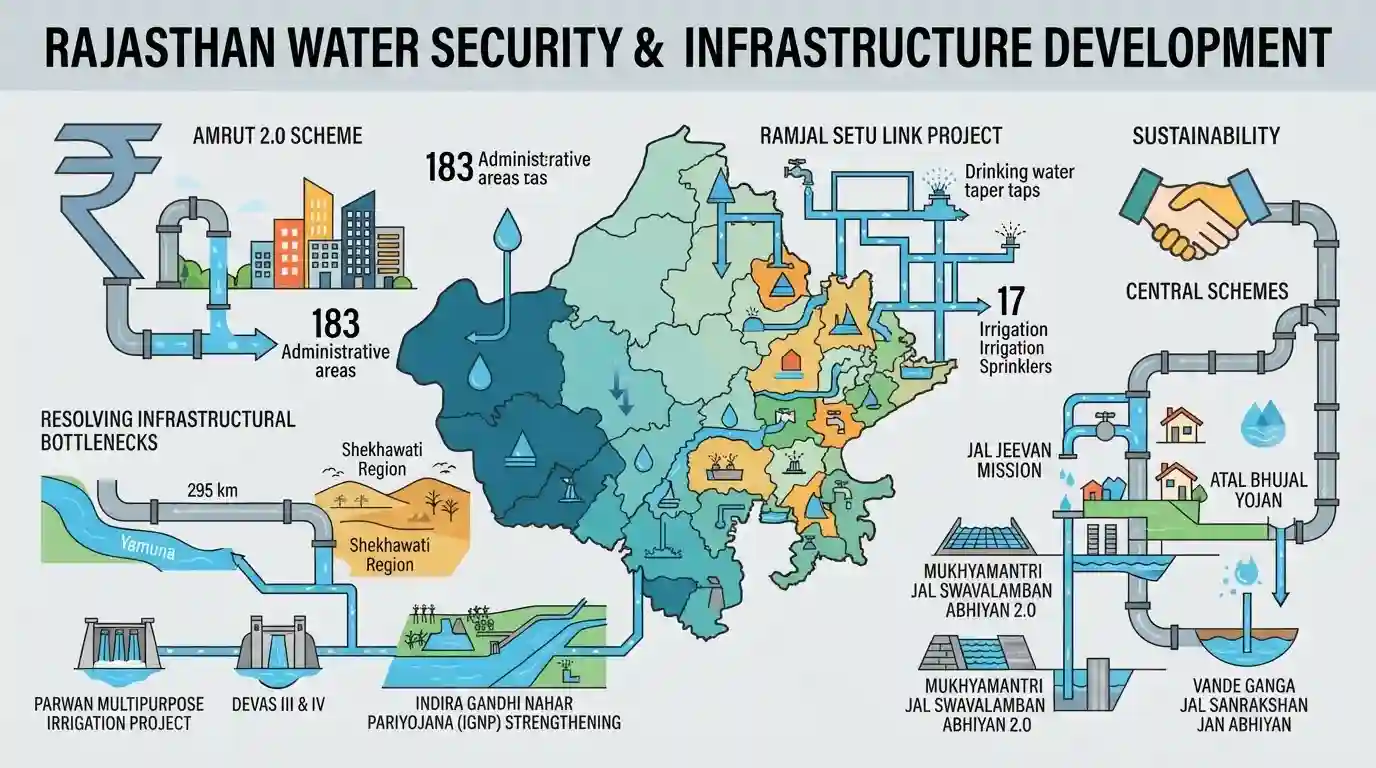
Rajasthan Chief Minister Bhajan Lal Sharma has declared water management and infrastructure development as top priorities to combat the state's geographic water scarcity. The government has approved ₹5,100 crore under the AMRUT 2.0 scheme to strengthen drinking water infrastructure across 183 urban local bodies. A flagship initiative, the Ramjal Setu Link Project, is being advanced to secure drinking water for 17 districts while boosting irrigation. Furthermore, the state has actively resolved long-pending infrastructural bottlenecks, implementing the Yamuna Water Agreement to bring a 295-km water pipeline to the Shekhawati region, and accelerating critical projects like the Parwan Multipurpose Irrigation Project, Devas III and IV, and the Indira Gandhi Nahar Pariyojana (IGNP) strengthening. Emphasizing sustainability, Rajasthan is integrating Central schemes such as the Jal Jeevan Mission and Atal Bhujal Yojana with regional campaigns like the Mukhyamantri Jal Swavalamban Abhiyan 2.0 and Vande Ganga Jal Sanrakshan Jan Abhiyan to promote deep-rooted water conservation and groundwater recharge.
Key Points
- The Rajasthan government has prioritized water management, sanctioning ₹5,100 crore under the AMRUT 2.0 scheme to upgrade drinking water facilities across 183 Urban Local Bodies.
- The Ramjal Setu Link Project is being fast-tracked to ensure long-term drinking water security for 17 districts while also augmenting local irrigation capabilities.
- Historical pending projects are seeing expedited progress, notably the Yamuna Water Agreement, which will construct a 295-km pipeline to supply water to Sikar, Jhunjhunu, and Churu in the Shekhawati region.
- Crucial regional irrigation and drinking water ventures, including the Parwan Multipurpose Irrigation Project, Narmada water extension, Devas III and IV for Udaipur, and strengthening of the IGNP, have been accelerated.
- The state is synergizing Central initiatives like Atal Bhujal Yojana and Jal Jeevan Mission with state-led campaigns like Mukhyamantri Jal Swavalamban Abhiyan 2.0 for holistic groundwater conservation.
Important Terms
Ramjal Setu Link Project

A major ₹90,000-crore river-linking and water infrastructure initiative in Rajasthan aimed at securing drinking water for 17 eastern districts and providing irrigation to over 4.8 lakh hectares of land.
UPSC context
GS Paper I & III: Geography of India, state-level infrastructure planning, and drought-mitigation models.
Yamuna Water Agreement
A landmark 2026 inter-state pact between Rajasthan and Haryana to implement a 1994 MoU, conveying 580 MCM of Rajasthan's Yamuna water share during monsoons via underground pipelines.
UPSC context
GS Paper II: Federalism, interstate water disputes, and cooperative federalism mechanisms in India.
Devas III and IV
Two key drinking water and dam projects under construction in Udaipur, designed to channel additional water through tunnels to meet the urban water demands of Udaipur city.
UPSC context
GS Paper I & III: Geography of Rajasthan, micro-irrigation, and urban drinking water management.
Parwan Multipurpose Irrigation Project
An under-construction dam project on the Parwan River in Rajasthan, designed to provide irrigation to Jhalawar, Baran, and Kota districts alongside drinking water.
UPSC context
GS Paper I & III: Major river valley projects, regional water geography, and agricultural infrastructure.
AMRUT 2.0
The second phase of India's flagship urban renewal mission, targeting 100% water supply coverage in all statutory towns through functional taps and water body rejuvenation.
UPSC context
GS Paper II & III: Urban development schemes, municipal governance, and water infrastructure.
Atal Bhujal Yojana
A Central Sector Scheme aimed at improving groundwater management through community participation, demand-side interventions, and water security plans across water-stressed districts.
UPSC context
GS Paper III: Sustainable agriculture, groundwater depletion, and community-led resource conservation.
Prelims Trap
"Atal Bhujal Yojana is a Centrally Sponsored Scheme implemented across all states in India."
It is a Central Sector Scheme (50% GoI, 50% World Bank) implemented only in select water-stressed areas across 7 specific states, not pan-India.
Static Concepts Connected
What is the constitutional framework governing inter-state river waters?
- Article 262: Empowers Parliament to provide for the adjudication of any dispute regarding the use, distribution, or control of inter-state river waters.
- ISWD Act 1956: Enacted under Art 262, it allows the Centre to set up ad-hoc tribunals whose decisions are final and binding on the parties.
- Article 131 limitation: The Supreme Court's original jurisdiction over state disputes does not extend to water disputes explicitly referred to tribunals under Article 262.
What are the key features of the Atal Bhujal Yojana?
- Funding mechanism: A Central Sector Scheme worth ₹6,000 crore, co-funded on a 50:50 basis by the Government of India and the World Bank.
- Target geography: It is currently implemented in 7 water-stressed states: Gujarat, Haryana, Karnataka, MP, Maharashtra, Rajasthan, and UP.
- Community participation: Mandates the formulation of Water Security Plans (WSPs) at the Gram Panchayat level through community-led Water User Associations.
Cross-Topic Patterns
River linking and cooperative federalism
The Yamuna Water Agreement (Haryana-Rajasthan) highlights how inter-state consensus is successfully bypassing tribunals to execute mega-infrastructure, standing in sharp contrast to the highly litigated Cauvery or SYL canal disputes.
AMRUT 2.0 and urban water security
AMRUT 2.0's expansion to all statutory towns pairs urban infrastructure with source sustainability (Jal Jeevan Mission), reflecting a shift toward holistic climate-resilient urban planning in water-stressed regions.

Expect a 2026 prelims question pairing regional river interlinking projects (like Ramjal Setu/PKC-ERCP) with their specific river basins.
Linked PYQs · 5
Linked PYQs · 5
- 2018RPSC_PRELIMSGS1
Match the following: List-I – List-II (Major Irrigation Project) (Districts benefited by irrigation facilities) A. Siddhmukh Project (i) Jalore and Barmer B. Narmada Project (ii) Jalore, Pali and Jodhpur C. Jawai Project (iii) Udaipur and Pratapgarh D. Jakham Project (iv) Hanumangarh and Churu Code:
- 2021RPSC_PRELIMSGS1
The 'Parwan' multipurpose irrigation project of Rajasthan will provide irrigation facilities to which districts?
- 2018RPSC_PRELIMSGS1
In Rajasthan, for the first time, which of the following projects has made sprinkler irrigation mandatory?
- 2023RPSC_PRELIMSGS1
Which of the following statements is/are correct regarding the Atal Bhujal Yojana in Rajasthan? (a) The Atal Bhujal Yojana is being run by the Government of Rajasthan with financial assistance from the Government of India. (b) The focus of this scheme is to improve groundwater management and prevent its declining levels.
- 2013RPSC_PRELIMSGS1
The Atal Mission for Rejuvenuation and Urban Transformation (AMRUT) primarily focuses on – 1. Water supply. 2. Sewerage facilities. 3. Public transportation facilities. 4. Construction of parks and recreational centers, mainly for children. 5. Flood control through drainage of floodwater. Select the correct answer using the codes given below
