Rajasthan water security enhanced through interstate agreements
Source:et-government ↗
Why It Matters
Water scarcity and irrigation/drinking water projects are highly recurrent themes in RPSC RAS Prelims. Interstate water pacts (such as those involving Mahi, Chambal, Beas, and Narmada) and major schemes like the Jal Jeevan Mission are central to Rajasthan's geography and economic development syllabus.
Summary
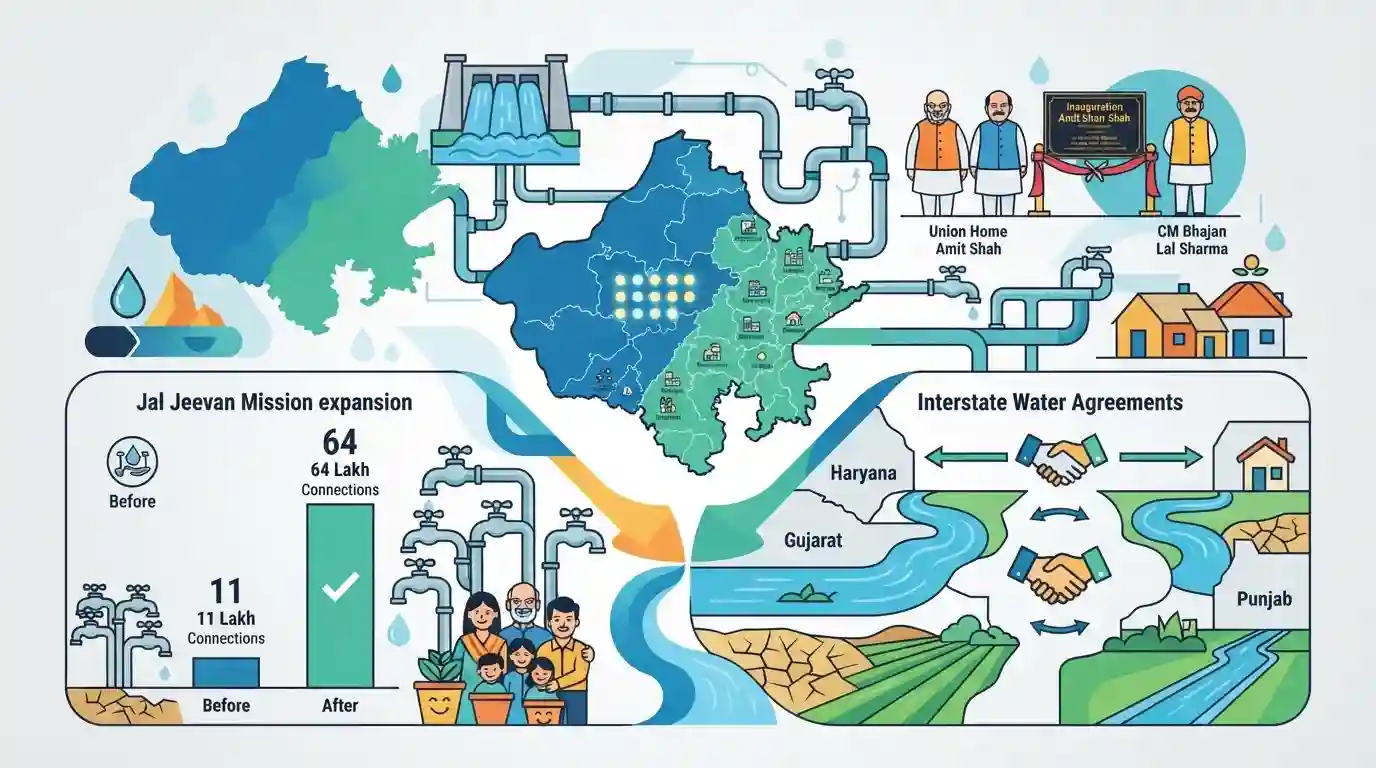
Rajasthan has undertaken a massive push to secure its water future through an expansion of the Jal Jeevan Mission and new interstate water pacts with Haryana, Gujarat, and Punjab. During a recent event in Chittorgarh, Union Home Minister Amit Shah and CM Bhajan Lal Sharma inaugurated 944 development projects worth ₹5,659 crore across 15 districts. The initiatives aim to solve chronic water scarcity by drastically increasing household tap connections from 11 lakh to 64 lakh and ensuring robust interstate cooperation for river water sharing.
Key Points
- Union Home Minister Amit Shah and Rajasthan Chief Minister Bhajan Lal Sharma inaugurated development projects worth ₹5,659 crore in Nimbahera, Chittorgarh, focusing on water security.
- Rajasthan has signed crucial interstate agreements with Haryana, Gujarat, and Punjab to enhance water sharing and address drinking water shortages in the state.
- Under the Jal Jeevan Mission, the state is vastly expanding its reach from 11 lakh to 64 lakh households, recently extending tap water connections to an additional 1,500 villages.
- The new infrastructure projects span across 15 districts, with significant focus on parched regions like Banswara, Barmer, Jaisalmer, and Jodhpur.
Important Terms
Jal Jeevan Mission

A flagship central government scheme launched in 2019 that aims to provide safe and adequate drinking water to all rural households in India through functional individual tap connections.
UPSC context
Highly relevant for RPSC General Studies focusing on welfare schemes, rural infrastructure, and solutions to Rajasthan's chronic water scarcity.
Interstate Water Agreements
Collaborative treaties negotiated between states—such as Rajasthan's recent pacts with Haryana, Gujarat, and Punjab—to equitably share and manage vital river water resources.
UPSC context
Crucial for RPSC Geography and Polity topics covering regional resource allocation, river basin management, and cooperative federalism.
Bhajan Lal Sharma
The current Chief Minister of Rajasthan, whose administration is prioritizing massive infrastructure investments and central scheme implementations to address the state's historical water challenges.
UPSC context
Important for RPSC Current Affairs questions related to state leadership, recent policy announcements, and key administrative initiatives.
Prelims Trap
"The new Yamuna water agreement with Haryana brings drinking water to the parched western districts of Barmer and Jaisalmer."
The Yamuna water agreement (Hathnikund barrage) specifically targets the Shekhawati region (Churu, Sikar, Jhunjhunu), while the broader infrastructural projects target western desert districts.
Static Concepts Connected
What are the core targets and funding parameters of the Jal Jeevan Mission (JJM)?
- Core Objective: Aims to provide safe and adequate drinking water through individual Functional Household Tap Connections (FHTCs) to all rural households by 2024.
- Funding Pattern: For Rajasthan (a non-special category state), the fund sharing pattern between the Centre and the State is 50:50.
- Nodal Agency: Administered by the Department of Drinking Water and Sanitation under the Ministry of Jal Shakti.
Which major interstate river water arrangements currently supply Rajasthan?
- Ravi-Beas Waters: Receives water from Harike Barrage (Punjab) via the Indira Gandhi Canal, crucial for western districts like Jaisalmer and Bikaner.
- Mahi Bajaj Sagar: Joint project with Gujarat on the Mahi river, providing irrigation to Banswara and Dungarpur districts along with hydroelectric power.
- Yamuna Waters: Under the 1994 Upper Yamuna River Board allocation, Rajasthan receives water, recently augmented by a pipeline pact from Hathnikund barrage.
Cross-Topic Patterns
Water Pacts + Cooperative Federalism
The resolution of decades-old water sharing issues (like Yamuna waters with Haryana) exemplifies cooperative federalism, bypassing contentious Article 262 water tribunals in favor of bilateral political pacts.
JJM + Human Capital Outcomes
Linking JJM tap water coverage to reduced waterborne disease burden directly ties rural infrastructure to human capital development and health indicators in Rajasthan's arid regions.

Expect a matching question pairing recent interstate water agreements (e.g., Hathnikund barrage) with their specific beneficiary districts.
Linked PYQs · 4
Linked PYQs · 4
- 2023RPSC_PRELIMSGS1
The Mahi Bajaj Sagar project is a joint venture of:
- 2013RPSC_PRELIMSGS1
Match the following – Irrigation Project – Participating States 1. Chambal Project (i) Only Rajasthan 2. Mahi-Bajasagar Project (ii) Rajasthan and Madhya Pradesh 3. Beas Project (iii) Rajasthan and Gujarat 4. Siddhmukh Project (iv) Punjab, Haryana and Rajasthan (v) Punjab and Rajasthan Code:
- 2021RPSC_PRELIMSGS1
The 'Parwan' multipurpose irrigation project of Rajasthan will provide irrigation facilities to which districts?
- 2023RPSC_PRELIMSGS1
Which of the following is not a part of the Rajasthan Urban Drinking Water, Sewage and Infrastructure Corporation Limited?
