Rajasthan extends wheat procurement window under minimum support price
Source:business-standard ↗
Why It Matters
Wheat is a primary Rabi crop in Rajasthan. Understanding its procurement mechanics, state-level top-up bonuses over the central MSP, and the administrative-logistical challenges during severe weather events is highly relevant for both agricultural economics and governance policies in Rajasthan.
Summary
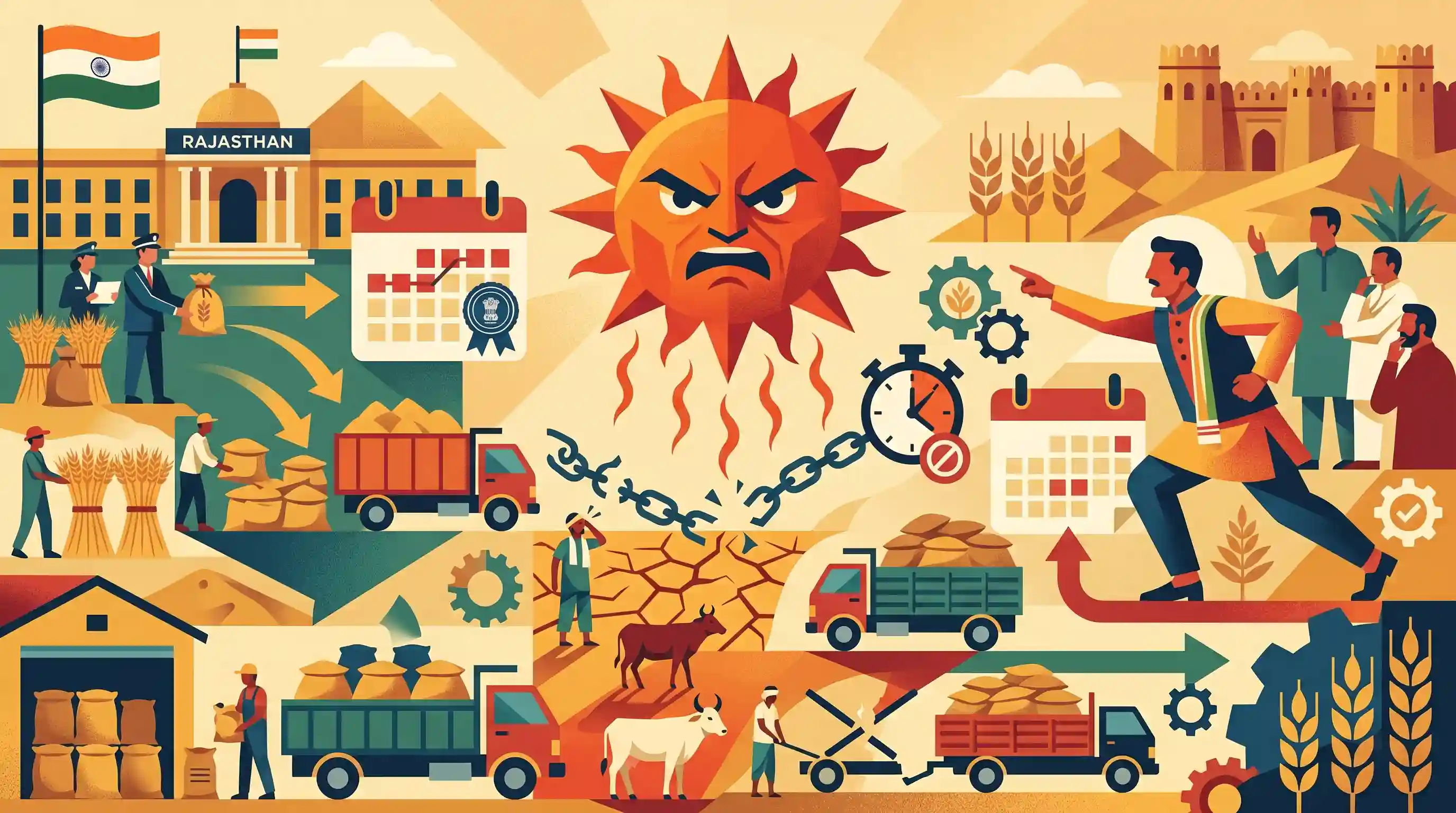
The article details the Rajasthan government's decision to extend wheat procurement under MSP till June 19, 2024, and the political push by former CM Ashok Gehlot to extend it further to June 30, 2024, owing to extreme heatwaves and logistical delays impacting Rabi farmers.
Key Points
- The Rajasthan government extended the deadline for purchasing wheat under the Minimum Support Price (MSP) system to June 19, 2024, to facilitate farmers during the Rabi marketing season.
- Former Chief Minister Ashok Gehlot appealed to the state government to further extend the wheat procurement deadline to June 30, 2024, to prevent distress selling to private traders.
- The effective price for wheat procurement in Rajasthan for the 2024-25 season is ₹2,400 per quintal, which consists of the central MSP of ₹2,275 and an additional state bonus of ₹125 per quintal.
- The demand for extension was prompted by extreme heatwave conditions, slow registration processes on the official portal, delayed payments, and administrative hurdles such as a shortage of gunny bags (bardana).
Important Terms
Minimum Support Price (MSP)

A government-guaranteed floor price at which state agencies purchase notified crops from farmers, safeguarding them against post-harvest market crashes and distress sales.
UPSC context
GS Paper III (Agriculture). Tests understanding of direct subsidies, price-risk insurance, and farm income stabilization policies.
Rabi Marketing Season (RMS)
The official annual period during which government agencies procure winter-sown (Rabi) crops, primarily wheat, from farmers at the announced Minimum Support Price.
UPSC context
GS Paper III (Agricultural Marketing). Tests awareness of cropping calendars, state-led procurement schedules, and agricultural supply chains.
Food Corporation of India (FCI)
A statutory public sector body established under the Food Corporations Act, 1964, tasked with procuring, storing, and distributing foodgrains to maintain national food security.
UPSC context
GS Paper III (Food Security). Tests understanding of the Public Distribution System, buffer stock management, and grain logistics.
Rabi Crops
Crops sown in winter (October to December) and harvested in spring (March to April), such as wheat, barley, gram, and mustard, requiring cool growing seasons.
UPSC context
GS Paper III (Cropping Patterns). Tests knowledge of seasonal farming, irrigation requirements, and agricultural productivity in India.
Prelims Trap
The Food Corporation of India must procure all offered surplus grain from states irrespective of state-level bonuses.
Under the 2014 directive, FCI restricts central pool procurement to only local PDS/NFSA requirements if a state pays a bonus above the central MSP, ending unlimited central off-take.
Static Concepts Connected
What is the institutional mechanism for determining MSP in India?
- Recommendatory Body: The Commission for Agricultural Costs and Prices (CACP) analyzes production costs to recommend MSPs for 22 mandated crops and sugarcane's FRP.
- Approving Authority: The Cabinet Committee on Economic Affairs (CCEA), chaired by the Prime Minister, holds the final decision-making power to approve and announce MSPs.
How does the central directive on state bonuses affect FCI procurement?
- 2014 Central Directive: If a state announces a financial bonus above central MSP, FCI limits central pool procurement to only that state's local PDS requirement.
- Policy Objective: This restriction prevents market price distortions, discourages competitive state populism, and manages the central government's food subsidy bill.
Cross-Topic Patterns
Extreme heatwaves + Farm logistics
Rising summer temperatures compress harvesting schedules, delaying procurement operations and straining storage infrastructure during heatwaves.
Agricultural subsidies + Fiscal federalism
State-specific bonuses above central MSP create friction between central fiscal guidelines and state-level political incentives, affecting national crop pricing.

FCI's 2014 cap on central pool procurement for states offering bonuses is highly likely to feature in 2026 statement-based questions.
Linked PYQs · 1
Linked PYQs · 1
- 2021RPSC_PRELIMSGS1
“Nabi MG” is
