Rajasthan Executes First Exploration Licence for Rare Earth Elements
Source:rediff ↗
Why It Matters
Rare Earth Elements (REE) are indispensable for modern technology, green energy, and defense applications. Rajasthan's proactive step in executing the country's first exploration licence marks a significant move towards mineral self-reliance. For RPSC Prelims, newly identified mineral regions (like Navatala-Devigarh in Balotra) and the specific minerals found there are highly probable targets for direct geography and economy questions.
Summary
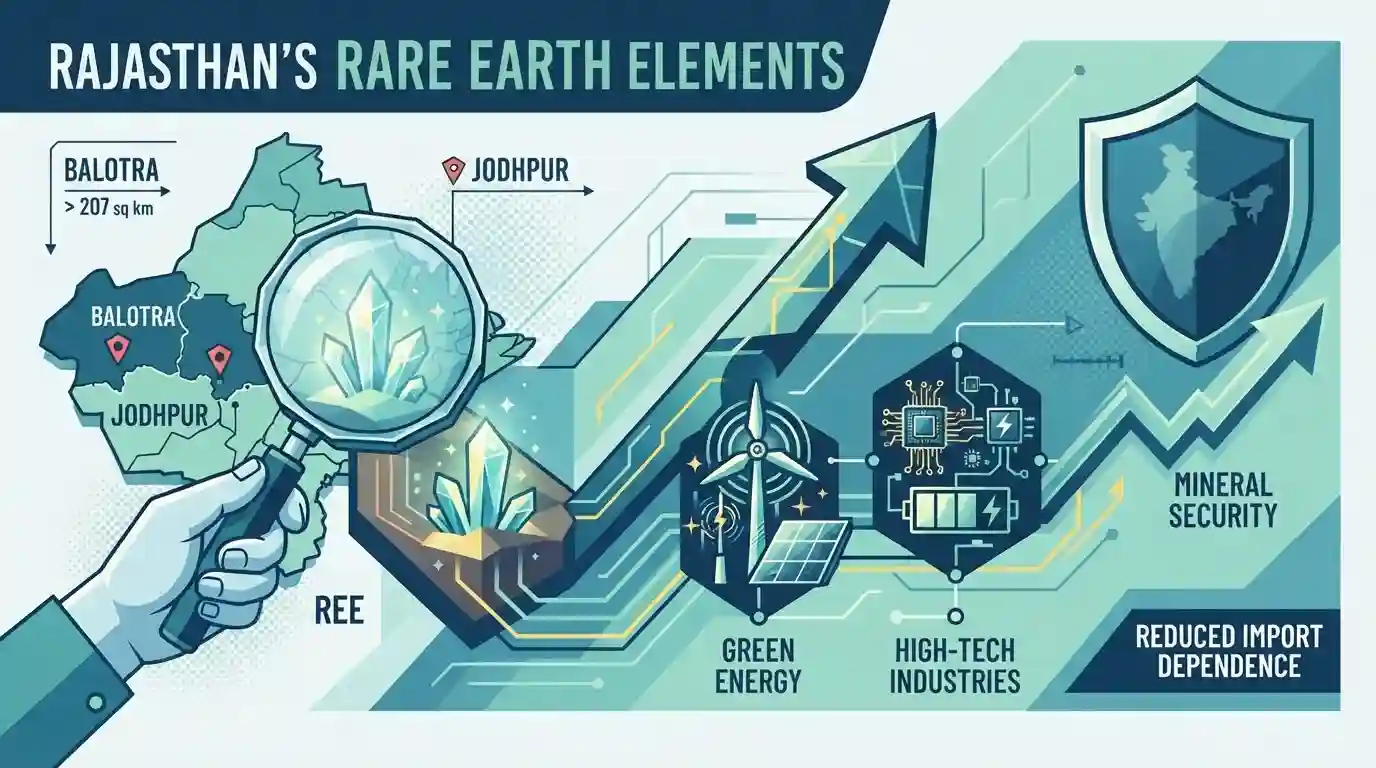
Rajasthan has emerged as the first state in India to execute an exploration licence for Rare Earth Elements (REE). The licence, granted to CMPDI, covers an area of over 207 sq km in the Balotra and Jodhpur districts. This initiative aims to explore critical minerals like lanthanum and neodymium, which are essential for high-tech and green energy industries, thereby bolstering India's mineral security and reducing import dependence.
Key Points
- Rajasthan has become the first state in India to issue an exploration licence for Rare Earth Elements (REE).
- The licence was granted to the Central Mine Planning and Design Institute Limited (CMPDI) for a 207.63 sq km area in the Balotra and Jodhpur districts.
- The specific locations for exploration include Navatala-Devigarh (Pachpadra) and Shergarh.
- Initial indicators suggest the presence of critical REEs such as lanthanum, cerium, praseodymium, and neodymium.
- These minerals are critical for advanced sectors like electric vehicles (EVs), renewable energy, defence, space, and electronics.
Important Terms
Rare Earth Elements (REEs)

A group of 17 chemically similar metallic elements—15 lanthanides plus scandium and yttrium. While relatively abundant in Earth's crust, they are rarely found in concentrated, easily exploitable deposits.
UPSC context
GS Papers 1 & 3. Tests knowledge of global resource distribution, mineral security, and green energy technology components.
Central Mine Planning and Design Institute Limited (CMPDI)
A Mini-Ratna (Category-I) public sector enterprise and a fully-owned subsidiary of Coal India Limited. It provides consultancy services for mineral exploration, mine planning, and environmental management.
UPSC context
GS Paper 3 (Economy). Relevant for understanding the role of PSUs in ensuring India's critical mineral supply chain security.
Exploration Licence (EL)
A mineral concession introduced by the MMDR Amendment Act, 2023. It authorizes reconnaissance and prospecting operations for specific critical and deep-seated minerals to encourage private and foreign investment.
UPSC context
GS Papers 2 & 3. Tests awareness of recent mining sector reforms and legislative policies boosting critical mineral self-reliance.
Department of Mines and Geology, Rajasthan
The state agency responsible for systematic geological exploration and mineral administration in Rajasthan. It recently executed India’s first auctioned exploration licence for rare earth elements.
UPSC context
GS Paper 2 & 3. Highlights state-level initiatives and competitive federalism in resource management and critical mineral auctions.
Neodymium
A highly sought-after rare earth element essential for manufacturing high-strength permanent magnets. It is crucial for modern technologies like wind turbine generators, electric vehicle motors, and consumer electronics.
UPSC context
GS Paper 3 (Science & Tech). Frequently tested in Prelims regarding specific applications of critical minerals in renewable energy.
Prelims Trap
All Rare Earth Elements are classified as atomic minerals and their exploration is strictly reserved for the Department of Atomic Energy.
The MMDR Amendment Act 2023 removed several critical minerals, including certain REEs, from the atomic minerals list to allow non-DAE exploration.
Static Concepts Connected
How does the 'Exploration Licence' (EL) regime work for critical minerals?
- MMDR Act 2023: Introduced a new licence specifically for deep-seated and critical minerals like REEs, gold, and lithium.
- Auction Route: Granted through competitive bidding to private or public entities to conduct reconnaissance and prospecting operations.
- Revenue Share: The exploring entity earns a percentage of the premium paid by the eventual mining leaseholder, incentivizing discovery.
What are Rare Earth Elements (REEs) and where are they traditionally found in India?
- Composition: A set of 17 elements (15 lanthanides plus scandium and yttrium) divided into Light (LREEs) and Heavy (HREEs).
- Monazite Sands: Historically, India's REE wealth is heavily concentrated in coastal beach placer sands containing Monazite.
- Light vs Heavy: Rajasthan’s inland exploration targets Light REEs (lanthanum, neodymium), which are generally more abundant globally than Heavy REEs.
Cross-Topic Patterns
EV Supply Chain + Critical Minerals
Neodymium and Praseodymium are indispensable for permanent magnets in electric vehicles and wind turbines, bridging mineral geography directly with India's Panchamrit climate goals.
Fossil PSUs + Green Energy Transition
A Coal India subsidiary (CMPDI) exploring REEs highlights how traditional fossil-fuel PSUs are actively diversifying their portfolios into critical minerals to adapt to the clean energy transition.

MMDR Act 2023 amendments, the new Exploration Licence regime, and specific REE applications will likely merge into one 2026 Prelims MCQ.
Linked PYQs · 2
Linked PYQs · 2
- 2023RPSC_PRELIMSGS1
Which mineral resources are produced in the areas of Kalakuta, Leelvani, Nardia, and Timma Mori in Rajasthan?
- 2025RPSC_PRELIMSGS1
Where are the most important resources of lignite located in Rajasthan?
