Unseasonal heavy downpours disrupt kharif crop sowing in Rajasthan
Source:india-today ↗
Why It Matters
Understanding the deviation of pre-monsoon precipitation, Western Disturbances, and the hydrological constraints of aquifer recharge is highly critical for RPSC RAS aspirants. This article directly connects to the physical geography of Rajasthan, district-level rainfall distribution, and traditional water harvesting systems (like Khadin) which are frequently asked in the RAS Prelims exam.
Summary
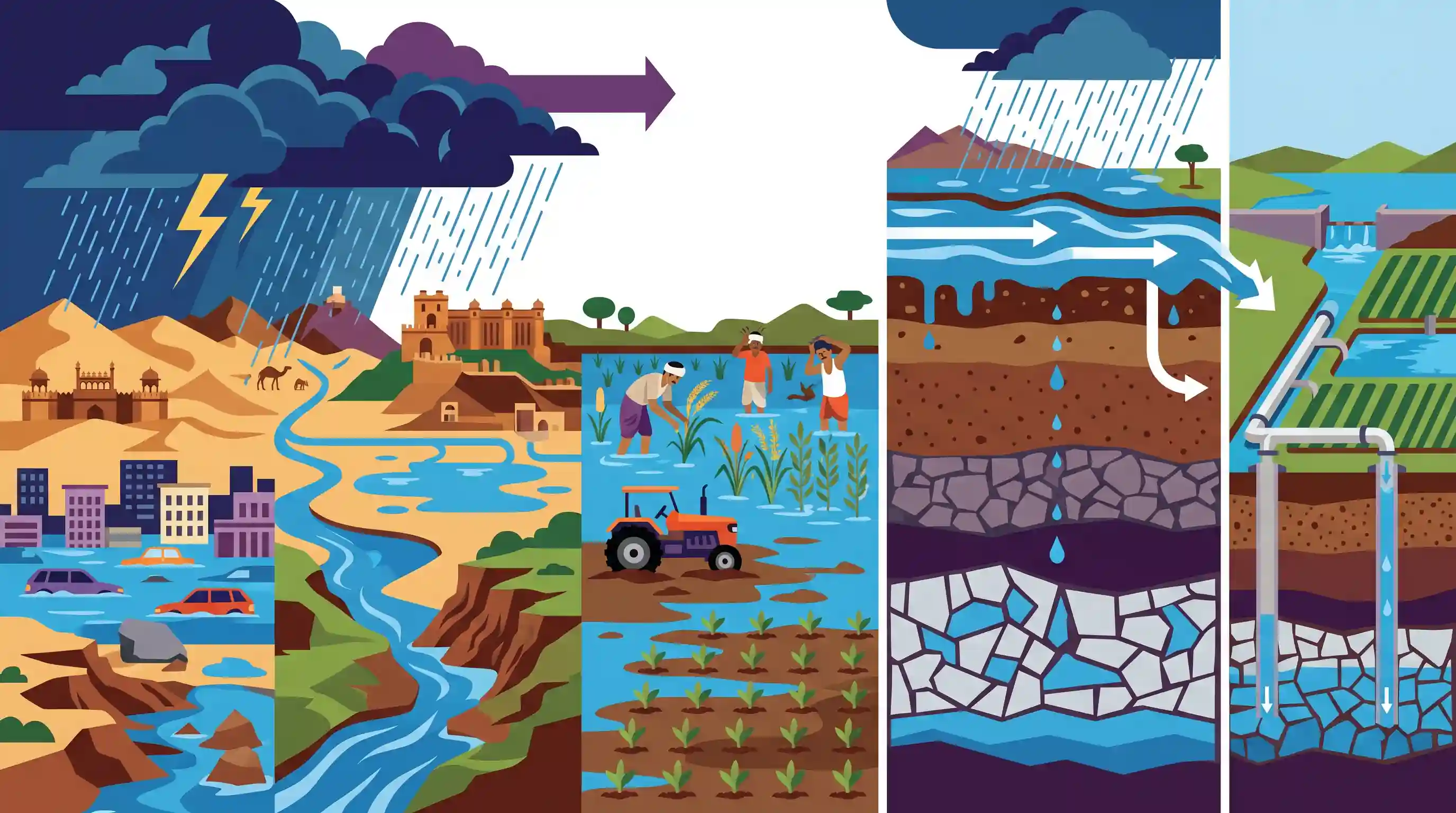
In early June 2026, Rajasthan recorded an unprecedented 187% excess rainfall, driven by Western Disturbances, pre-monsoon events, and climate change, rather than the regular southwest monsoon. While traditionally known for dry conditions, the state faced urban waterlogging, topsoil erosion, and disrupted Kharif sowing cycles. Crucially, the sudden intense downpours cause massive surface runoff, preventing the infiltration required to recharge depleted deep-aquifer groundwater. This shift highlights a major ecological challenge: Rajasthan must adapt its water resource management and agricultural planning to handle rapid extreme rainfall events alongside its traditional drought-mitigation practices.
Key Points
- Rajasthan recorded 187% excess rainfall than normal between June 1 and June 9, 2026, emerging as India's wettest region during this brief window.
- The excessive rainfall was not due to the regular South-West monsoon but resulted from a combination of active Western Disturbances (WDs), pre-monsoon convective activity, and climate change-induced erratic weather shifts.
- Intense, short-duration downpours cause massive surface runoff instead of gentle infiltration, which fails to recharge Rajasthan's highly depleted deep-groundwater aquifers and leads to a paradox of temporary flooding alongside long-term water scarcity.
- The unseasonal rains, accompanied by hailstorms in districts like Sri Ganganagar, disrupt the sowing schedules of key Kharif crops, wash away fertile topsoil, and damage infrastructure in urban centers like Jaipur.
- The changing climate paradigm requires Rajasthan to shift focus from solely coping with droughts to also managing short-interval extreme precipitation events.
Important Terms
Western Disturbances

Extratropical cyclonic storms originating in the Mediterranean region that bring winter and pre-monsoon precipitation to northwest India, crucial for Rabi crops like wheat.
UPSC context
GS Paper I (Climatology) and GS Paper III (Agriculture); tests understanding of non-monsoonal precipitation dynamics and winter crop cycles.
Southwest Monsoon
The primary wind-driven seasonal rainfall system in India, active from June to September, which provides over 70% of the country's annual precipitation.
UPSC context
GS Paper I (Indian Climate); tests monsoon mechanisms, onset/withdrawal patterns, and its vital socio-economic impact on agriculture.
Kharif Crops
Monsoon-season crops sown with the onset of the southwest monsoon (June–July) and harvested in autumn, including water-intensive crops like paddy, maize, and cotton.
UPSC context
GS Paper I (Geography) and GS Paper III (Agriculture); tests cropping patterns, climatic requirements, and national food security.
Groundwater Recharge
The hydrological process where surface water from rain or waterbodies percolates downward through soil and rock layers to replenish underground aquifers.
UPSC context
GS Paper III (Environment and Water Resources); tests sustainable development, aquifer mapping, and conservation schemes like Atal Bhujal Yojana.
Surface Runoff
The portion of precipitation that flows overland into surface water bodies instead of infiltrating the soil, often causing erosion and flooding during extreme downpours.
UPSC context
GS Paper I (Hydrology) and GS Paper III (Disaster Management); tests water-cycle mechanisms, urban flooding, and soil conservation techniques.
Deep Aquifers
Confined underground geological formations storing ancient water (fossil water) that recharge extremely slowly and are highly vulnerable to irreversible depletion.
UPSC context
GS Paper I (Geography) and GS Paper III (Water Security); tests resource equity, aquifer management, and sustainable extraction limits.
Prelims Trap
Western Disturbances impact Indian weather and precipitation exclusively during the winter months of December to February.
WDs can occur year-round. While winter WDs cause 'Mawat', unseasonal or active WDs in late spring/early summer (June) frequently trigger extreme convective pre-monsoon precipitation events.
Static Concepts Connected
What is the Khadin water conservation system of Rajasthan?
- Origin and design: Pioneered by 15th-century Paliwal Brahmins, utilizing long earthen embankments (dhoras) across hill slopes to trap runoff.
- Groundwater recharge: Increases localized aquifer recharge by 35–50% through standing water infiltration, preventing rapid surface runoff.
- Salinity control: Reduces soil salinity by 20–30%, allowing organic Rabi cultivation in hyper-arid tracts without external irrigation.
How do localized climatic phenomena define Rajasthan's water regime?
- The 25cm Isohyet: Serves as the crucial climatic boundary separating the hyper-arid western desert from the semi-arid eastern plains.
- Pre-monsoon Andhi: Intense solar heating bakes the Thar, generating localized convective low-pressure updrafts that lift loose sand as dust storms.
- Mawat precipitation: Gentle winter rains from Mediterranean-origin Western Disturbances driven by westerly jet streams, highly beneficial for Rabi crops.
Cross-Topic Patterns
Traditional harvesting vs. extreme runoff
Indigenous structures like Khadins, built for gentle infiltration, face physical breaches during modern climate-induced, high-intensity short-duration rainfall events.
Aquifer hydrology vs. agricultural choices
Severe deep-groundwater depletion (74% over-exploited blocks) cannot be solved by erratic extreme rain, exposing the ecological risk of shifting to water-intensive cash crops.

Western Disturbance anomalies and CGWB groundwater classification trends are highly likely to be paired in a 2026 climate-change question.
Linked PYQs · 4
Linked PYQs · 4
- 2025RPSC_PRELIMSGS1
What is the correct ascending order of the following group of districts of Rajasthan based on average rainfall in the southwest monsoon?
- 2023RPSC_PRELIMSGS1
Which of the following groups of districts is correctly arranged in descending order according to the amount of received monsoon rainfall?
- 2024RPSC_PRELIMSGS1
In which district of Rajasthan 'Khadin' is a popular method of water conservation?
- 2018RPSC_PRELIMSGS1
The dust storms occurring in Rajasthan during May-June months are responsible for: (a) Origin of convective currents at some places (b) Aravalli hills are parallel to the southwest winds. (c) Origin of very intense easterly winds
