Mission Madhuhari Integrates Digital Twin Technology for Diabetes Care
Source:et-government ↗
Why It Matters
This initiative is highly relevant for state-specific current affairs and Science & Technology sections in the RPSC RAS Prelims. It serves as a prime example of e-governance and the practical application of Artificial Intelligence (AI) and digital twins in proactive public healthcare management and combating non-communicable diseases.
Summary
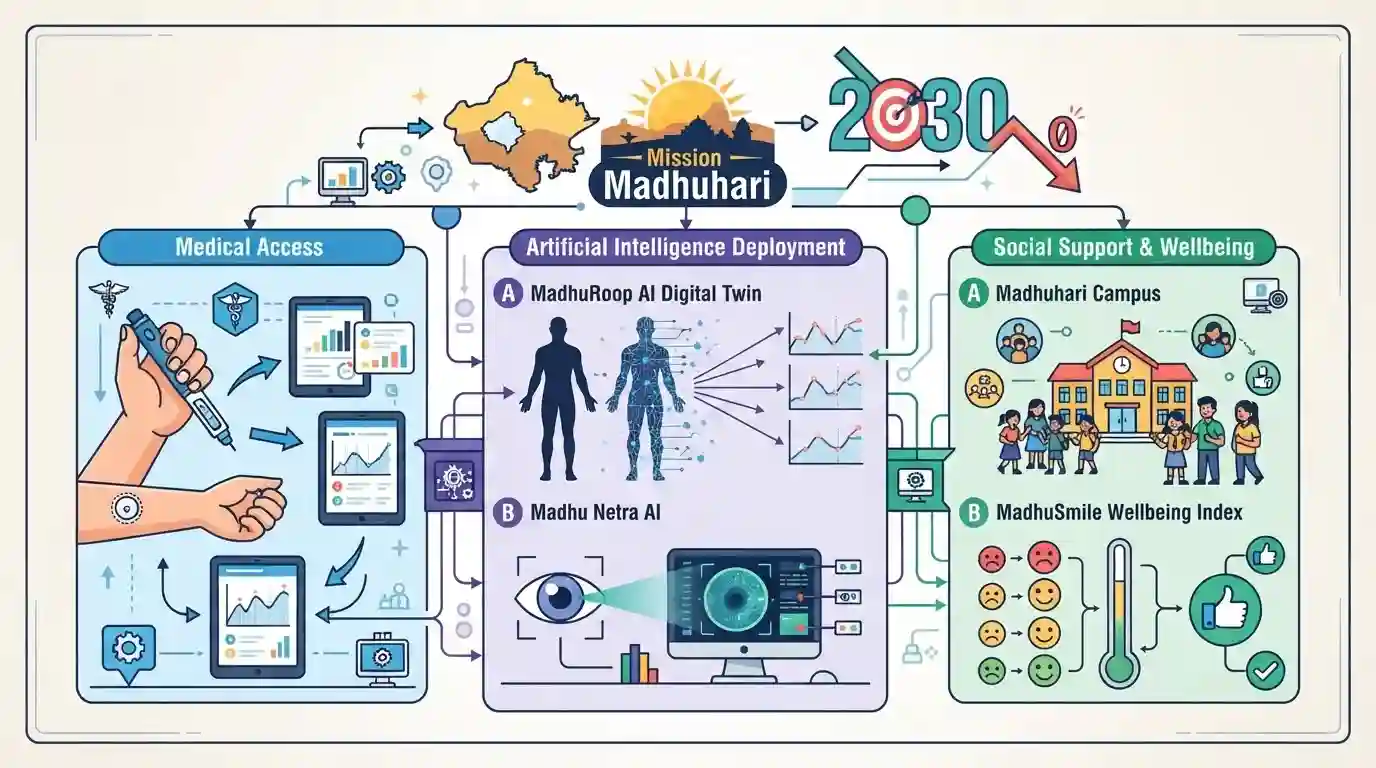
The Government of Rajasthan is implementing 'Mission Madhuhari' to combat Type 1 Diabetes in children and young people, aiming to significantly reduce mortality by 2030. The mission takes a multi-pronged approach combining free access to insulin and Continuous Glucose Monitoring (CGM) devices with advanced digital tracking. Leveraging state-of-the-art Artificial Intelligence, the state has deployed the 'MadhuRoop AI Digital Twin' for predicting blood sugar risks and 'Madhu Netra AI' for eye complication screening. Alongside medical care, it incorporates robust social support frameworks like the Madhuhari Campus in educational institutions and the MadhuSmile Wellbeing Index to evaluate patients' emotional health.
Key Points
- Mission Madhuhari is a comprehensive health initiative by the Rajasthan Government dedicated to diagnosing, monitoring, and managing Type 1 Diabetes in children and young people.
- The program integrates cutting-edge technology, including the 'MadhuRoop AI Digital Twin' to analyze glucose risk and 'Madhu Netra AI' for highly accurate diabetic retinopathy screening.
- Enrolled patients are provided with free insulin, glucometers, test strips, and Continuous Glucose Monitoring (CGM) devices to enable real-time tracking.
- Ecosystem initiatives include 'Madhuhari Bank' for insulin supply, 'Madhuhari Campus' for school-level support, and a 'MadhuSmile Wellbeing Index' to measure socio-emotional health.
- The state has established independent clinic evaluations (categorized into Platinum, Gold, and Silver) to ensure accountability and standard treatment protocols.
Important Terms
Mission Madhuhari

Rajasthan's public health initiative for Type-1 diabetes in children and youth, aiming for zero mortality by 2030 through free insulin, digital tracking, and specialized clinics.
UPSC context
GS Paper 2 (Health/State Welfare). Tests knowledge of regional health initiatives and non-communicable disease management.
MadhuRoop AI Digital Twin
An advanced AI system deployed by Rajasthan to analyze patient health data and predict future risks of hypoglycemia and hyperglycemia in Type-1 diabetic patients.
UPSC context
GS Paper 3 (Science & Tech). Highlights the application of Artificial Intelligence and digital twin technology in public healthcare.
Madhu Netra AI
An artificial intelligence-driven screening system implemented by Rajasthan to detect diabetic retinopathy and other serious eye complications with over 90% accuracy.
UPSC context
GS Paper 3 (Science & Tech). Relevant for emerging AI use-cases in disease diagnosis and preventive healthcare.
Type 1 Diabetes
A chronic autoimmune condition where the pancreas produces little to no insulin. Unlike Type 2 diabetes, it is not primarily linked to lifestyle factors or insulin resistance.
UPSC context
GS Paper 3 (Science). Crucial for basic science questions distinguishing between autoimmune conditions and lifestyle-induced diseases.
Continuous Glucose Monitoring (CGM)
A wearable medical technology that automatically tracks blood glucose levels day and night, forming a core component of digital diabetes management under Mission Madhuhari.
UPSC context
GS Paper 3 (Science & Tech). Tests understanding of modern medical devices and technological interventions in disease management.
William J. Clinton Foundation
A global health organization and key partner in Rajasthan's Mission Madhuhari, providing analytical and program implementation support to improve access to Type-1 diabetes care.
UPSC context
GS Paper 2 (Role of NGOs/Civil Society). Demonstrates international collaboration in strengthening India's public health systems.
Prelims Trap
Mission Madhuhari is a Central scheme targeting lifestyle-induced Type-2 diabetes among the elderly.
It is a Rajasthan state initiative specifically targeting Type-1 Diabetes (autoimmune) in children and youth, not lifestyle-induced Type-2 diabetes.
Static Concepts Connected
What are the fundamental differences between Type 1 and Type 2 Diabetes?
- Type 1 Diabetes: An autoimmune condition where the pancreas produces little or no insulin; typically diagnosed in children and requires lifelong insulin therapy.
- Type 2 Diabetes: A chronic condition marked by insulin resistance. It is heavily linked to lifestyle factors and predominantly affects adults, though youth incidence is rising.
What is 'Digital Twin' technology and how is it used in healthcare?
- The Concept: A dynamic virtual model of a physical object, system, or patient, which is continuously updated with real-time data to mirror its real-world counterpart.
- Medical Application: It uses continuous patient data (like CGM glucose readings) to simulate metabolic responses, predicting adverse health events before they occur and enabling personalized medicine.
Cross-Topic Patterns
State pilots shaping National Health Policy
Rajasthan’s school-level screening being adopted into central guidelines mirrors cooperative federalism, similar to how the Mid-Day Meal scheme began in Tamil Nadu before national rollout.
Digital Twins entering Public Health
Usually confined to manufacturing or Smart Cities infrastructure, Digital Twin technology is now crossing into predictive public health modeling, showcasing AI's expanding governance footprint.

A 2026 prelims statement will likely test 'Digital Twins' as a predictive tool in public health rather than just urban infrastructure.
Linked PYQs · 3
Linked PYQs · 3
- 2016RPSC_PRELIMSGS1
The Chief Minister Free Medicine Scheme was implemented in Rajasthan on
- 2025RPSC_PRELIMSGS1
Identify the correct statements with respect to Artificial Intelligence (AI) with the help of the codes given below: A. Machine learning is a subset of AI. B. In supervised learning, computer systems are trained without marked input data. C. Machines learn through trial and error, and are rewarded during reinforcement learning. Code:
- 2025RPSC_PRELIMSGS1
Identify the layer among the following that is used for wireless connection in IoT devices:
