Dharti Aaba Janjatiya Gram Utkarsh Abhiyan Implementation In Rajasthan
Source:rasonly ↗
Why It Matters
Crucial for RPSC RAS aspirants tracking Rajasthan's national rankings, tribal welfare programs, and central-state flagship implementation achievements.
Summary
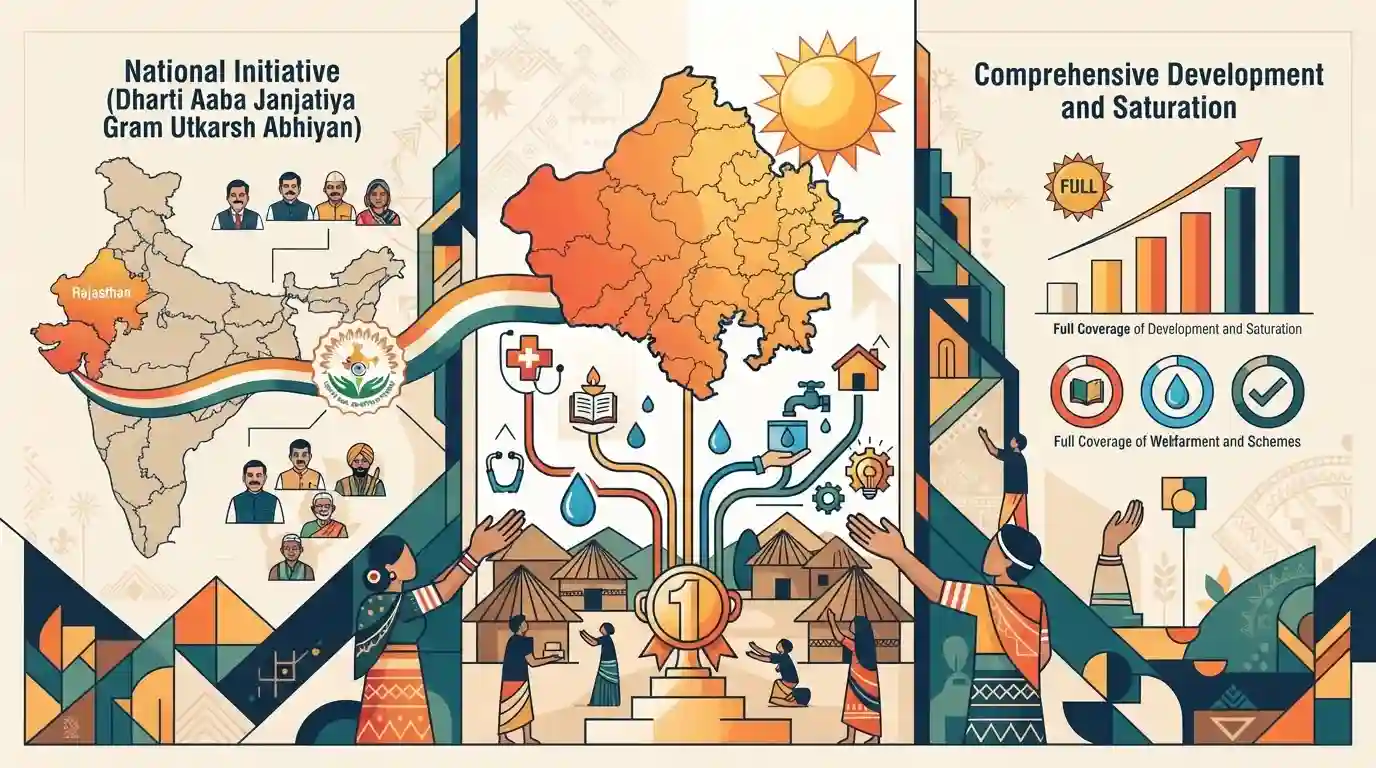
Rajasthan has secured the top rank among states in implementing the Dharti Aaba Janjatiya Gram Utkarsh Abhiyan, a major national initiative aimed at ensuring comprehensive development and saturation of welfare schemes in tribal-majority villages.
Key Points
- Rajasthan has emerged as the leading state in the implementation and execution of the Dharti Aaba Janjatiya Gram Utkarsh Abhiyan.
- The campaign focuses on the holistic development and welfare of tribal-majority villages and communities across the state.
- It targets critical infrastructure gaps, livelihood generation, education, and healthcare in tribal areas.
Important Terms
Dharti Aaba Janjatiya Gram Utkarsh Abhiyan

A flagship national initiative launched to ensure comprehensive development and saturation of welfare schemes in tribal-majority villages across India, named in honor of tribal icon Birsa Munda.
UPSC context
Important for RPSC and UPSC: tests knowledge of government welfare schemes, tribal development policies, and administrative implementation rankings in Rajasthan.
Ministry of Tribal Affairs
The nodal central ministry responsible for formulating policies, planning, and coordinating programs for the socio-economic development of Scheduled Tribes in India.
UPSC context
Relevant for RPSC Polity and Administration: evaluates institutional frameworks managing tribal welfare, central-state coordination, and scheme implementation.
Government of Rajasthan
The sub-national executive and administrative governing body of Rajasthan responsible for executing central and state welfare initiatives within the region.
UPSC context
Crucial for RPSC exams: assesses state-level policy execution, administrative performance, and governance rankings in national developmental schemes.
Static Concepts Connected
What are the key constitutional provisions and administrative mechanisms for tribal development in Rajasthan?
- Article 275(1): Article 275(1) provides Grants-in-Aid from the Consolidated Fund of India for promoting the welfare of Scheduled Tribes and raising the administration level of Scheduled Areas.
- Fifth Schedule: The Fifth Schedule of the Constitution applies to tribal areas in Rajasthan, establishing Tribes Advisory Councils (TAC) to advise on welfare and advancement.
- MADA & Boards: Modified Area Development Approach (MADA) clusters and DTDP (Dang, Mewad, and Magra area development boards) target underdeveloped pockets in Rajasthan.
Cross-Topic Patterns
Tribal Welfare Schemes + State Budgetary Allocations
Central tribal welfare schemes like DAJGUA intersect with Rajasthan's TSP (Tribal Sub-Plan) and MADA areas for localized fund allocation and administrative monitoring.

DAJGUA launch details, implementing ministries, and Rajasthan's rank will feature as a direct multi-statement RPSC prelims question.
Linked PYQs · 2
Linked PYQs · 2
- 2021RPSC_PRELIMSGS1
In Rajasthan, the Scheduled Tribe population has the second highest percentage (2011)
- 2024RPSC_PRELIMSGS1
Who among the following are eligible for Amrita Scheme in Rajasthan? (i) Persons with specially abled 40% or more disability. (ii) Specially abled category with more than 40% percent disability. (iii) B.P.L. family persons. (iv) Families where 2 or more people are specially abled. (v) Families with a specially abled transgender.
