Ratlam Banswara Dungarpur Rail Project Advances With Land Acquisition
Source:ommcomnews ↗
Why It Matters
The development of the Ratlam-Banswara-Dungarpur rail link is crucial for connecting historically underserved, tribal-dominated regions of southern Rajasthan (Vagad area) with the broader national network. It is important for Prelims for questions on regional infrastructure projects, state-centre cost-sharing models, and geographical connectivity.
Summary
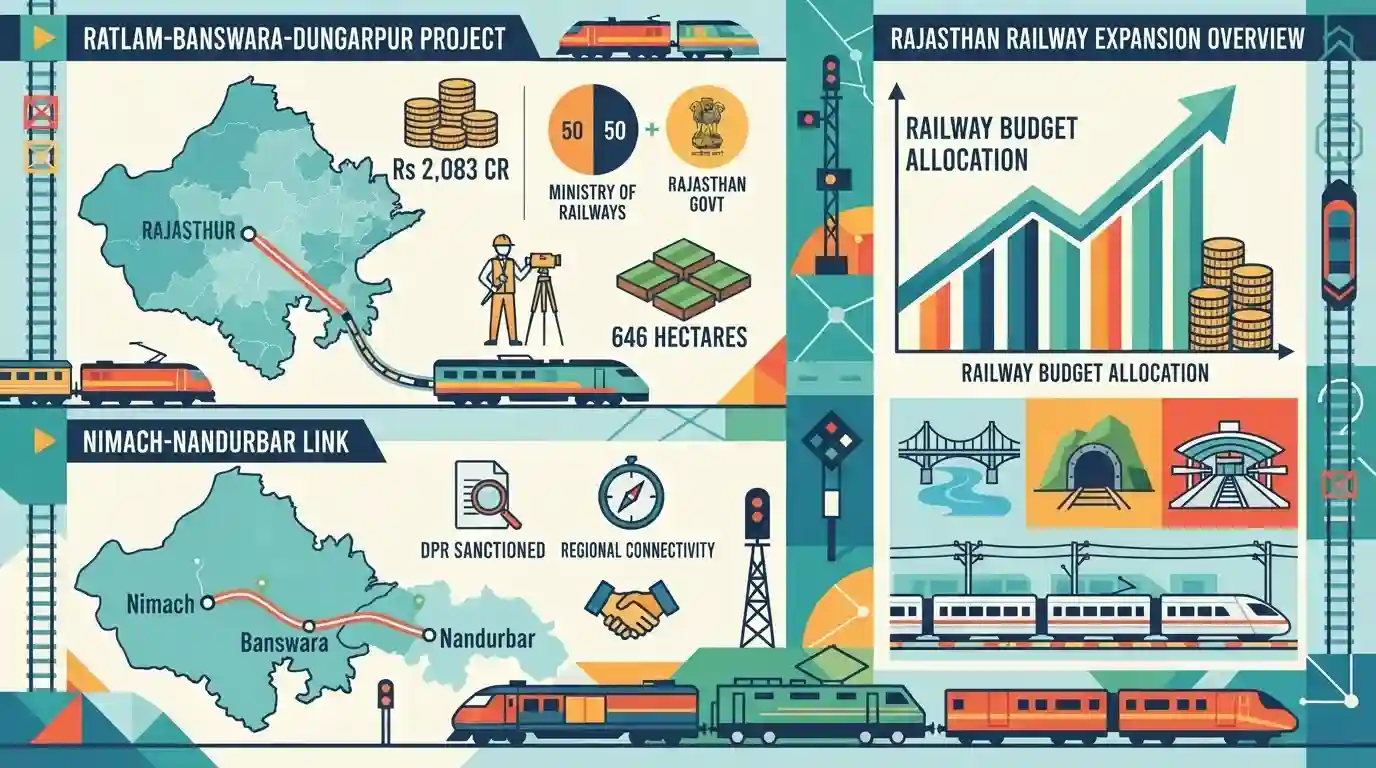
The Ratlam-Banswara-Dungarpur railway project in Rajasthan is gaining momentum with the acquisition of 646 hectares of land. The 189-km track, estimated at Rs 2,083 crore, is being developed under a 50:50 cost-sharing mechanism between the Ministry of Railways and the Rajasthan Government, which is supplying the land free of cost. Moreover, a DPR has been sanctioned for a 380-km rail link from Nimach to Nandurbar to boost connectivity in the Banswara region. Backed by a historic railway budget allocation of Rs 10,228 crore for Rajasthan, these projects alongside several other ongoing and completed tracks signal a rapid expansion of the state's transport infrastructure.
Key Points
- The 189-km Ratlam-Banswara-Dungarpur railway line project is advancing, with 646 out of the required 1,736 hectares of land already acquired.
- The Rs 2,083 crore project operates on a 50:50 cost-sharing agreement between the Ministry of Railways and the Rajasthan Government, with the state also providing land free of charge.
- To further enhance connectivity in the tribal-dominated Banswara region, a Detailed Project Report (DPR) has been approved for a 380-km Nimach-Banswara-Dahod-Alirajpur-Nandurbar railway line.
- Reflecting a major infrastructure push, Rajasthan's railway budget allocation increased 15-fold from a 2009-14 average of Rs 682 crore to a record Rs 10,228 crore.
- Several other regional railway projects have been completed or are in progress, including the Bina-Kota doubling, Dausa-Gangapur City, and Pushkar-Merta routes.
Important Terms
Ratlam-Banswara-Dungarpur new railway line project

A 189-km railway project in Rajasthan with an estimated cost of ₹2,083 crore. It is being executed through a 50:50 cost-sharing agreement between the Railways Ministry and the Rajasthan Government, which provides land free of cost.
UPSC context
GS Paper 3 (Infrastructure). Relevant for topics on regional connectivity and examples of cooperative federalism in project financing.
Nimach-Banswara-Dahod-Alirajpur-Nandurbar new railway line
A proposed 380-km railway link aiming to connect regions across Madhya Pradesh, Rajasthan, Gujarat, and Maharashtra. A Detailed Project Report (DPR) is currently sanctioned to evaluate this multi-state tribal corridor project.
UPSC context
GS Paper 3 (Infrastructure). Highlights infrastructure expansion in backward or tribal regions, critical for inclusive growth and regional development.
50:50 Cost-Sharing Mechanism
A collaborative financing model where the Union and State governments share the capital cost of an infrastructure project equally. In railway projects, states typically also provide the required land free of cost.
UPSC context
GS Paper 2 (Federalism) & GS Paper 3 (Investment Models). Tests understanding of Centre-State financial relations and cooperative infrastructure development.
Prelims Trap
Since Railways is a Union Subject, state governments cannot financially contribute to railway construction projects.
While Railways is a Union Subject (Entry 22), states frequently enter 50:50 cost-sharing agreements and provide free land to expedite projects.
Static Concepts Connected
How do State Governments participate in Railway development?
- Joint Ventures: Ministry of Railways and State Governments form JV companies to develop localized rail infrastructure.
- Cost & Land Sharing: States often share up to 50% of the project cost and provide land free of cost to make unviable projects bankable.
- Cooperative Federalism: Though Railways is in the Union List, cost-sharing acts as a mechanism of cooperative federalism to align transport with state priorities.
What is the constitutional status of the Banswara and Dungarpur regions?
- Fifth Schedule: These districts are designated Scheduled Areas under the Fifth Schedule of the Constitution, possessing a high concentration of tribal populations (e.g., Bhil).
- Governor's Powers: The Governor has special administrative responsibilities and can modify the application of parliamentary or state laws in these areas.
- Tribal Sub-Plan (TSP): Large infrastructure projects in these regions often dovetail with the TSP approach to ensure direct benefits to tribal communities.
Cross-Topic Patterns
Infrastructure & Tribal Integration
Rail connectivity in the Bhil-dominated Vagad region connects physical infrastructure development (GS3) directly with the socioeconomic empowerment and integration of vulnerable tribal populations (GS2).
Bypassing Land Acquisition Delays
States providing land free of cost for central projects serves as a cooperative federalism workaround to mitigate the capital costs and delays often associated with land acquisition laws.

Expect a GS3 question on how Centre-State cost-sharing models are overcoming funding and land acquisition bottlenecks in rail infra.
Linked PYQs · 4
Linked PYQs · 4
- 2021RPSC_PRELIMSGS1
In Rajasthan, the Scheduled Tribe population has the second highest percentage (2011)
- 2021RPSC_PRELIMSGS1
What is the share of the Rajasthan government in the financing of the National Agricultural Extension and Technical Mission?
- 2021RPSC_PRELIMSGS1
The 'Parwan' multipurpose irrigation project of Rajasthan will provide irrigation facilities to which districts?
- 2021RPSC_PRELIMSGS1
According to the 2011 census, in which districts of Rajasthan is the rural-urban sex ratio highest? Rural Sex Ratio – Urban Sex Ratio (A) Rajsamand – Banswara (B) Dungarpur – Tonk (C) Pali – Churu (D) Jalore – Nagaur
