Chandipura Virus Outbreak and Rural Vector-Borne Diseases
Source:Indian Express ↗
ఇది ఎందుకు ముఖ్యం
The high case-fatality rate of Chandipura virus in children, coupled with the absolute lack of specific drugs or vaccines, makes it a critical public health concern. Its prevalence in rural and tribal pockets underscores the deep links between housing materials (kutcha houses), monsoonal vector ecology, and rural health vulnerability, making it an important topic for health policy, disaster response, and epidemiological study in UPSC.
సారాంశం
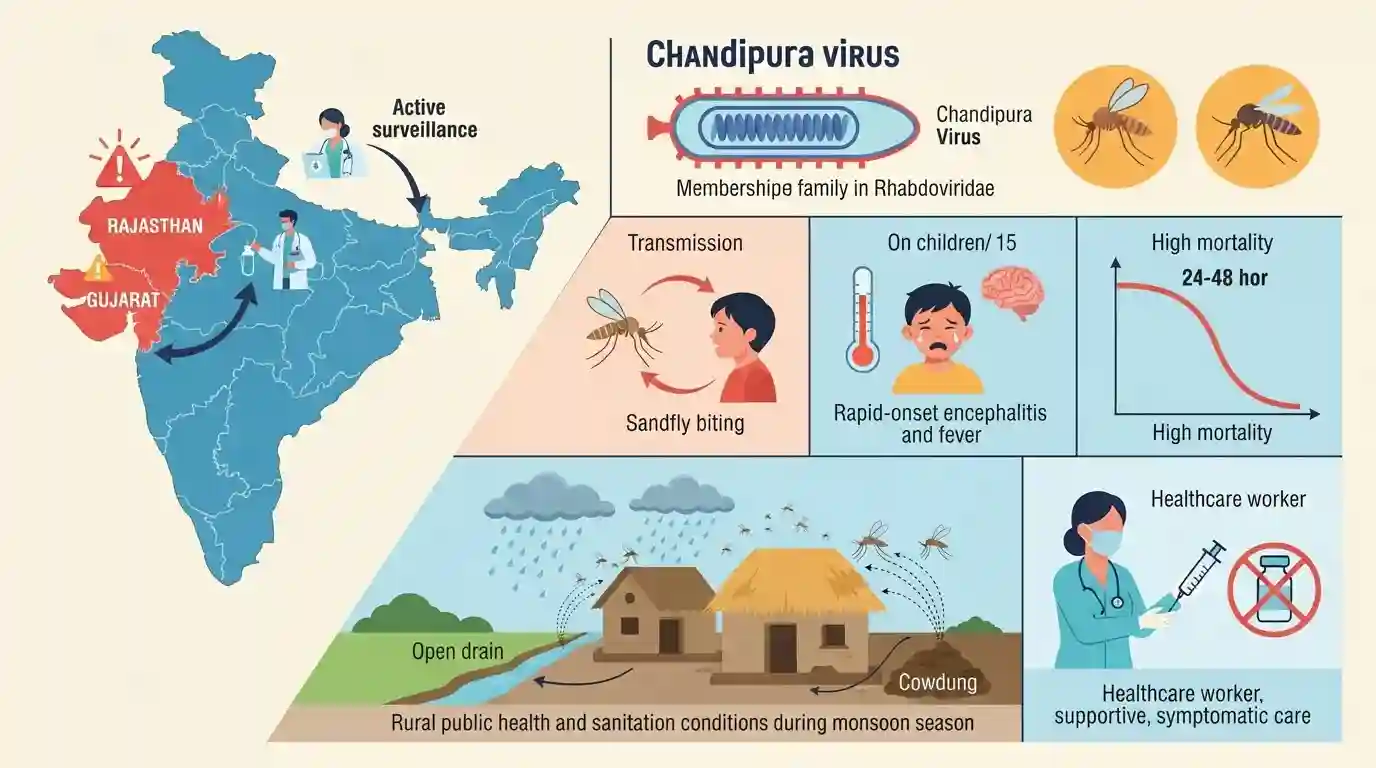
The Chandipura virus (CHPV) has caused recent fatalities in Rajasthan and Gujarat, triggering health alerts and active surveillance. CHPV is a highly fatal, vector-borne pathogen belonging to the Rhabdoviridae family that is transmitted by sandflies and mosquitoes. It primarily affects children under the age of 15, causing rapid-onset encephalitis and high mortality within 24-48 hours. Lacking specific vaccines or antiviral therapies, management relies entirely on symptomatic care. Outbreaks are strongly linked to monsoon seasonality and rural socio-environmental conditions, particularly kutcha houses where cowdung usage attracts vector sandflies.
ముఖ్య అంశాలు
- The Chandipura virus (CHPV) is a member of the Rhabdoviridae family (the same family that contains the rabies virus) and is endemic to Central India.
- Transmission occurs through the bites of Phlebotomine sandflies (such as Phlebotomus papatasi) and certain mosquito species (like Aedes aegypti). The virus resides in the salivary glands of these vectors.
- The disease leads to encephalitis (inflammation of brain tissues). Symptoms start with sudden high fever, headache, and body aches, but rapidly progress to altered sensorium, seizures, and potential organ failure.
- CHPV primarily targets children under 15 years of age. The progression is extremely rapid, and death can occur within 24 to 48 hours of hospitalization. Case fatality rates have historically reached up to 78% in outbreaks.
- There is no specific antiviral treatment or vaccine available for CHPV. Treatment is entirely symptomatic, focusing on controlling brain inflammation and maintaining organ function.
- Outbreaks are highly seasonal (correlated with monsoon when vector populations peak) and predominantly affect rural, tribal, and peripheral regions. Kutcha houses using cowdung paint or cakes are highly vulnerable as they attract sandflies.
ముఖ్యమైన పదాలు
Chandipura Virus (CHPV)

A highly fatal RNA pathogen of the Rhabdoviridae family first isolated in Maharashtra (1965). Transmitted by sandflies, it causes rapid-onset, severe brain inflammation (encephalitis) primarily in children under 15 years old.
UPSC context
GS Paper III (S&T/Health); tests understanding of emerging zoonotic pathogens, viral disease epidemiology, and public health management in India.
Acute Encephalitis Syndrome (AES)
A broad clinical category representing rapid-onset brain inflammation, characterized by high fever, seizures, and altered mental status. It is caused by various viral, bacterial, or protozoan pathogens, heavily impacting pediatric populations.
UPSC context
GS Paper II (Social Justice/Health) and Paper III (S&T); tests public health surveillance, health infrastructure, and epidemic control frameworks.
Rhabdoviridae Family
A family of bullet-shaped, single-stranded RNA viruses infecting vertebrates, invertebrates, and plants. It includes medically significant pathogens such as the rabies virus and the Chandipura vesiculovirus.
UPSC context
GS Paper III (Science & Technology/Health); tests fundamental virology, biological taxonomy, and viral disease profiles of public health relevance.
Phlebotomine Sandflies
Tiny, blood-sucking insect vectors of the genus Phlebotomus. They breed in rural, organic environments (like mud cracks and cow dung) and transmit major diseases including Leishmaniasis (Kala-azar) and Chandipura virus.
UPSC context
GS Paper III (Science & Technology/Health); tests biological vectors, transmission mechanisms, and rural sanitation's impact on public epidemiology.
Vector-Borne Diseases
Human illnesses caused by parasites, viruses, and bacteria transmitted by vectors like mosquitoes, ticks, sandflies, and fleas. They constitute a major global public health challenge, particularly in tropical climates.
UPSC context
GS Paper II (Public Health) and Paper III (S&T); tests healthcare policy, epidemiology, preventive healthcare, and state disease control schemes.
Rajasthan Department of Medical, Health and Family Welfare
The state government administrative department in Rajasthan responsible for executing public healthcare policies, managing medical infrastructure, implementing health schemes, and conducting active epidemic surveillance.
UPSC context
GS Paper II (Governance/Health); tests healthcare delivery, state public health machinery, and inter-state epidemiological surveillance coordination.
ప్రిలిమ్స్ ఉచ్చు
Chandipura virus spreads primarily through the bite of infected mammals, like rabies.
Although CHPV belongs to the Rhabdoviridae family (like the Rabies virus), it is not transmitted via animal bites. It is predominantly a vector-borne disease transmitted by sandflies.
అనుసంధానమైన స్థిర భావనలు
What are the primary pathogens causing Acute Encephalitis Syndrome (AES) in India?
- Viral Pathogens: Japanese Encephalitis Virus (JEV), Chandipura Virus (CHPV), Nipah, and Enteroviruses are the leading viral causes.
- Bacterial Agents: Scrub typhus (Orientia tsutsugamushi) and Streptococcus pneumoniae frequently contribute to the AES burden.
- Distinct Vectors: While JEV is transmitted by Culex mosquitoes, CHPV is transmitted by Phlebotomine sandflies.
Which major diseases in India are transmitted by the Phlebotomine sandfly?
- Kala-Azar: Also known as Visceral Leishmaniasis, caused by a protozoan parasite, historically endemic in Bihar, UP, Jharkhand, and West Bengal.
- Chandipura Virus: An emerging, highly fatal viral RNA pathogen causing acute encephalitis, primarily in Central and Western India.
- Sandfly Fever: Also known as Pappataci fever, a milder viral, non-lethal, influenza-like disease.
అంతర-అంశ నమూనాలు
Rural housing and vector-borne diseases
The link between kutcha houses, cowdung usage, and sandfly breeding highlights how schemes like PM Awas Yojana (Gramin) act as indirect public health interventions by eliminating vector habitats.
Climate change and disease transmission vectors
Altered monsoon patterns and rising temperatures are expanding the geographical reach and breeding windows of vectors like sandflies, shifting the endemism of neglected tropical diseases.

Expect a match-the-following prelims question linking vectors to diseases: Sandfly to Kala Azar/CHPV, Culex to JEV, Aedes to Zika.
అనుసంధాన PYQలు · 2
అనుసంధాన PYQలు · 2
- 2023PrelimsGS1
'Wolbachia method' is sometimes talked about with reference to which one of the following?
- 2024MainsGS2
In a crucial domain like the public healthcare system the Indian State should play a vital role to contain the adverse impact of marketisation of the system. Suggest some measures through which the State can enhance the reach of public healthcare at the grassroots level.
