Rajasthan crosses 5000 MW milestone under PM-KUSUM solar scheme
Source:energetica-india ↗
Why It Matters
Rajasthan's dominant performance in the PM-KUSUM scheme is highly relevant for the RPSC Prelims, as it intersects state economy, renewable energy infrastructure, and agricultural empowerment. Questions frequently target the nodal agencies (like RRECL) and the socio-economic impacts of state-level achievements in national schemes.
Summary
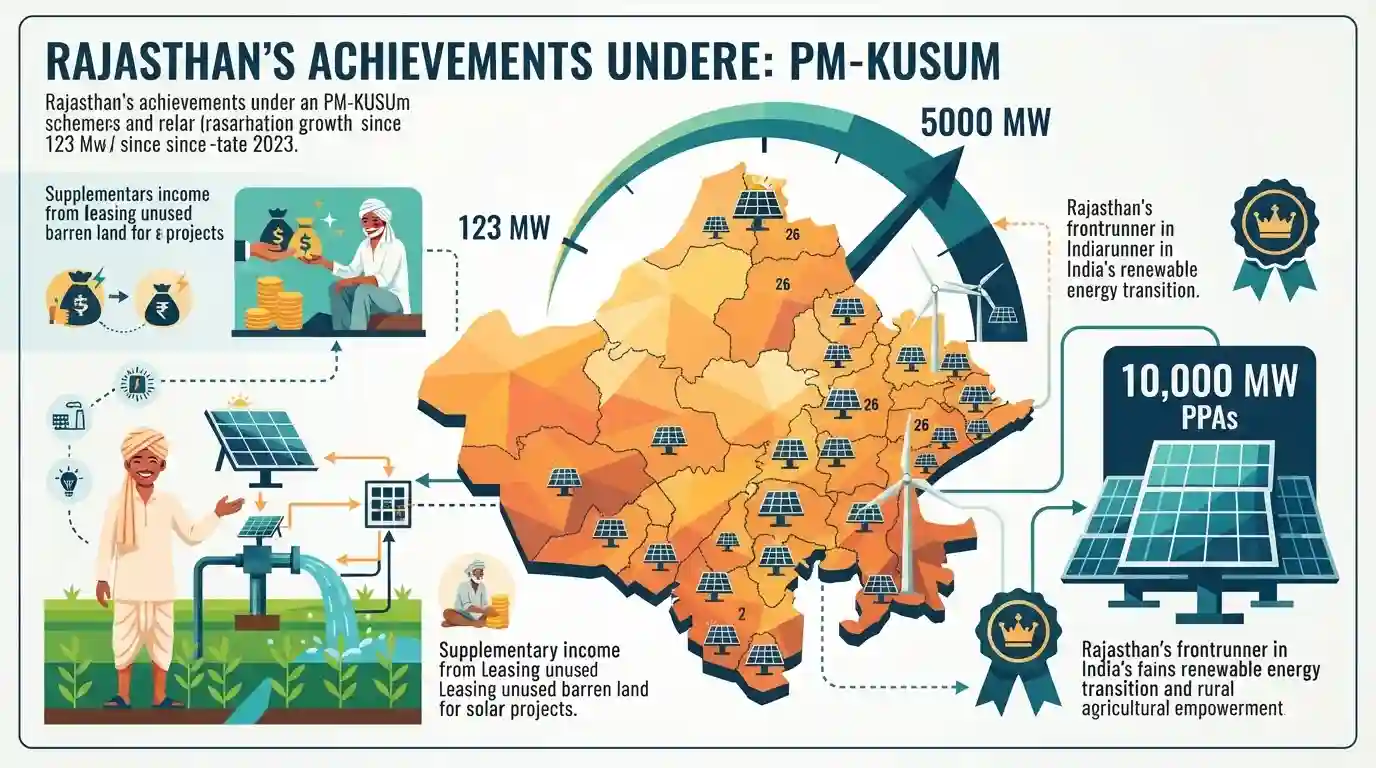
Rajasthan has achieved a significant milestone by crossing 5,000 MW (5 GW) of commissioned capacity under the Pradhan Mantri Kisan Urja Suraksha evam Utthaan Mahabhiyan (PM-KUSUM) scheme. Experiencing rapid growth from a mere 123 MW at the end of 2023, the state has now deployed over 2,300 decentralized solar projects across 26 districts. This expansion benefits more than 3.34 lakh farmers by providing them with reliable daytime power for agriculture and significantly reducing their electricity costs. Additionally, the scheme serves as a supplementary income source for farmers who lease their unused or barren land for these solar installations. With Power Purchase Agreements (PPAs) tied up for another 10,000 MW, Rajasthan cements its position as a frontrunner in India's renewable energy transition and rural agricultural empowerment.
Key Points
- Rajasthan has crossed the 5,000 MW (5 GW) milestone in commissioned solar capacity under the PM-KUSUM scheme.
- The capacity expansion saw an exponential increase from just 123 MW at the end of 2023 to 5,000 MW, executed through over 2,300 decentralized solar projects.
- The initiative has directly benefited over 3.34 lakh farmers across 26 districts in the state by providing reliable daytime electricity for agricultural purposes.
- Beyond immediate power needs, the scheme enables farmers to earn supplementary income by leasing barren or uncultivable land for decentralized solar installations.
- Power Purchase Agreements (PPAs) for over 10,000 MW have already been tied up, ensuring a robust pipeline for future solar capacity addition in the agricultural sector.
Important Terms
PM-KUSUM (Pradhan Mantri Kisan Urja Suraksha evam Utthaan Mahabhiyan)

A central scheme promoting solar energy in agriculture by funding standalone solar pumps, solarizing grid-connected pumps, and enabling farmers to set up small solar plants on barren land for extra income.
UPSC context
GS Paper 2 & 3 (Schemes, Economy). Tests knowledge of rural development, agricultural policies, and India's renewable energy transition.
Government of Rajasthan
The state-level executive authority implementing central policies like PM-KUSUM locally. By fostering a supportive regulatory environment and securing power purchase agreements, it has made Rajasthan a national leader in solar energy.
UPSC context
RAS Pre & Mains (Rajasthan Polity & Economy). Tests awareness of state governance, achievements in renewable energy, and regional welfare initiatives.
Ministry of New and Renewable Energy (MNRE)
The nodal central government ministry responsible for the research, development, and deployment of clean energy technologies across India, including the funding and administration of the PM-KUSUM scheme.
UPSC context
GS Paper 2 (Governance). Tests understanding of the institutional framework driving India's green energy initiatives and climate commitments.
Decentralized Solar Projects
Small-scale solar power facilities located near consumption points, such as farms. They reduce transmission losses, ease grid burdens, and ensure reliable localized daytime electricity for agricultural irrigation.
UPSC context
GS Paper 3 (Science & Tech, Environment). Tests understanding of sustainable infrastructure, energy efficiency, and modern agricultural solutions.
Power Purchase Agreement (PPA)
A long-term legal contract between a renewable electricity generator (like a farmer) and a buyer (usually a DISCOM) detailing the commercial terms, conditions, and fixed tariffs for selling surplus power.
UPSC context
GS Paper 3 (Economy & Infrastructure). Evaluates knowledge of commercial mechanisms in the energy sector and grid integration.
Prelims Trap
The 5GW milestone under PM-KUSUM was achieved entirely by distributing standalone off-grid solar water pumps.
PM-KUSUM has multiple components. The 5GW grid-connected capacity and leasing of barren land relate strictly to Component A, not the standalone pumps of Component B.
Static Concepts Connected
What are the three core components of the PM-KUSUM scheme?
- Component A: Decentralized ground-mounted grid-connected solar plants (500 kW to 2 MW) set up on farmers' barren or fallow land.
- Component B: Installation of standalone off-grid solar-powered agriculture water pumps to replace diesel pumps.
- Component C: Solarization of existing grid-connected agriculture pumps, allowing farmers to sell excess electricity to the grid.
Which state agencies govern renewable energy implementation in Rajasthan?
- RRECL: Rajasthan Renewable Energy Corporation Limited is the primary nodal agency for implementing PM-KUSUM and state solar policies.
- RERC: Rajasthan Electricity Regulatory Commission approves procurement capacities and determines pre-fixed levelized tariffs for solar power.
Cross-Topic Patterns
Annadata to Urjadata rural economic shift
PM-KUSUM links energy infrastructure with agricultural economics. It creates secondary income streams from barren lands and drastically reduces the state's agricultural electricity subsidy burden.
Integration with State Solar Policy
The decentralized 5GW capacity addition under PM-KUSUM is a crucial pillar in achieving the ambitious 30 GW solar target outlined in the Rajasthan Solar Energy Policy.

Expect a multi-statement question combining Rajasthan's 5GW PM-KUSUM milestone, Component A leasing rules, and RRECL as the nodal agency.
Linked PYQs · 2
Linked PYQs · 2
- 2023RPSC_PRELIMSGS1
Which agency has been given the responsibility of implementing the PM-KUSUM scheme (Component A) in Rajasthan, which involves the establishment of solar power plants with a capacity of 0.5 MW to 2 MW?
- 2021RPSC_PRELIMSGS1
In which year was the Rajasthan Solar Energy Policy announced?
