Rajasthan Renewable Energy Milestone and Solar Power Capacity
Source:thebuckstopper ↗
Why It Matters
Renewable energy targets and state achievements are highly critical for RPSC RAS Prelims, often featuring in questions related to Rajasthan's economic progress, solar policies, and energy infrastructure. The state's 125 GW target and massive investment pledges make it a key current affairs focus.
Summary
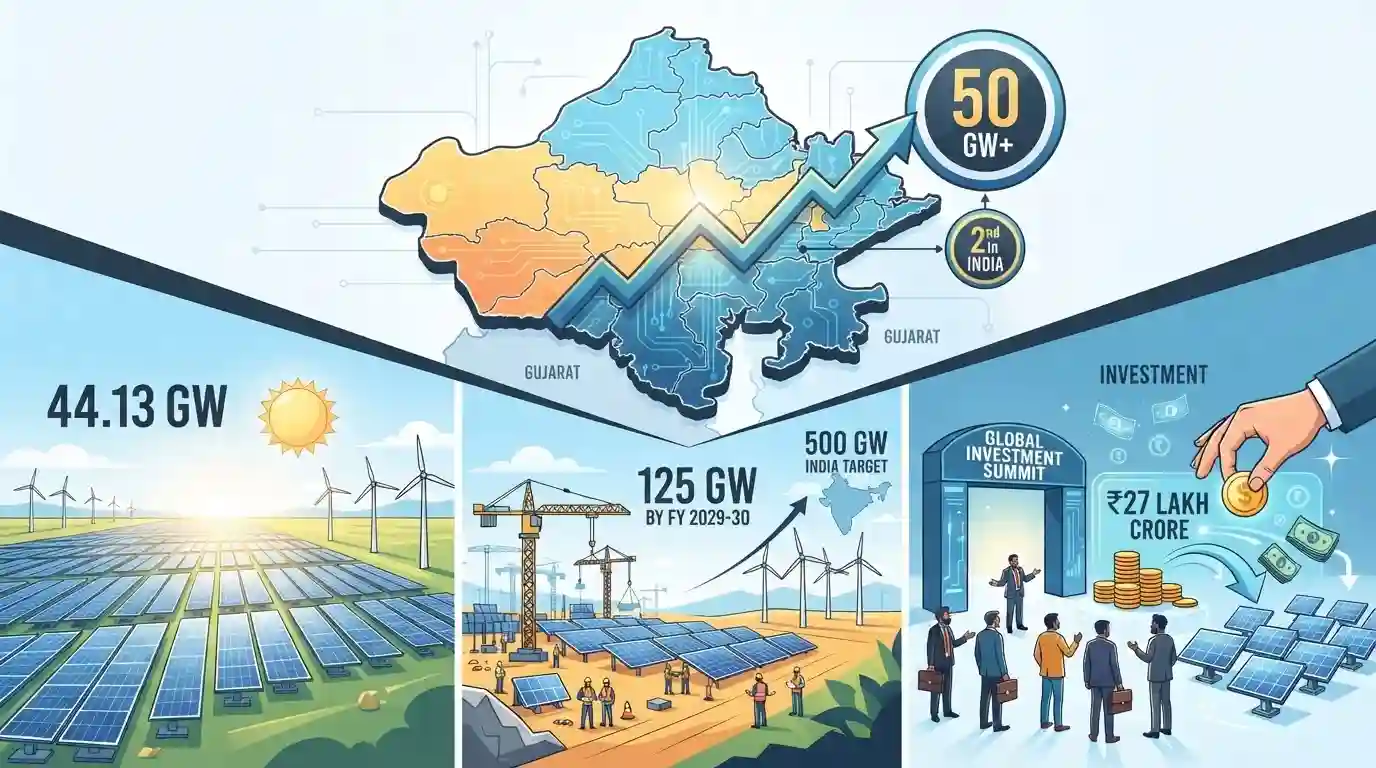
Rajasthan has crossed a significant landmark by achieving over 50 GW of installed renewable energy capacity, making it the second-highest in India after Gujarat. The bulk of this capacity is driven by solar power (44.13 GW). The state aims to escalate its renewable capacity to 125 GW by FY 2029-30 to support India's larger 500 GW target. Notably, the recent Rising Rajasthan Global Investment Summit saw massive investor interest, with Rs 27 lakh crore pledged towards the solar energy sector alone, underscoring the state's central role in India's clean energy transition.
Key Points
- Rajasthan has reached a milestone of over 50 GW (50.33 GW) installed capacity of clean/renewable energy, recording an annual growth rate of 44%.
- Solar energy contributes the largest share to this milestone, accounting for 44.13 GW of the state's total renewable capacity.
- Rajasthan currently ranks second in India for total installed renewable energy capacity, behind Gujarat (52.61 GW).
- The state has set a goal to achieve 125 GW of renewable energy capacity by FY 2029-30, aligning with the national target of 500 GW by 2030.
- At the Rising Rajasthan Global Investment Summit, the solar energy sector attracted investment pledges worth Rs 27 lakh crore out of a total of Rs 35 lakh crore.
Important Terms
Rising Rajasthan Global Investment Summit

A flagship summit organized by Rajasthan in late 2024 to attract global private investments, which secured massive financial pledges—including Rs 27 lakh crore specifically for solar and green energy projects.
UPSC context
GS Paper 3 (Economy/Investment Models). Tests knowledge of state-led economic initiatives, competitive federalism, and green financing.
500 GW Non-Fossil Energy Target
India's major climate commitment, pledged as part of the "Panchamrit" strategy at COP26, to install 500 gigawatts of non-fossil fuel-based electricity generating capacity by the year 2030.
UPSC context
GS Paper 3 (Environment & Energy). Tests awareness of India's Nationally Determined Contributions (NDCs) and decarbonization roadmaps.
Installed Renewable Energy Capacity
The total maximum electricity-generating capability of a region's operational green infrastructure. Scaling this capacity is critical for India's climate targets, with leading states like Rajasthan and Gujarat crossing the 50 GW milestone.
UPSC context
GS Paper 3 (Infrastructure: Energy). Evaluates knowledge of India's renewable energy deployment, state-level resource distribution, and climate progress.
Clean Energy Transition
The structural economic and infrastructural shift from fossil fuel-based power generation (like coal) to sustainable, renewable energy sources (like solar and wind) to reduce emissions and ensure long-term energy security.
UPSC context
GS Paper 3 (Conservation/Climate Change). Essential for understanding sustainable development policies, global warming mitigation, and energy sector reforms.
Prelims Trap
Rajasthan currently ranks first in India for total installed renewable energy capacity.
Aspirants confuse solar dominance with overall renewables. While Rajasthan leads in solar energy, Gujarat is currently #1 in total renewable capacity due to its strong wind-solar mix.
Static Concepts Connected
What are the core commitments of India's Panchamrit strategy from COP26?
- Non-fossil Capacity: Reach 500 GW of non-fossil energy capacity by the year 2030.
- Renewable Share: Meet 50% of the country's energy requirements from renewable sources by 2030.
- Emissions Reduction: Reduce total projected carbon emissions by one billion tonnes from now to 2030.
- Net Zero: Achieve the target of Net Zero carbon emissions by 2070.
What are the primary challenges of integrating high solar/wind capacity into the national grid?
- Intermittency: Solar and wind generation is variable, creating temporal supply-demand mismatches often referred to as the 'Duck Curve'.
- Grid Stability: Lack of synchronous inertia from traditional mechanical turbines makes grid frequency regulation and voltage control highly complex.
- Transmission Bottlenecks: Renewable energy is geographically concentrated (e.g., western deserts), requiring massive investments in Green Energy Corridors to evacuate power.
Cross-Topic Patterns
Solar Infrastructure vs. Avian Biodiversity
Massive solar parks and overhead transmission lines in Rajasthan's Thar desert form a primary threat to the critically endangered Great Indian Bustard, frequently triggering Supreme Court interventions.
Competitive Federalism in Climate Finance
State-led investor summits (like Rising Rajasthan and Vibrant Gujarat) highlight competitive federalism in attracting 'green capital', which is essential for meeting India's decentralized national 500 GW target.

Expect a 2026 Prelims question mixing state rankings in RE capacity, PM-KUSUM implementation details, and COP26 Panchamrit targets.
Linked PYQs · 4
Linked PYQs · 4
- 2021RPSC_PRELIMSGS1
In which year was the Rajasthan Solar Energy Policy announced?
- 2023RPSC_PRELIMSGS1
Which agency has been given the responsibility of implementing the PM-KUSUM scheme (Component A) in Rajasthan, which involves the establishment of solar power plants with a capacity of 0.5 MW to 2 MW?
- 2021RPSC_PRELIMSGS1
What is the proposed percentage of plan expenditure of total expenditure on electricity in the 2021-22 Rajasthan Budget?
- 2012RPSC_PRELIMSGS1
The first solar energy policy was announced by the Government of Rajasthan in -
