Rajasthan Rooftop Solar Capacity Crosses One Thousand Megawatts
Source:thebuckstopper ↗
Why It Matters
This development highlights Rajasthan's proactive role in decentralized solar energy generation. For RPSC RAS, understanding the state-specific additions to central schemes (like the ₹17,000 state top-up subsidy) and physical targets achieved is vital for both Prelims (MCQs on scheme features) and Mains (GS-1 Economics & GS-3 Science/Tech).
Summary
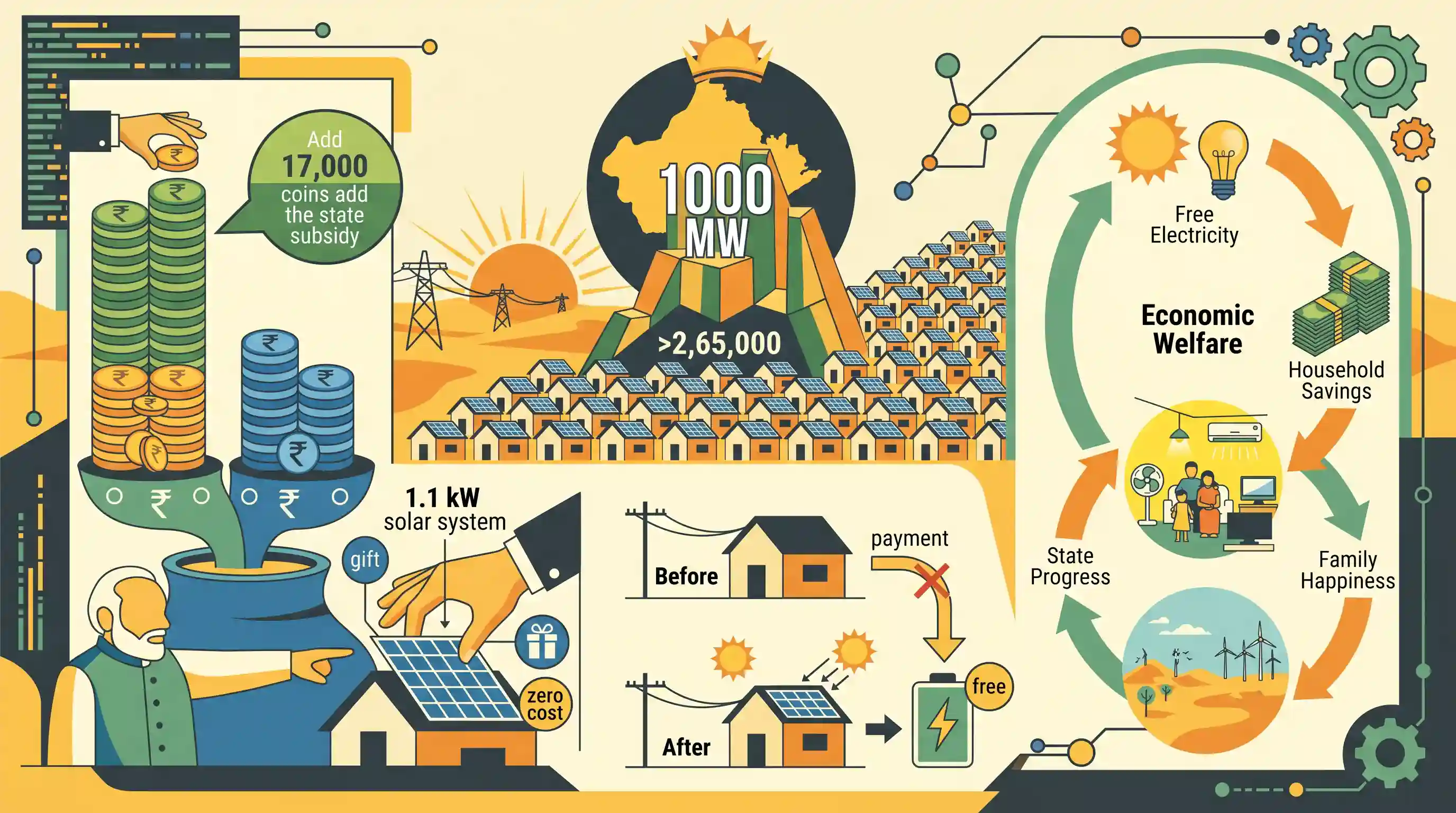
Rajasthan has set a new record in green energy transition by crossing 1,000 MW in cumulative rooftop solar capacity (reaching 1,001.57 MW) across more than 2,65,000 households. This development comes under the PM Surya Ghar: Muft Bijli Yojana, heavily supported by the state government through an additional ₹17,000 subsidy, enabling free installation of 1.1 kW systems for eligible families.
Key Points
- Rajasthan has achieved a major milestone by installing over 1,000 MW (specifically 1,001.57 MW) of cumulative rooftop solar capacity.
- The milestone was achieved under the PM Surya Ghar Free Electricity Scheme, benefitting over 2.65 lakh households in the state so far.
- The central PM Surya Ghar scheme, launched on February 15, 2024, targets 1 crore households nationwide and provides up to 40% subsidy to ensure clean energy adoption.
- The Rajasthan State Government provides an additional state subsidy of ₹17,000 for eligible domestic consumers.
- Combining the central and state subsidies allows households to install a 1.1 kW rooftop solar system completely free of cost, yielding up to 150 units of free electricity per month.
Important Terms
PM Surya Ghar: Muft Bijli Yojana

A central sector scheme launched in February 2024 aiming to provide up to 300 units of free electricity monthly to 1 crore Indian households through rooftop solar installations.
UPSC context
GS Paper 3 (Infrastructure, Schemes). Tests knowledge of renewable energy initiatives and decentralized power generation.
Rooftop Solar
The installation of solar photovoltaic panels on residential, commercial, or institutional building roofs to generate decentralized clean electricity, minimizing transmission and distribution losses.
UPSC context
GS Paper 3 (Energy, Environment). Tests understanding of renewable energy targets, distributed power, and carbon mitigation.
Net Metering
A utility billing mechanism that credits solar energy system owners for the excess electricity they feed back into the power grid, offsetting their retail power bills.
UPSC context
GS Paper 3 (Energy). Previously tested in UPSC Prelims to assess knowledge of consumer-level renewable energy tools.
DISCOM
Power distribution companies responsible for the last-mile delivery of electricity to retail consumers and the primary revenue collectors of the Indian power sector.
UPSC context
GS Paper 3 (Infrastructure). Evaluates structural reforms, operational efficiencies (AT&C losses), and financial viability in green transition.
Central Financial Assistance
Direct financial subsidies provided by the Central Government to eligible residential consumers to reduce the upfront capital expenditure of installing rooftop solar systems.
UPSC context
GS Paper 3 (Energy, Subsidies). Evaluates fiscal policies and financial incentive designs supporting the domestic transition to clean energy.
Prelims Trap
PM Surya Ghar is a Centrally Sponsored Scheme with a mandatory 60:40 fund-sharing ratio between the Centre and States.
It is actually a Central Sector Scheme (100% centrally funded). State top-ups, like Rajasthan's ₹17,000, are voluntary state-level additions, not a mandated cost-sharing formula.
Static Concepts Connected
Difference between Central Sector and Centrally Sponsored Schemes
- Central Sector Schemes: 100% funded by the Union Government and implemented by the central machinery.
- Centrally Sponsored Schemes: Partially funded by the Centre (e.g., 60:40 or 90:10) but implemented directly by State governments.
- Syllabus Division: Typically target subjects under the Union List, whereas Centrally Sponsored schemes target State or Concurrent List subjects.
Net Metering vs Gross Metering in solar systems
- Net Metering: Adjusts the consumer's bill based on net energy consumed (grid imports minus solar exports), financially highly beneficial for residential users.
- Gross Metering: Exports all generated solar power to the grid at a fixed rate, while importing all consumed electricity at standard retail tariffs.
Cross-Topic Patterns
Cooperative Federalism in Green Energy
States topping up Central Sector Schemes (like Rajasthan's solar subsidy) show how states voluntarily align local budgets to accelerate national climate targets.
Rooftop Solar vs DISCOM Health
Widespread residential solar generation reduces high-tariff retail demand, complicating revenue models and cross-subsidy structures for struggling state distribution companies (DISCOMs).

PM Surya Ghar's funding model and operational distinctions from PM-KUSUM are prime areas for multi-statement Prelims questions.
Linked PYQs · 4
Linked PYQs · 4
- 2025RPSC_PRELIMSGS1
Which of the following statements are correct with respect to the PM Surya Ghar Free Electricity Scheme? (i) Under this scheme, solar plants will be installed on one crore houses to provide free electricity up to 300 units per month. (ii) Provision of 30% subsidy for installing rooftop solar plants (iii) 100% online system for registration, application, approval and grant (iv) Provision of lending to each applicant at a bank interest rate of 4%
- 2024RPSC_PRELIMSGS1
Which of the following statements about Rajasthan Multi Bijli Yojana is/are correct? A. Provide plants on one side to provide 100 solar plants. B. Subsidy for setting up rooftop solar panels. C. Provision of loan at book interest.
- 2021RPSC_PRELIMSGS1
In which year was the Rajasthan Solar Energy Policy announced?
- 2023RPSC_PRELIMSGS1
Which agency has been given the responsibility of implementing the PM-KUSUM scheme (Component A) in Rajasthan, which involves the establishment of solar power plants with a capacity of 0.5 MW to 2 MW?
