Rajasthan Uniform Civil Code Public Consultations Debate
Source:The Hindu ↗
Why It Matters
The implementation of the Uniform Civil Code (UCC) at the state level is a significant constitutional, legal, and political issue in India. For RPSC RAS aspirants, details about Rajasthan's UCC committee (headed by Ranjana Prakash Desai), its key proposals, and the underlying constitutional provisions (Article 44 DPSP and the Concurrent List) are highly relevant for both Prelims and Mains exams.
Summary
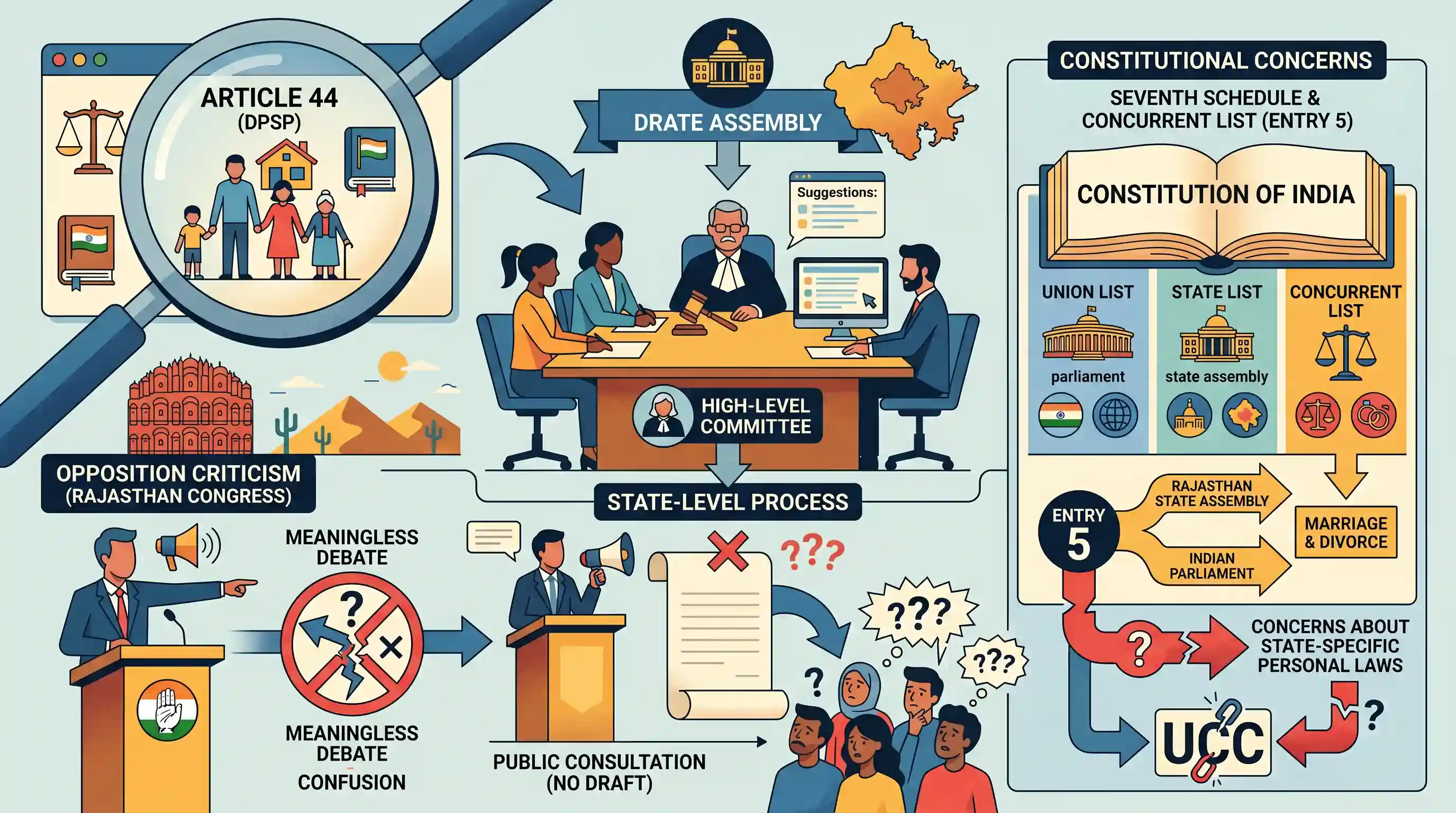
The Rajasthan Congress has criticized the BJP-led state government for organizing public consultations on the proposed Uniform Civil Code (UCC) without publishing a draft of the bill. A high-level committee chaired by retired Supreme Court Judge Ranjana Prakash Desai is currently drafting Rajasthan’s UCC. Opposition leaders argue that a public debate without a concrete draft is meaningless and creates confusion, while also raising constitutional concerns about state-specific personal laws since marriage and divorce fall under the Concurrent List of the Indian Constitution.
Key Points
- Rajasthan has initiated steps to become the fifth Indian state to enact a Uniform Civil Code (UCC), following Uttarakhand, Gujarat, Assam, and Madhya Pradesh.
- A high-level committee under the chairmanship of retired Supreme Court Judge Ranjana Prakash Desai has been formed to draft the UCC for Rajasthan and has begun conducting public consultations in Udaipur and Jodhpur divisions.
- Key proposed provisions of the Rajasthan UCC draft include mandatory registration of marriages and divorces, a complete ban on polygamy, mandatory registration of live-in relationships, and equal rights for sons and daughters in ancestral property, while tribal communities will be excluded.
- The opposition Rajasthan Congress (led by PCC president Govind Singh Dotasra and Leader of the Opposition Tikaram Jully) has strongly objected to holding public consultations without releasing a draft copy of the bill to the public and stakeholders first.
- The opposition also raised constitutional concerns, noting that personal laws (marriage, divorce, succession) fall under Entry 5 of the Concurrent List, arguing that a disjointed state-by-state implementation rather than a central model could lead to legislative inconsistency.
Important Terms
Uniform Civil Code (UCC)

A proposed common set of civil laws governing personal matters such as marriage, divorce, inheritance, and adoption for all citizens, irrespective of their religion or caste.
UPSC context
GS Paper II (Polity & Governance). Relevant for topics on secularism, gender equality, and legal reforms under personal laws.
Article 44 of the Indian Constitution
A Directive Principle of State Policy (DPSP) that directs the State to endeavor to secure a Uniform Civil Code (UCC) for all citizens throughout India.
UPSC context
GS Paper II (Polity & Constitution). Tests understanding of DPSPs, constitutional mandates, and non-justiciable rights.
Concurrent List (Seventh Schedule)
A list of 52 subjects in the Seventh Schedule of the Indian Constitution on which both the Union and State governments can make laws.
UPSC context
GS Paper II (Federalism). Tests knowledge of legislative division of power, federal structures, and joint-jurisdiction areas like personal law.
Directive Principles of State Policy (DPSP)
Non-justiciable guidelines in Part IV of the Indian Constitution that direct the State to establish social and economic democracy when enacting laws.
UPSC context
GS Paper II (Polity). Critical for evaluating the constitutional vision, welfare state concepts, and judicial interpretations.
Ranjana Prakash Desai Committee
A high-level expert panel constituted to draft the Uniform Civil Code (UCC) framework, most notably for Uttarakhand and subsequently for Rajasthan.
UPSC context
GS Paper II (Polity & Governance). Relevant for studying committee-based lawmaking, cooperative federalism, and state-level initiatives.
Prelims Trap
State legislatures cannot enact a Uniform Civil Code because Article 44 directs only the Union Parliament to establish a uniform code.
Article 44 uses "the State" as defined in Article 12, which includes state legislatures. Furthermore, personal laws fall under Entry 5 of the Concurrent List, granting states legislative competence.
Static Concepts Connected
How is legislative power over personal laws distributed under the Constitution?
- Seventh Schedule: Entry 5 of List III (Concurrent List) governs marriage, divorce, adoption, wills, and succession, giving both Center and States legislative power.
- Article 44: Article 44 (DPSP) directs "the State" (which includes state governments under Article 12) to endeavor to secure a UCC for all citizens.
- Article 254(2) Assent: If a state UCC conflicts with existing central laws (like the Hindu Marriage Act), it requires Presidential assent under Article 254(2) to be valid in that state.
What is the Doctrine of Repugnancy under Article 254?
- General Rule: If a State law on a Concurrent List subject conflicts with a Central law, the Central law prevails and the State law is void to the extent of repugnancy.
- The Exception: A repugnant State law can prevail within that specific state if it has been reserved for the President's consideration and received assent.
- Parliamentary Override: Even after granting assent under Article 254(2), Parliament is not prevented from subsequently enacting a law that amends, varies, or repeals the State law.
Cross-Topic Patterns
UCC vs. Fifth/Sixth Schedule Autonomy
Excluding scheduled tribes from state UCCs highlights the tension between achieving national uniformity (Article 44) and preserving tribal customary autonomy under the Fifth and Sixth Schedules.
Federalism and Article 254 Assent
State-specific personal laws create inter-state legal conflicts, requiring complex applications of Article 254(2) presidential assent to manage civil law fragmentation within Indian federalism.

Mains 2026 may analyze the federal friction of state-level UCCs under Entry 5 (Concurrent List) versus the goal of national uniformity.
Linked PYQs · 2
Linked PYQs · 2
- 2023RPSC_PRELIMSGS1
Match the following list – P (Directive Principles) with list – R (Article): List – P List – R A. Equal justice and free legal aid I. Article 48 A B. Protection of the environment II. Article 39 A C. Right to work III. Article 41 D. Preservation of monuments IV. Article 49 Choose the correct option: . A B C D
- 2021RPSC_PRELIMSGS1
Which of the following pairs of Directive Principles of State Policy as described in the Constitution of India is correctly matched?
