Rajasthan Uniform Civil Code Committee Divisional Consultations
Source:daily-pioneer ↗
Why It Matters
The drafting of a state-level Uniform Civil Code touches upon key constitutional principles such as Article 44 (DPSP), federalism, and the jurisdiction of states to legislate on personal law matters (Concurrent List). For RPSC RAS Prelims, understanding the specific composition of the committee (headed by Justice Ranjana Prakash Desai) and state-specific governance developments is crucial.
Summary
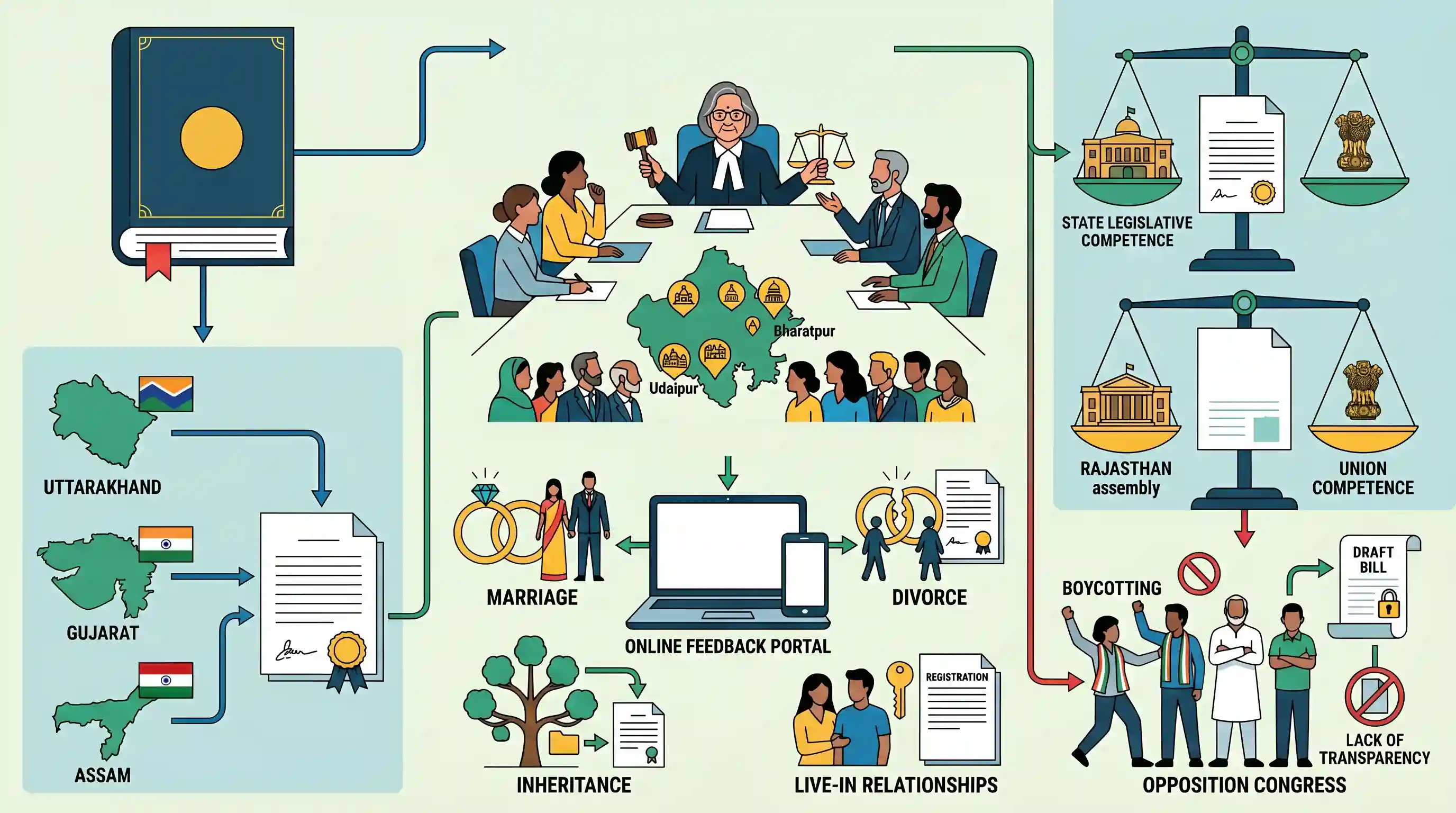
The Rajasthan government's Uniform Civil Code (UCC) drafting committee, under the chairpersonship of retired Supreme Court Justice Ranjana Prakash Desai, has commenced its divisional-level public consultations across Rajasthan (including Ajmer, Kota, Jaipur, Udaipur, and Bharatpur) [1.1]. The panel has sought feedback on a 19-question online portal regarding critical civil issues like marriage, divorce, inheritance, and the compulsory registration/regulation of live-in relationships [1.1]. While Uttarakhand, Gujarat, and Assam have already moved ahead with UCC legislation, the opposition Congress in Rajasthan has boycotted the committee's proceedings, citing a lack of transparency as the draft bill has not yet been made public [1.1].
Key Points
- The Rajasthan state-level committee tasked with preparing the draft Uniform Civil Code (UCC) has launched public consultations and sought responses to 19 questions via an online portal.
- The committee is chaired by retired Supreme Court Judge Justice Ranjana Prakash Desai. Other key committee members leading the divisional consultations include Shatrughan Singh, Basant Singh Chhaba, and Ramswaroop Agarwal.
- The 19-question survey asks for public and expert views on marriage, divorce, inheritance, property rights, and the potential registration and regulation of live-in relationships.
- Public hearings are being organized across various divisional headquarters including Ajmer, Kota, Jaipur, Udaipur, and Bharatpur to gather diverse viewpoints from citizens, religious groups, and legal experts.
- Uttarakhand was the first state to implement a UCC in February 2024, followed by Gujarat and Assam, with Madhya Pradesh also forming a drafting committee.
- The main opposition Congress party, led by Rajasthan State Chief Govind Singh Dotasra, has boycotted the consultations, asserting that the draft has not been made public and accusing the ruling party of creating a political distraction.
Important Terms
Uniform Civil Code (UCC) Draft Bill

A legislative proposal designed to formulate a common set of personal laws governing civil matters such as marriage, divorce, inheritance, and adoption for all citizens, irrespective of their religion.
UPSC context
GS Paper II (Polity). Tests understanding of Article 44, legal reforms, and the interface between religious freedom and equal civil rights.
Rajasthan Uniform Civil Code (RUCC)
A state-level initiative aiming to codify uniform personal laws in Rajasthan, featuring proposed provisions like equal property rights, prohibition of polygamy, and mandatory registration of live-in relationships.
UPSC context
GS Paper II (Polity). Analyzes regional legal uniformity, state-level implementation of DPSPs, and challenges regarding tribal community exemptions.
Directive Principles of State Policy (DPSP)
Non-justiciable constitutional guidelines (Part IV, Articles 36-51) that instruct the State to secure a just social order, with Article 44 directing the state to endeavour for a nationwide Uniform Civil Code.
UPSC context
GS Paper II (Polity). Tests fundamental constitutional concepts, non-justiciability versus governance, and the balance between DPSP and Fundamental Rights.
Entry 5 of the Concurrent List
A constitutional provision under the Seventh Schedule (List III) that empowers both the Union Parliament and State legislatures to legislate on marriage, divorce, succession, and adoption.
UPSC context
GS Paper II (Federalism). Tests division of legislative powers, Center-State relations, and state competence to enact personal law reforms.
Ranjana Prakash Desai Committee
A high-level expert panel, led by former Supreme Court Justice Ranjana Prakash Desai, tasked with holding public consultations and drafting Uniform Civil Code bills for states like Uttarakhand and Rajasthan.
UPSC context
GS Paper II (Polity/Governance). Evaluates the role of committees and judicial-administrative experts in drafting complex social legislations and gathering public consensus.
State Legislative Competence
The constitutional authority granted to state legislatures under Article 246 to enact laws on matters specified in the State and Concurrent Lists of the Seventh Schedule.
UPSC context
GS Paper II (Federal Structure). Tests understanding of federalism, conflict of laws (repugnancy), and the role of presidential assent in concurrent subjects.
Prelims Trap
Only the Parliament of India has the legislative competence to enact a Uniform Civil Code, as Article 44 specifies 'throughout the territory of India'.
Personal laws (marriage, divorce, succession) fall under Entry 5 of the Concurrent List (List III), allowing state legislatures to enact state-specific UCCs.
Static Concepts Connected
What is the constitutional basis and legislative competence for a Uniform Civil Code?
- Article 44: Directs the State to secure a UCC for all citizens throughout India, categorized under Part IV (DPSPs) as a Liberal-Intellectual principle.
- Concurrent List: Entry 5 of List III covers marriage, divorce, adoption, and succession, granting both the Union and State Legislatures concurrent powers to legislate.
- Article 254(2): State-enacted UCCs that conflict with existing Central civil laws require the President's assent under Article 254(2) to remain valid in that State.
How are tribal customary rights constitutionally protected from uniform civil regulations?
- Fifth & Sixth Schedules: Govern tribal governance and customary laws, protecting tribal autonomy from general state and central civil laws.
- Articles 371A and 371G: Explicitly protect local customary laws, religious practices, and land systems of Nagaland and Mizoram from Parliamentary acts.
- Article 342 Exemption: Modern state UCC drafts (e.g., Uttarakhand, Rajasthan) explicitly exempt Scheduled Tribes notified under Article 342 to prevent constitutional conflicts.
Cross-Topic Patterns
State-led UCCs vs Constitutional Federalism
State-by-state UCCs risk creating a fragmented civil regime, testing whether Article 44's mandate for uniformity can be satisfied through regional, state-level variations.
Article 25 vs Article 44
The clash between freedom of religion/custom customary practices and state-mandated social reform highlights the enduring tension between fundamental rights and non-justiciable DPSPs.

State-level UCC laws will likely trigger questions on Concurrent List Entry 5, Article 254 assent, and tribal exemptions under Article 342.
Linked PYQs · 2
Linked PYQs · 2
- 2023RPSC_PRELIMSGS1
Match the following list – P (Directive Principles) with list – R (Article): List – P List – R A. Equal justice and free legal aid I. Article 48 A B. Protection of the environment II. Article 39 A C. Right to work III. Article 41 D. Preservation of monuments IV. Article 49 Choose the correct option: . A B C D
- 2021RPSC_PRELIMSGS1
Which of the following pairs of Directive Principles of State Policy as described in the Constitution of India is correctly matched?
