Gupt Vrindavan Dham Foundation Laid in Jaipur Using Makrana Marble
Source:tennews ↗
Why It Matters
The specific mention of materials like Makrana marble and Bhaislana black stone provides direct relevance to Rajasthan's economic geography and mineral resources, which are core topics in the RPSC Prelims syllabus. Additionally, the development of new prominent cultural and religious centers ties into the broader theme of Rajasthan's art, culture, and tourism.
Summary
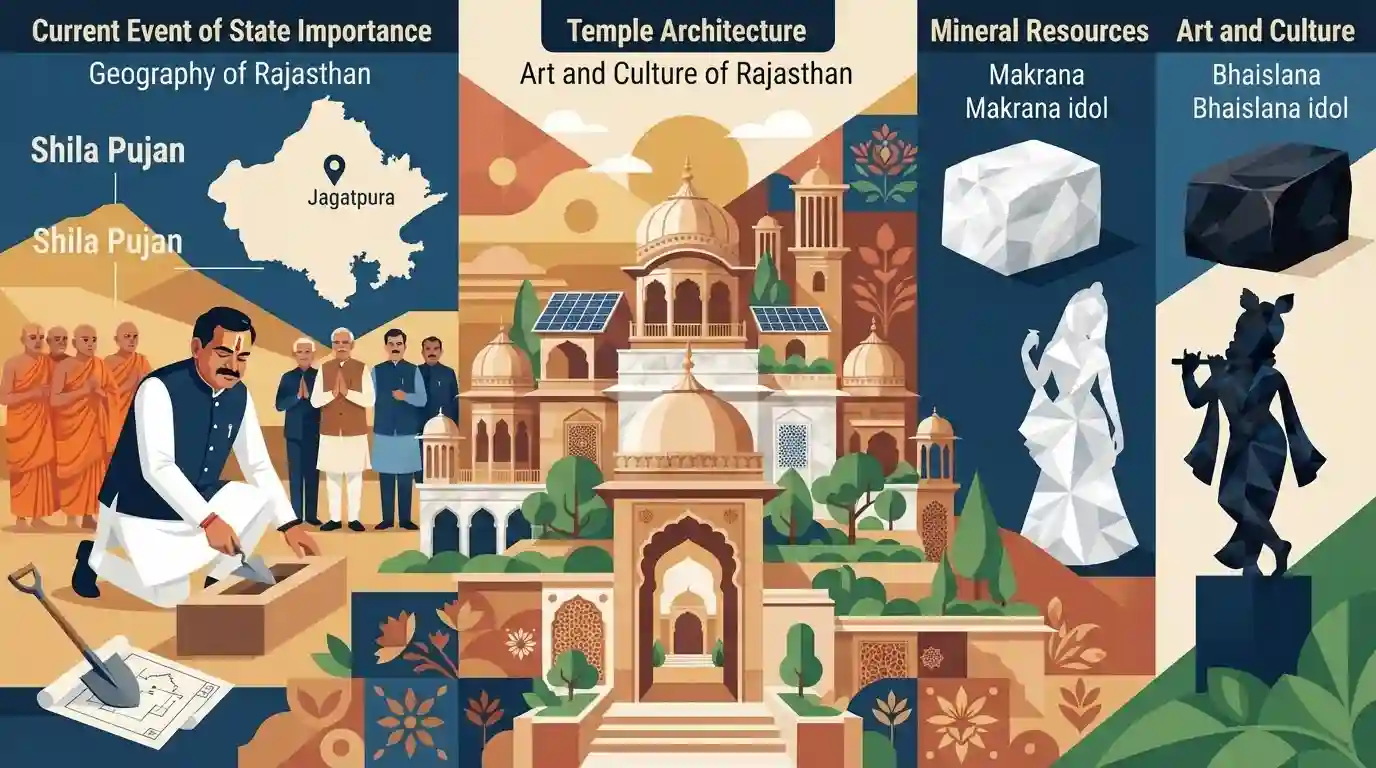
Rajasthan Chief Minister Bhajanlal Sharma performed the Shila Pujan for the new Gupt Vrindavan Dham temple in Jagatpura, Jaipur, an initiative by the Hare Krishna Movement. The temple will promote Sanatan culture and Vedic knowledge while showcasing Rajasthan's renowned mineral wealth. Specifically, the Radharani idol will be carved from high-quality white Makrana marble, and the Lord Krishna idol will be made from rare black stone sourced from Bhaislana. The complex will integrate traditional architectural motifs and eco-friendly design principles.
Key Points
- Rajasthan Chief Minister Bhajanlal Sharma participated in the Shila Pujan ceremony for Gupt Vrindavan Dham in Jagatpura, Jaipur.
- The project is spearheaded by the Hare Krishna Movement to serve as a center for Sanatan culture, spiritual heritage, and Vedic teachings.
- The temple's Radharani idol will be crafted from premium white Makrana marble, a celebrated mineral resource of Rajasthan.
- The Lord Krishna idol will be carved from a special black stone sourced from the ancient quarries of Bhaislana near Pavta.
- The temple complex will feature prominent eco-friendly architectural elements, including representations of 108 peacocks and green building concepts.
Important Terms
Gupt Vrindavan Dham

A grand cultural and spiritual complex under construction in Jagatpura, Jaipur. Spread across 6 acres, this 17-story center developed by the Hare Krishna Movement aims to promote Vedic knowledge, Sanatan culture, and Rajasthan's architectural heritage.
UPSC context
Relevant for Art & Culture and Rajasthan State Affairs (RPSC/UPSC). Highlights temple architecture, spiritual tourism, and heritage conservation.
Makrana Marble
A premium, high-density, pure white calcitic marble quarried in Rajasthan. Known for its water resistance and longevity, it holds a Geographical Indication (GI) tag and is a Global Heritage Stone Resource.
UPSC context
Crucial for UPSC Geography, Economy (GI Tags), and Art & Culture, given its use in iconic monuments like the Taj Mahal.
Bhaislana Black Stone
A distinctive, deep black natural marble featuring curved grey/white veins, quarried in the Kotputli region of Jaipur, Rajasthan. Valued for its density, durability, and dramatic aesthetic in premium stone carving.
UPSC context
Important for Geography (Mineral Resources of Rajasthan) and regional economy. Highlights the state's diverse natural stone wealth.
Hare Krishna Movement
A prominent Gaudiya Vaishnava spiritual organization (associated with ISKCON/Srila Prabhupada's vision) promoting Krishna consciousness, Vedic education, and Bhagavad Gita teachings. They are leading the construction of Gupt Vrindavan Dham in Jaipur.
UPSC context
Connects to Art & Culture (Bhakti Movement legacy) and Civil Society initiatives like cultural education and large-scale temple infrastructure.
Prelims Trap
Bhaislana black stone is an igneous basalt rock found predominantly in the Deccan Plateau.
Bhaislana in Rajasthan yields black marble (a metamorphic rock), not igneous basalt. Aspirants often automatically misattribute black stones to Deccan volcanism.
Static Concepts Connected
What geological process formed Rajasthan's Makrana marble?
- Metamorphic Origin: It is formed by the regional metamorphism of limestone under high heat and pressure within the ancient Aravalli mountain belt.
- Chemical Composition: Composed primarily of high-purity calcium carbonate (calcite), making it highly durable, water-resistant, and ideal for fine carving.
- GI Tag Recognition: Recognized as Asia's first Global Heritage Stone Resource, it holds a Geographical Indication (GI) tag for its unique enduring quality.
How did historical Indian architecture utilize distinct regional stone types?
- Sandstone in North: Red and buff sandstone from the Vindhyan ranges were extensively used in North Indian and Mughal architecture (e.g., Fatehpur Sikri).
- Granite in South: Chola and Pallava temples predominantly utilized locally available hard granite from the peninsular shield (e.g., Brihadeeswarar Temple).
- Marble in Rajasthan: White Makrana marble was favored for intricate Jain temples (Dilwara) and later monumental Indo-Islamic tombs (Taj Mahal).
Cross-Topic Patterns
Architecture + GI tags
Mapping local stones (like Makrana marble or Chunar sandstone) to their GI status and historical monuments is a recurring Prelims theme.
Aravalli Metamorphism + Economic Geography
Links the Aravalli mountain range's ancient tectonic and metamorphic history to its modern economic geography, supplying 90% of India's marble.

Expect a Prelims mapping question pairing specific Indian building stones (Makrana marble, Bhaislana) with their GI tags or source regions.
Linked PYQs · 2
Linked PYQs · 2
- 2018RPSC_PRELIMSGS1
Which of the following are the important mineral-based industries in Rajasthan? (a) Zinc Smelting Industry (b) Cement Industry (c) Electronic Industry (d) Marble Industry Code:
- 2016RPSC_PRELIMSGS1
Choose the temples built during the Gurjara-Pratihara period from the following temples of Rajasthan: 1. Adiwara Temple of Ahad. 2. Harshat Mata Temple of Abhaneri. 3. Neelkanth Temple of Rajorgarh. 4. Harihar Temple of Osian. Code:
