Rajasthan Roadways Expands Fleet with New Public Buses
Source:etv-bharat ↗
Why It Matters
Public transport infrastructure and state roadways financial health are critical indicators of regional economic management. Understanding transport-related reforms and Gross Fixed Capital Formation shares is highly relevant for the RPSC RAS prelims exam.
Summary
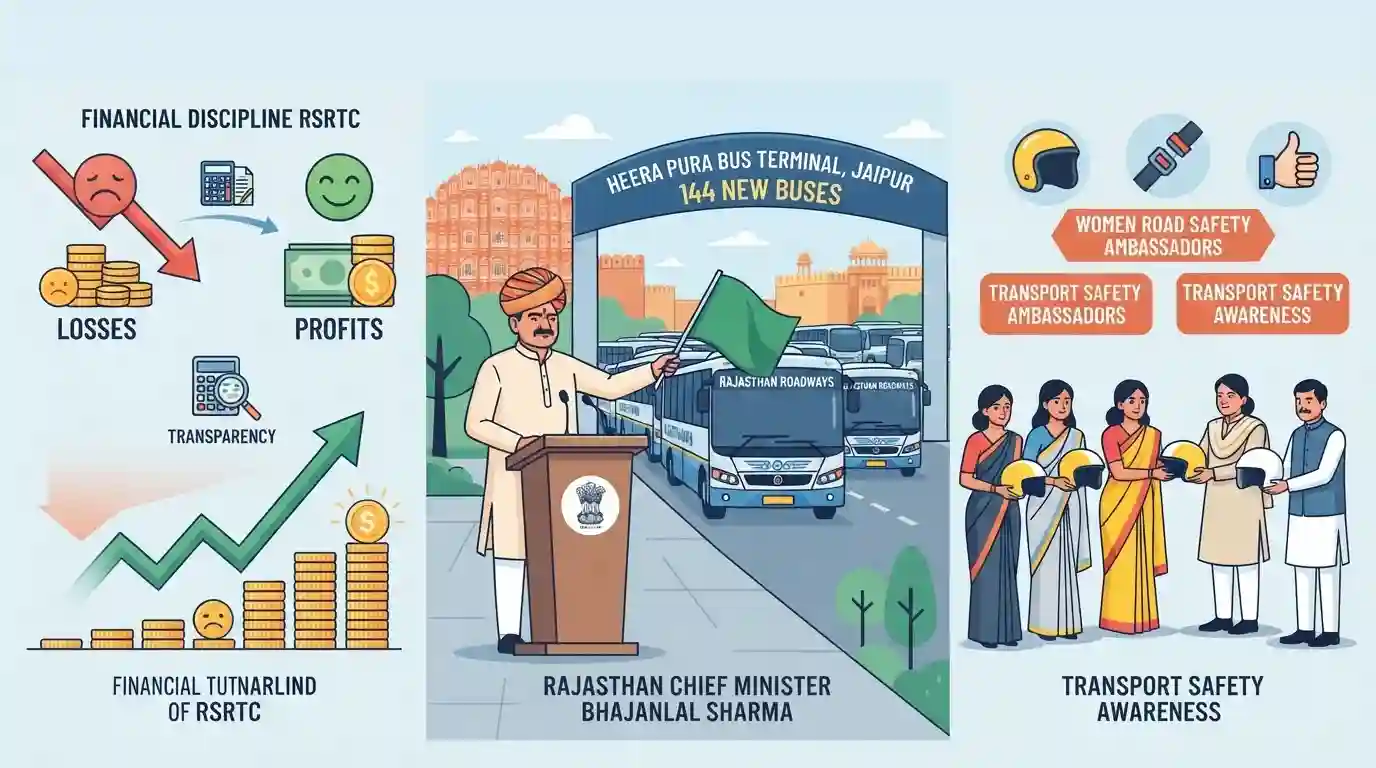
Rajasthan Chief Minister Bhajanlal Sharma flagged off 144 new public transport buses from the Heera Pura bus terminal in Jaipur. During the event, the CM highlighted that Rajasthan Roadways (RSRTC) has transitioned from a loss-making entity to a profit-making one due to strict financial discipline and transparency. Additionally, helmets were distributed to women road safety ambassadors to raise awareness about transport safety.
Key Points
- Rajasthan Chief Minister Bhajanlal Sharma flagged off 144 new buses from the Heera Pura bus terminal in Jaipur to strengthen the state's public transport fleet.
- The Chief Minister emphasized the transition of Rajasthan Roadways from a historically loss-making entity into a profit-making state enterprise through improved management, financial discipline, and transparency.
- To promote road safety awareness, CM Sharma distributed helmets to women who were designated as road safety ambassadors.
- The event was attended by Deputy Chief Minister and Transport Minister Premchand Bairwa, MP Manju Sharma, and other senior officials.
- The expansion of the public transport system is part of a broader vision of safe, affordable, and accessible travel facilitated by the dual-level (double-engine) government initiatives.
Important Terms
Rajasthan State Road Transport Corporation

A state-owned public transport provider in Rajasthan established in 1964 under the Road Transport Corporations Act, 1950, managing the state's largest intercity bus network.
UPSC context
GS Paper III (Infrastructure: Roads) — tests knowledge of state-level public infrastructure, operational reforms, and transit systems.
State Transport Undertaking (STU)
A government-owned enterprise responsible for providing public passenger road transport services within a state or union territory under the Road Transport Corporations Act.
UPSC context
GS Paper III (Infrastructure: Roads) — tests understanding of public sector undertakings, urban/rural mass transit, and e-mobility integrations.
Road Safety Ambassadors
Trained community-level volunteers and representatives appointed to raise public awareness, promote safety gear like helmets, and advocate for safe riding practices to minimize accidents.
UPSC context
GS Paper III (Road Safety & Infrastructure) — tests knowledge of grassroots transport safety initiatives, public-private-civic partnerships, and behavioral change.
Gramin Sewa
A targeted public transport scheme offering reliable and cost-effective road connectivity to rural populations, often utilizing performance-linked collaborations to ensure financial viability.
UPSC context
GS Paper III (Rural Development and Infrastructure) — tests policies on rural connectivity, public transit access, and financial turnaround of public services.
Prelims Trap
"All State Road Transport Corporations (SRTCs) are incorporated solely under the Companies Act, 2013."
State Road Transport Corporations (SRTCs) are statutory bodies created under the Road Transport Corporations Act, 1950, not typical companies incorporated under the Companies Act.
Static Concepts Connected
What is the statutory framework governing State Road Transport Corporations (SRTCs)?
- RTC Act, 1950: SRTCs are statutory corporations established by state governments under the provisions of the Road Transport Corporations Act, 1950.
- Central Approval: The Act empowers state governments to create these public transport bodies, but they must first obtain the previous approval of the Central Government.
What are standard governance strategies for turning around loss-making PSUs?
- Financial Restructuring: Injecting fresh capital, restructuring outstanding debt, and prioritizing asset monetization to clean up and strengthen the corporate balance sheet.
- Operational Autonomy: Increasing operational autonomy through performance contracts (like the MoU system) to minimize political interference in day-to-day management.
- Transparency Mechanisms: Enhancing financial discipline through rigorous audits, e-procurement, and transparent tender processes to plug revenue leakages.
Cross-Topic Patterns
State PSUs & Green Urban Mobility
The financial turnaround of SRTCs aligns directly with the PM-eBus Sewa scheme, demonstrating how state PSU viability is a prerequisite for executing large-scale green urban mobility projects.
Gender Empowerment in Civic Governance
Engaging women as road safety ambassadors links gender empowerment with civic governance—a recurring GS-2 theme emphasizing behavioral change through community-led grassroots mobilization.

Expect Mains GS-3 to link the financial turnaround of State PSUs with the viability of green urban mobility schemes like PM-eBus Sewa.
Linked PYQs · 1
Linked PYQs · 1
- 2024RPSC_PRELIMSGS1
In Rajasthan's Gross Fixed Capital Formation of 2022-23, what is the order in which sectors are arranged from highest to lowest share? A. Construction B. Transport C. Agriculture D. Manufacturing
