Rajasthan Mandates Carpooling for Government Staff to Cut Fuel
Source:sride ↗
Why It Matters
This directive reflects a growing shift in public administration where sustainable transport practices (like carpooling and EV adoption) are institutionalized to optimize government expenditure and reduce carbon footprints. It highlights state-level implementation of climate-action targets (SDGs) and administrative efficiency.
Summary
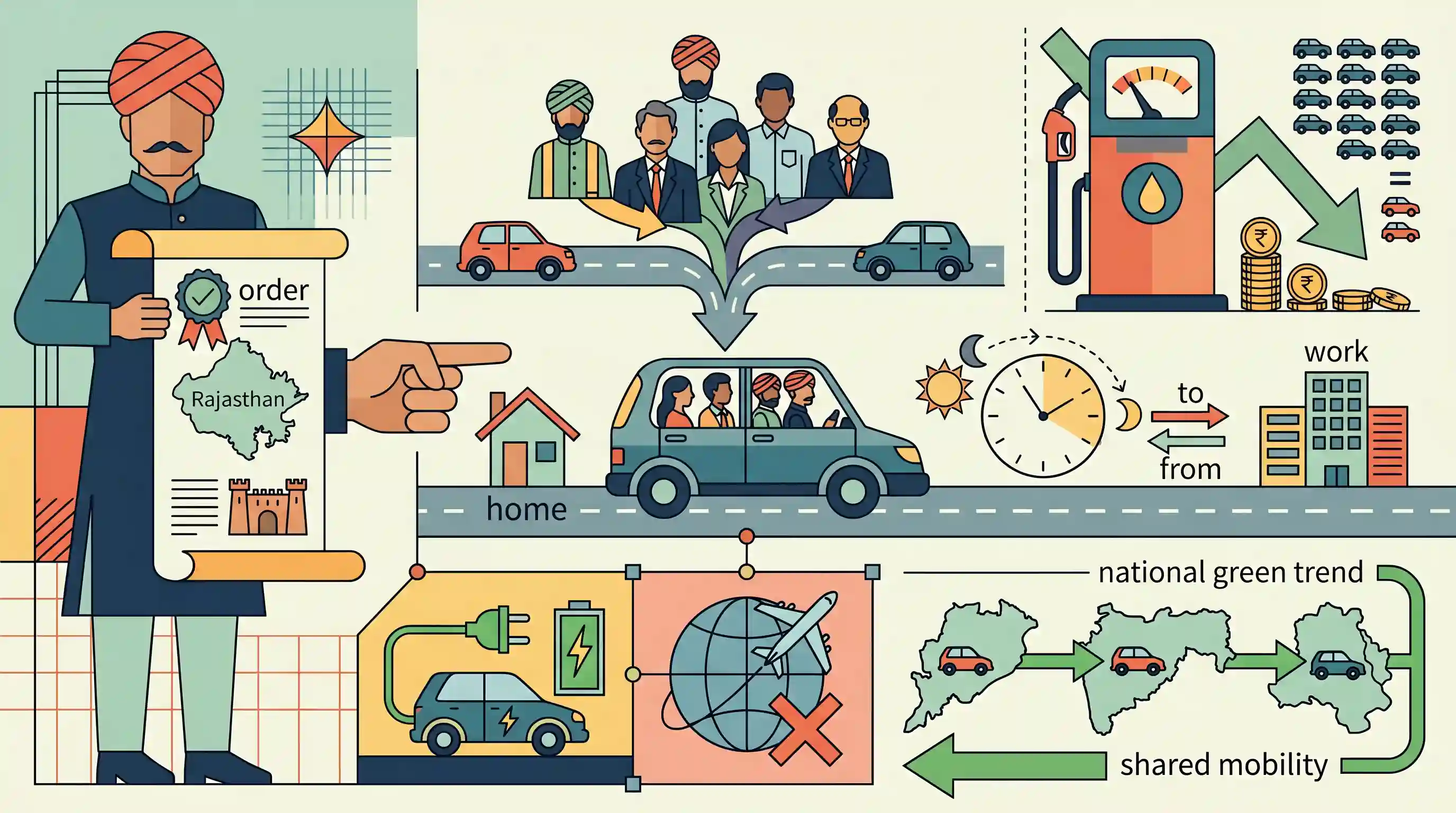
Rajasthan Chief Minister Bhajan Lal Sharma has issued a government circular mandating carpooling for all state officials and employees commuting in the same direction to and from work. Aimed at cutting public fuel consumption and administrative expenditure, the initiative is coupled with other sustainability-oriented measures like EV adoption and a foreign-travel ban. This move mirrors a national trend in green governance and shared mobility seen in states like Odisha, Maharashtra, and Delhi.
Key Points
- Rajasthan Chief Minister Bhajan Lal Sharma issued a circular directing state government officials and employees travelling in the same direction to carpool for their daily office commute.
- The directive applies to daily travel to and from work using both government and private vehicles, prioritizing carpooling as standard operating practice.
- This green governance initiative requires no new infrastructure or fleets, making it an immediate, low-cost lever to reduce fuel bills, lower traffic congestion, and cut emissions.
- The initiative is supported by broader state policies, including EV (Electric Vehicle) adoption and a ban on official foreign travel to curb state expenditure.
- Similar fuel-saving directives and shared-mobility policies have been enacted in other Indian states, including Odisha, Maharashtra, and Delhi, following calls by the Prime Minister to conserve petrol and diesel.
Important Terms
sRide

A leading peer-to-peer carpooling and workplace shared-mobility platform in India that connects daily commuters traveling similar routes to help them share rides and split fuel costs.
UPSC context
GS Paper III (Infrastructure & Environment) — Tests digital solutions for urban decongestion and sustainable transport.
Shared Mobility
A transportation paradigm that allows users to access transportation services on an as-needed basis (such as carpooling), optimizing vehicle utility and mitigating urban traffic congestion.
UPSC context
GS Paper III (Infrastructure & Urban Development) — Relevant for sustainable urban transport policies and fuel conservation.
Energy Security
The uninterrupted and affordable availability of energy; a critical focus for India, which imports over 85% of its crude oil and is vulnerable to global supply disruptions.
UPSC context
GS Paper III (Energy & Economic Geography) — Tests policies reducing import dependence and transitioning to green energy.
Fiscal Discipline
The practice of managing public spending and government revenues prudently to control deficits, exemplified by state-level austerity measures restricting non-essential administrative expenditure.
UPSC context
GS Paper III (Indian Economy & Budgeting) — Examines public expenditure management and state-level administrative reforms.
PM-Surya Ghar: Muft Bijli Yojana
A Central Sector Scheme launched in 2024 to install rooftop solar panels across one crore Indian households, providing up to 300 units of free electricity monthly.
UPSC context
GS Paper III (Renewable Energy & Schemes) — Tests policies promoting residential solar adoption and energy self-reliance.
Green Governance
An administrative approach that integrates environmental sustainability and resource efficiency—such as EV adoption and energy-saving measures—directly into public policy and daily government operations.
UPSC context
GS Paper II & III (Governance and Environment) — Relates to sustainable administrative practices and governance reforms.
Prelims Trap
The Department of Environment and Climate Change is the nodal agency for monitoring Sustainable Development Goals (SDGs) in Rajasthan.
In Rajasthan, the Planning Department (specifically the Centre for SDG Implementation under the Directorate of Economics & Statistics) is the designated nodal agency for SDGs, not the Environment Department.
Static Concepts Connected
What is the Bureau of Energy Efficiency (BEE) and its mandate?
- Statutory Status: Established as a statutory body under the Energy Conservation Act, 2001, operating under the Union Ministry of Power.
- Core Mandate: Aims to reduce the energy intensity of the Indian economy by developing policies and strategies focusing on self-regulation and market principles.
- Key Initiatives: Spearheads flagship schemes including Star Labeling for appliances, the Perform, Achieve and Trade (PAT) scheme, and the Energy Conservation Building Code (ECBC).
How do shared-mobility initiatives map to United Nations SDGs?
- SDG 11 (Sustainable Cities): Targets providing access to safe, affordable, accessible, and sustainable transport systems for all, notably by expanding public transport.
- SDG 12 (Responsible Consumption): Promotes sustainable management and efficient use of natural resources (like fossil fuels) through institutional practices.
- SDG 13 (Climate Action): Integrates urgent climate change measures into national and sub-national policies, strategies, and planning.
Cross-Topic Patterns
Behavioral Economics & Green Governance
This mandate applies 'Nudge Theory' in public administration, using low-cost behavioral shifts rather than heavy capital expenditure to achieve institutional emission reductions.
Sub-national Climate Federalism
With transport being key to India's Net-Zero 2070 goal, state-level EV policies and carpooling rules demonstrate decentralized federal climate mitigation in action.

State-level green mobility mandates and sub-national climate action plans are increasingly targeted to test cooperative federalism in GS-3.
Linked PYQs · 2
Linked PYQs · 2
- 2023RPSC_PRELIMSGS1
When is Energy Conservation Day celebrated in Rajasthan?
- 2021RPSC_PRELIMSGS1
Which department has been declared as the nodal department for the effective implementation of Sustainable Development Goals in Rajasthan?
