Rajasthan Launches Samrasta Sankalp Campaign For Social Harmony
Source:the-print ↗
Why It Matters
This article highlights how medieval Bhakti philosophy and figures like Sant Ravidas are leveraged in modern state policies and public campaigns to promote social reform and egalitarian values. It links directly to the RPSC RAS syllabus on Indian Art, Culture, and History of Bhakti reformers.
Summary
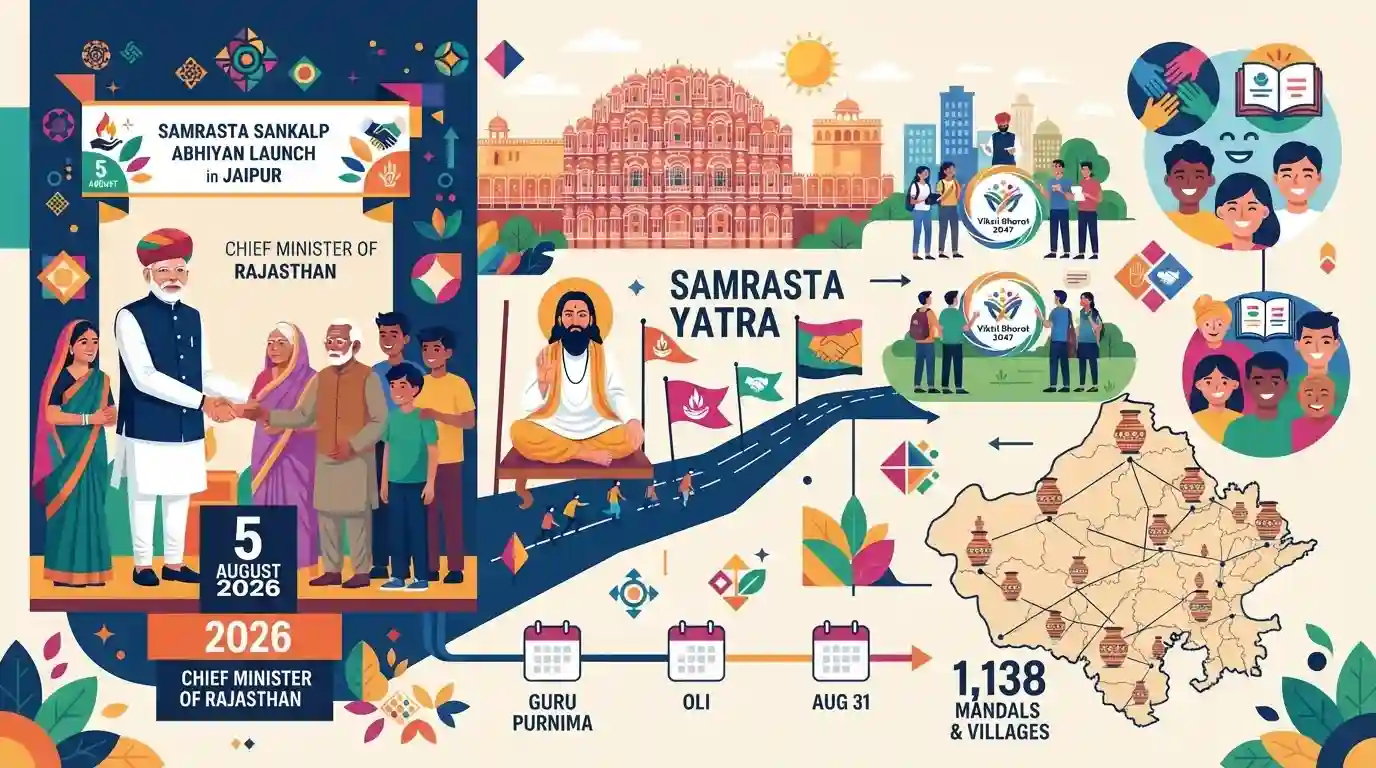
On August 5, 2026, Rajasthan Chief Minister Bhajanlal Sharma launched the 'Samrasta Sankalp Abhiyan' in Jaipur to promote social harmony and national unity. Inspired by the teachings of the medieval Bhakti saint Sant Ravidas, the campaign aims to spread messages of social justice, equality, and brotherhood. The initiative, which started in Kashi on Guru Purnima, runs till August 31, 2026, and features the 'Guru Ravidas Samrasta Yatra', youth outreach on 'Viksit Bharat 2047', and the transport of sacred soil urns to 1,138 mandals and villages throughout Rajasthan.
Key Points
- Rajasthan Chief Minister Bhajanlal Sharma launched the state-level 'Samrasta Sankalp Abhiyan' to promote social harmony, Sanatan cultural consciousness, and national unity.
- The campaign is inspired by the teachings of Bhakti movement saint Sant Ravidas, emphasizing equality, brotherhood, humanity, and rising above caste divisions.
- The campaign was initiated from Kashi on the occasion of Guru Purnima and involves carrying sacred soil urns to all 1,138 mandals and villages across Rajasthan.
- Running until August 31, 2026, the campaign includes honoring local saints and seers, organizing the 'Guru Ravidas Samrasta Yatra', and conducting youth and student outreach programs.
- Prominent figures attending the launch included Lalsingh Arya (National Convener), Madan Rathore (BJP State President), Premchand Bairwa, and Diya Kumari (Deputy CMs).
Important Terms
Samrasta Sankalp Abhiyan

A nationwide campaign launched in July 2026 to mark the 650th birth anniversary of Sant Ravidas, aimed at promoting social justice, equality, and national harmony.
UPSC context
Relevant for GS Paper I (Culture) and GS Paper II (Social Justice) regarding socio-cultural integration and modern harmony campaigns.
Sant Ravidas
A revered 15th-16th century Bhakti movement mystic poet, reformer, and disciple of Ramananda who championed Nirguna Bhakti, spiritual equality, and the egalitarian concept of 'Begumpura'.
UPSC context
Essential for GS Paper I (Art & Culture) focusing on Bhakti saints, medieval social reform, and philosophical literature.
Viksit Bharat 2047
The Indian government's strategic vision to transform India into a developed, self-reliant nation by 2047, focusing on four pillars: youth, poor, women, and farmers.
UPSC context
Highly relevant for GS Paper III (Economy and Inclusive Growth) testing national development targets and long-term socio-economic planning.
Guru Ravidas Samrasta Yatra
A prominent foot march organized under the Samrasta Sankalp Abhiyan from Jalandhar to Varanasi, spreading Sant Ravidas’s teachings of equality, harmony, and national integration.
UPSC context
Relates to GS Paper I (Art & Culture) and GS Paper II (Social Integration) regarding mass-mobilization techniques for social reform.
Prelims Trap
Sant Ravidas belonged to the Saguna Bhakti tradition because he is traditionally revered as the guru of Mirabai.
While Mirabai (a Saguna devotee of Krishna) revered Ravidas as her spiritual guru, Ravidas himself was a strict proponent of the Nirguna tradition (formless divine).
Static Concepts Connected
What are the key spiritual and social contributions of Sant Ravidas?
- Nirguna philosophy: Advocated worship of a formless, attribute-less divine, strongly rejecting idol worship, ritualism, and caste-based hierarchies.
- Scriptural presence: His spiritual hymns are preserved in the Sikh holy text Guru Granth Sahib (41 verses) and the Dadu Panthi Panchvani.
- Begumpura concept: Envisioned 'Begumpura'—a utopian city without sorrow, taxes, or social discrimination, reflecting early ideals of social democracy.
What was Ramananda's role in the North Indian Bhakti movement?
- Northward transition: Credited with bringing the Bhakti movement from South to North India, bridging the gap between Sanskrit scriptures and vernacular outreach.
- Egalitarian discipleship: Initiated disciples regardless of caste, gender, or creed, including Sant Ravidas (cobbler), Kabir (weaver), and Dhanna (peasant).
Cross-Topic Patterns
Bhakti philosophy and modern statecraft
State campaigns leverage medieval concepts like Ravidas's 'Begumpura' to reinforce constitutional values of fraternity, social justice, and welfare politics.
Sikh canon and subcontinental integration
The inclusion of non-Sikh Nirguna saints (Bhagats like Ravidas and Namdev) in the Adi Granth highlights early cross-regional spiritual integration in India.

GS-1 Prelims frequently tests Nirguna vs Saguna classifications; expect questions pairing Sant Ravidas's 'Begumpura' with his teachings.
Linked PYQs · 2
Linked PYQs · 2
- 2025RPSC_PRELIMSGS1
Which of the following statements is not true in relation to the Bhakti Movement?
- 2024RPSC_PRELIMSGS1
Which of the following statements is not correct regarding the Bhakti Movement?
