Rajasthan launches drone seeding and afforestation mission in Udaipur
Source:punjab-kesari ↗
Why It Matters
Important for RPSC Prelims regarding state environmental schemes (Mission Hariyalo Rajasthan, Namo Nurseries), geographical coverage of specific projects (sandalwood forests in Udaipur, Sirohi, etc.), and the use of technology (drone seeding) in afforestation.
Summary
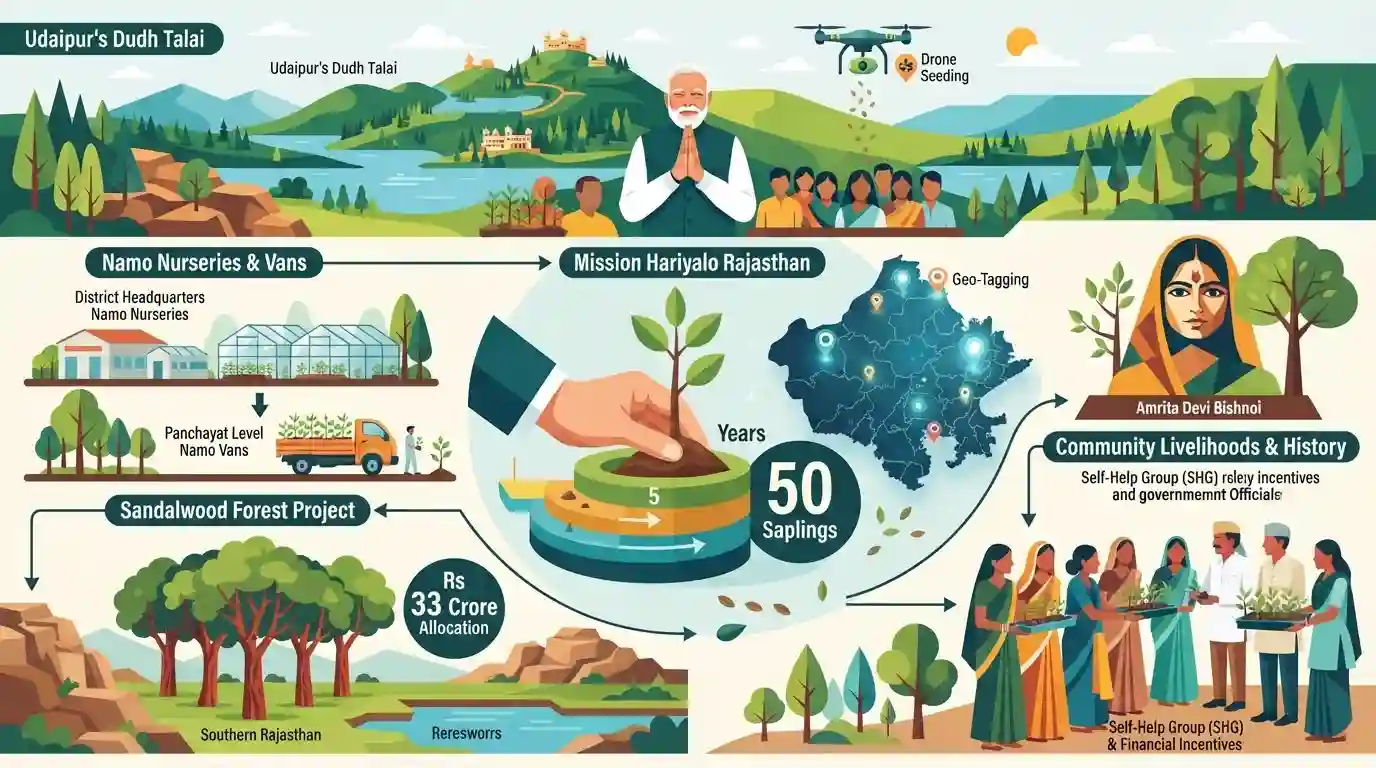
Rajasthan Chief Minister Bhajan Lal Sharma inaugurated the state-level Van Mahotsav at the Dudh Talai forest range in Udaipur, launching a drone seeding process to enhance green cover. He highlighted 'Mission Hariyalo Rajasthan', which targets planting 50 crore saplings over five years, with technological tracking via geo-tagging. Key initiatives announced include the creation of 'Namo Nurseries' at district headquarters, 'Namo Vans' at the Panchayat level, and a Rs 33 crore sandalwood forest project focusing on southern Rajasthan districts. The government is also integrating livelihood generation with conservation by distributing incentives to self-help groups under the Rajasthan Forestry and Biodiversity Project, drawing inspiration from historical figures like Amrita Devi Bishnoi.
Key Points
- Rajasthan CM launched drone seeding and inaugurated the state-level Van Mahotsav at Dudh Talai forest range in Udaipur.
- Mission Hariyalo Rajasthan aims to plant 50 crore saplings over five years, supported by geo-tagging and caretakers like Van Mitras.
- A Rs 33 crore sandalwood forest project was initiated, initially covering Udaipur, Sirohi, Banswara, and Pratapgarh.
- Namo Nurseries (district level) and Namo Vans (Panchayat Samiti level) will be established to enhance afforestation.
- Livelihood incentives were distributed to 600 self-help groups under the Rajasthan Forestry and Biodiversity Project, linking conservation with employment.
Important Terms
Mission Hariyalo Rajasthan

A Rajasthan government afforestation initiative targeting 50 crore saplings over five years to boost green cover, utilizing drone seeding, geo-tagging, and community tracking.
UPSC context
GS Paper III (Environment); tests state-level climate change mitigation, sustainable forestry models, and technological integration in ecological governance.
Ek Ped Maa Ke Naam
A nationwide mass plantation drive launched by Prime Minister Narendra Modi on World Environment Day 2024, encouraging citizens to plant trees in honor of their mothers.
UPSC context
GS Paper III (Environment); tests public-private partnership in conservation, community-led afforestation, and emotional-cultural approaches to sustainable development.
Nagar Van Yojana
A central scheme launched in 2020 by the Ministry of Environment to develop urban forests and green spaces, improving urban microclimates, biodiversity, and air quality.
UPSC context
GS Paper I & III (Urbanization/Environment); tests urban planning, city climate resilience, micro-ecosystems, and municipal-level green interventions.
CAMPA Fund
A fund created under the Compensatory Afforestation Fund Act, 2016, managing monetary deposits from industries diverting forest lands to finance afforestation, restoration, and conservation.
UPSC context
GS Paper III (Environment); evaluates statutory mechanisms, environmental governance, forest conversion laws, and financial channels for ecological restoration.
Green India Mission
One of India’s eight National Action Plan on Climate Change (NAPCC) missions, aimed at protecting, restoring, and increasing forest and tree cover to tackle climate change.
UPSC context
GS Paper III (Environment & Climate Change); tests climate action frameworks, national mitigation policies, and India's commitments under the Paris Agreement.
Rajasthan Forestry and Biodiversity Project
A multi-phase project funded by international agencies like JICA and AFD to restore forest ecosystems, conserve biodiversity, and build sustainable livelihoods for forest-dependent communities.
UPSC context
GS Paper III (Environment & Livelihood); evaluates Joint Forest Management, externally aided conservation projects, and community-driven resource management.
Prelims Trap
Indian Sandalwood is exclusively found in the moist evergreen forests of South India.
Sandalwood is primarily a dry deciduous species. Its large-scale cultivation in southern Rajasthan proves it adapts to semi-arid, well-drained regions, not just southern tropical forests.
Static Concepts Connected
What are the key ecological characteristics of Indian Sandalwood (Santalum album)?
- Root hemiparasite: It acts as a root hemiparasite, meaning it relies on absorbing water and nutrients from the roots of nearby host plants during its early growth stages.
- Habitat: It thrives primarily in dry deciduous forests with well-drained soils, making regions in southern Rajasthan suitable for its cultivation.
- IUCN Status: Due to overexploitation and smuggling, it is currently classified as 'Vulnerable' on the IUCN Red List.
What is the ecological significance of the Khejri tree (Prosopis cineraria) in arid ecosystems?
- Nitrogen-fixing: As a leguminous tree, it enriches soil fertility in nutrient-poor desert regions by fixing atmospheric nitrogen.
- Drought-resistant: It possesses a deep taproot system, which helps stabilize shifting sand dunes and prevents severe desertification.
- Conservation history: It is a cultural keystone species, famously protected by the Bishnoi community during the 1730 Khejarli massacre led by Amrita Devi.
Cross-Topic Patterns
UAVs in ecological restoration
Drone seeding using biochar-coated seed balls connects with General Science applications of UAVs, previously tested in Prelims regarding agriculture, surveying, and payload delivery.
Bilateral aid in local conservation
The involvement of the Japanese International Cooperation Agency (JICA) in Rajasthan highlights a recurring theme of foreign bilateral funding driving state-level biodiversity and SHG livelihood projects.

Expect a multi-statement question merging plant parasitism (Sandalwood as hemiparasite), dry deciduous habitats, and drone seeding.
Linked PYQs · 2
Linked PYQs · 2
- 2025RPSC_PRELIMSGS1
Choose the incorrect statement with respect to the Rajasthan Forestry and Biodiversity Project (Phase-2).
- 2023RPSC_PRELIMSGS1
According to the India State Forest Report 2021, the forest area, in terms of forest cover, is 16,654 sq km, which is ___ percent of Rajasthan's geographical area.
