Rajasthan Launches Cooperative Ride Hailing Platform Bharat Taxi
Source:newsbytesapp ↗
Why It Matters
This represents a pioneering policy experiment in the urban transport and gig economy sector. By transitioning gig workers into cooperative shareholders ('Sarathis'), Rajasthan showcases a repeatable model to combat platform exploitation, improve worker social security, and deliver stable public pricing.
Summary
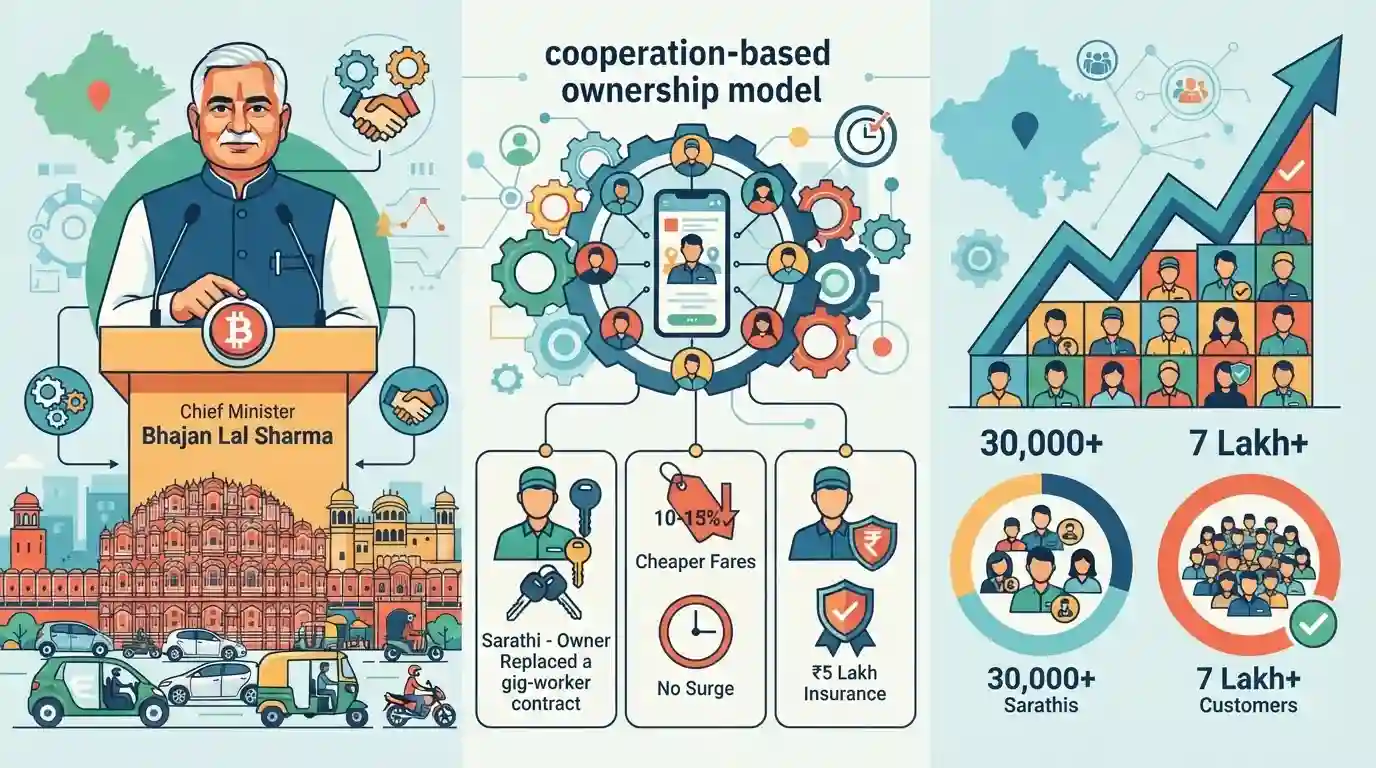
Rajasthan Chief Minister Bhajan Lal Sharma launched 'Bharat Taxi,' India's first government-backed cooperative ride-hailing platform, in Jaipur. Operating on a cooperation-based ownership model, the platform registers taxi, bike, and auto drivers as 'Sarathis' (owners) rather than gig-contractors. It promises fares 10-15% cheaper than private aggregators, no surge pricing, and a ₹5 lakh accident insurance coverage for its drivers. Since its soft launch, it has onboarded over 30,000 drivers and seven lakh customers, signaling a massive push toward cooperative-driven urban mobility and welfare.
Key Points
- Rajasthan Chief Minister Bhajan Lal Sharma launched 'Bharat Taxi,' a novel government-backed cooperative ride-hailing platform, at HCM RIPA in Jaipur.
- The platform runs on a cooperative business model where taxi, bike, and auto drivers become 'Sarathis' (owners) and members of the cooperative, receiving direct payments and a share of the cooperative's dividends.
- Bharat Taxi offers fares 10-15% lower than private platforms like Ola and Uber, with a strict policy of no surge pricing during peak hours.
- Passenger safety and support features include local drivers, a dedicated SOS emergency tool, and robust customer support.
- Drivers are provided with an accident insurance cover of up to ₹5 lakh.
- Since the platform's soft launch, over 30,000 Sarathis have registered, and nearly 7 lakh users have signed up in Jaipur.
- The launch event was attended by Union Minister of State for Cooperation Muralidhar Mohol and Rajasthan Minister of State for Cooperation (Independent Charge) Gautam Dak.
Important Terms
Bharat Taxi

India's first cooperative-led ride-hailing platform. Registered under the Multi-State Cooperative Societies Act, it makes drivers ('Sarathis') co-owners and shareholders, ensuring zero-commission earnings, no surge pricing, and social security benefits like insurance.
UPSC context
Highly relevant for GS-3 (Gig Economy & Employment) as an innovative, welfare-driven cooperative alternative to corporate transport aggregators.
Ministry of Cooperation
A central ministry created in 2021 to strengthen India's cooperative movement under the vision of "Sahakar Se Samriddhi." It actively supports diversifying cooperative societies into new areas like urban mobility, agriculture, and digital services.
UPSC context
Important for GS-2 (Governance/Statutory Bodies), testing knowledge of policy interventions that formalize grassroots economic organizations.
Rajasthan Department of Cooperation
The state nodal agency in Rajasthan tasked with expanding and managing the cooperative network. It played a crucial role in implementing and integrating the Bharat Taxi initiative with local public infrastructure.
UPSC context
Relevant for GS-2 (State Policies) and Rajasthan PCS, showcasing state-level execution of central cooperative paradigms.
HCM RIPA
Harish Chandra Mathur Rajasthan State Institute of Public Administration is a premier civil service training institute in Jaipur. It regularly hosts major state policy events, including the formal inauguration of the Bharat Taxi service.
UPSC context
Useful for GS-2 (Role of Civil Services) and specific state-level PCS questions regarding administrative training infrastructure.
Prelims Trap
Bharat Taxi is a state-level public enterprise registered under the Rajasthan Cooperative Societies Act.
It is operated by Sahakar Taxi Cooperative Limited, which is registered under the central Multi-State Cooperative Societies Act, 2002, and promoted by national entities like NCDC.
Static Concepts Connected
What are the key features of the Multi-State Cooperative Societies (MSCS) Act?
- Central Regulation: Registered and regulated by the Central Registrar of Cooperative Societies under the Ministry of Cooperation, rather than by individual state governments.
- Broad Jurisdiction: Applies to cooperative societies whose objectives and operations serve the interests of members in more than one state.
- Recent Reforms: Recent amendments introduced a Cooperative Election Authority to ensure fair elections and mandated concurrent audits to enhance transparency.
How does India manage welfare and definitions for gig/unorganized workers?
- e-Shram Portal: A centralized national database for unorganized and gig workers to seamlessly deliver targeted social security and central welfare programs like PM-JAY.
- Social Security Code: The 2020 Code formally recognizes gig and platform workers, theoretically mandating aggregators to contribute a percentage of turnover to a social security fund.
Cross-Topic Patterns
Platform Cooperativism vs Gig Economy
Bharat Taxi shifts drivers from gig contractors to member-owners, actively countering the algorithmic management and exploitation issues that recently prompted the Rajasthan Gig Workers Act.
DPI advancing urban mobility
Integrating ride-hailing with Digital Public Infrastructure (DigiLocker, e-Shram) illustrates the rapid expansion of India's digital stack from fintech into welfare-linked urban transport models.

Expect a 2026 Prelims question comparing the Multi-State Cooperative Societies Act with standard gig worker regulations and DPI frameworks.
Linked PYQs · 2
Linked PYQs · 2
- 2025RPSC_PRELIMSGS1
What is the objective of the Chief Minister Swanidhi Yojana in Rajasthan?
- 2024RPSC_PRELIMSGS1
Which of the following has been formed in place of Chief Minister's Rajasthan Economic Transformation Advisory Council (CMRETAC)?
