Rajasthan Police Accountability Enforced by Chief Minister
Source:aninews ↗
Why It Matters
This high-level administrative directive underscores Rajasthan's current police and security policy priorities. It emphasizes decentralized accountability down to Range IGs and district SPs, the financial dismantling of criminal networks, cyber patrolling against digital arrest scams, and the active involvement of citizen-centric institutions like Community Liaison Groups (CLGs). Understanding these mechanisms is crucial for RPSC RAS GS-II (Polity & State Administration) and GS-III (Law, Cyber Security & Contemporary Issues in Rajasthan).
Summary
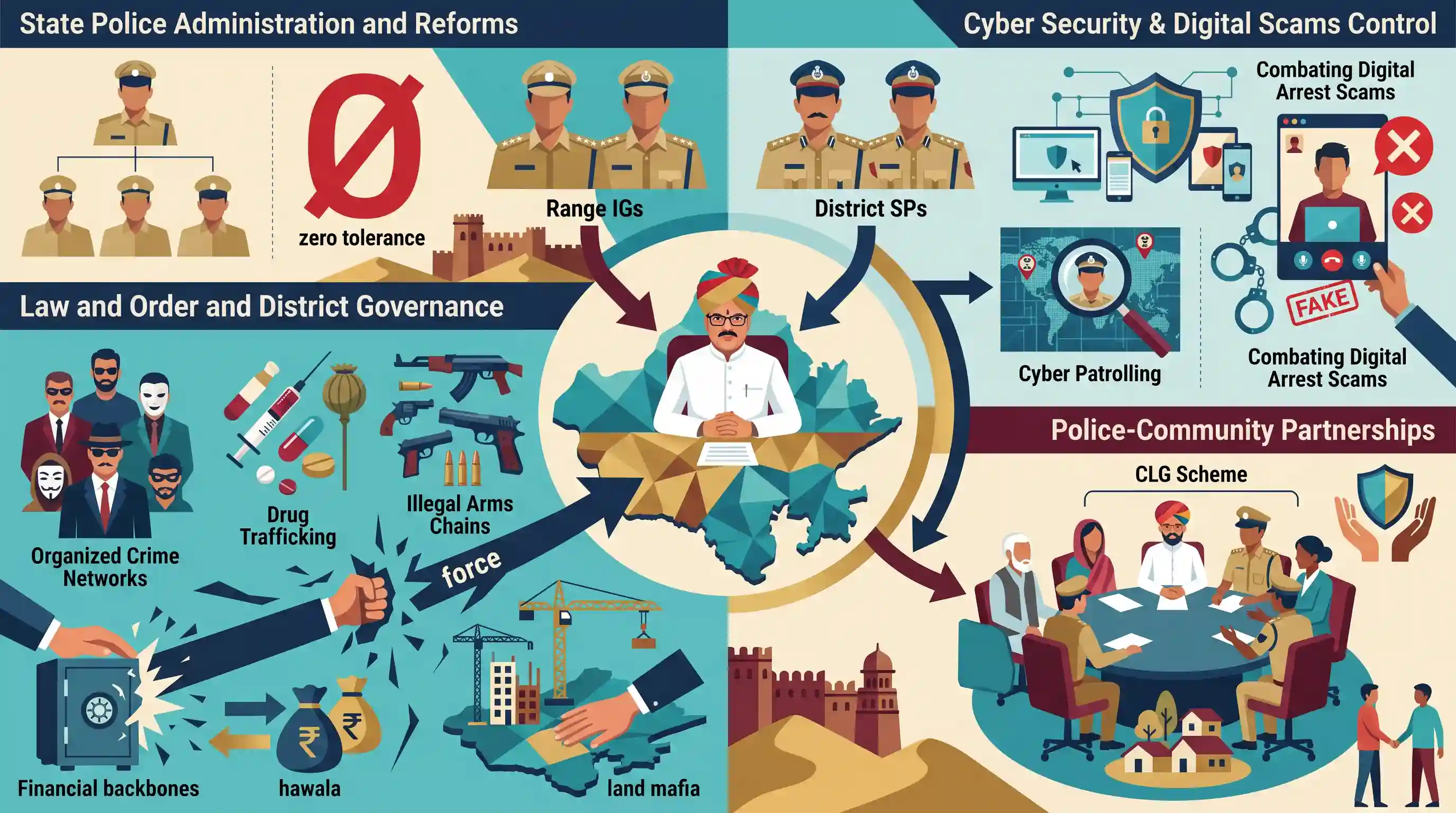
Rajasthan Chief Minister Bhajan Lal Sharma chaired a high-level review meeting to strengthen the state's law and order. Implementing a zero-tolerance policy, the CM held Range IGs and district SPs directly accountable for security in their jurisdictions. He directed state police to dismantle organized crime networks, drug trafficking syndicates, and illegal arms chains while crippling their financial backbones (such as hawala and land mafias). The meeting emphasized cyber security initiatives like cyber patrolling and combating digital arrest scams, alongside leveraging the Community Liaison Group (CLG) model to reinforce grassroots public-police partnership.
Key Points
- Rajasthan Chief Minister Bhajan Lal Sharma chaired a high-level review meeting in Jaipur to evaluate the state's law and order situation, declaring a zero-tolerance policy against crime.
- The Chief Minister declared that Range Inspector Generals (IGs) and district Superintendents of Police (SPs) will be held directly accountable for crimes and operational failures in their respective jurisdictions.
- The police department was directed to dismantle entire criminal networks—including organized crime syndicates, illegal weapons suppliers, and drug traffickers—rather than just arresting lower-level offenders.
- A special focus was put on the financial ecosystems of criminal syndicates, targeting hawala operations, land mafia activities, and illegal assets accumulated through drug trafficking.
- To counter the rising threat of cybercrime, the CM directed the strengthening of cyber patrolling, deployment of dedicated personnel in cyber cells, and swift action against digital arrest scams and online fraud.
- Regular Community Liaison Group (CLG) meetings across all districts were mandated to enhance coordination between local police and the public and resolve community issues effectively.
Important Terms
Narcotic Drugs and Psychotropic Substances (NDPS) Act

A 1985 central legislation that prohibits the cultivation, production, sale, possession, and consumption of narcotic drugs and psychotropic substances except for medical or scientific purposes.
UPSC context
GS Paper II (Government Policies) & Paper III (Internal Security); tests statutory frameworks controlling drug abuse and trafficking.
Community Liaison Group (CLG)
A community policing scheme in Rajasthan, legally backed by the Rajasthan Police Act 2007, involving local citizens to partner with the police in crime prevention and dispute resolution.
UPSC context
GS Paper II (Governance) & Paper III (Internal Security); tests community policing models and public-police coordination.
Rajasthan Police
The state-level law enforcement agency responsible for maintaining law and order, preventing crime, and ensuring public safety under the administrative control of the state's Home Department.
UPSC context
GS Paper III (Internal Security); tests understanding of state law enforcement machinery and police reforms.
Home Department
A crucial state government administrative department overseeing internal security, law and order, police administration, prisons, and civil defense within the state.
UPSC context
GS Paper II (State Executive & Administration); tests state machinery for public safety and law enforcement.
Chief Minister's Office
The administrative office supporting the state's Chief Minister, responsible for executive decision-making, policy monitoring, inter-departmental coordination, and direct administrative supervision.
UPSC context
GS Paper II (State Executive); tests executive machinery, state leadership, and public policy implementation structures.
Prelims Trap
Indian cyber laws or BNSS empower law enforcement to place suspects under 'digital arrest' via interactive video calls under emergency protocols.
There is absolutely no provision under the Bharatiya Nagarik Suraksha Sanhita (BNSS), CrPC, or the Information Technology Act for any form of 'digital arrest' or remote judicial custody via video calls.
Static Concepts Connected
What is the constitutional status of Police and Public Order in India?
- Seventh Schedule Status: Under Entry 2 (Police) and Entry 1 (Public Order) of List II (State List) of the Seventh Schedule, states hold primary legislative and executive power.
- Prakash Singh Directives: The landmark Prakash Singh Case (2006) directed states to establish State Security Commissions, Police Establishment Boards, and Police Complaints Authorities.
How is organized crime legislated in India at the Central and State levels?
- BNS Codification: Section 111 of the Bharatiya Nyaya Sanhita (BNS), 2023, formally codifies and defines organized crime as a distinct central offense.
- State Legislations: States like Maharashtra (MCOCA), Karnataka (KCOCA), and Gujarat (GUJCTOC) enacted special state-level laws to tackle localized syndicates before BNS was introduced.
Cross-Topic Patterns
Community policing and internal security
Programs like Rajasthan's CLG or Kerala's Janamaithri show how structured public-police trust acts as a first line of defense against both petty local crime and deep-rooted radicalization.
Federalism and cybercrime jurisdiction
As 'Police' is a state subject, cross-border cybercrimes like 'digital arrests' exploit jurisdictional friction, highlighting the urgent need for central-state coordination platforms like I4C.

BNS organized crime provisions vs state legislations and community policing models is a high-potential GS3 internal security theme for 2026.
Linked PYQs · 3
Linked PYQs · 3
- 2024RPSC_PRELIMSGS1
Which of the following has been formed in place of Chief Minister's Rajasthan Economic Transformation Advisory Council (CMRETAC)?
- 2025RPSC_PRELIMSGS1
Who becomes the Chairman of the District Planning Committee in Rajasthan?
- 2023RPSC_PRELIMSGS1
Which company was established by the Government of Rajasthan in the 21st century with the objective of developing information technology (IT) skills?
