Rajasthan Electric Bus Deployment Across Eight Urban Centers
Source:first-india ↗
Why It Matters
The electrification of urban public transport is a crucial step towards reducing vehicular emissions and achieving India's climate goals. The implementation of the PM e-Bus Sewa scheme in Rajasthan showcases the ongoing efforts to modernize urban infrastructure and promote sustainable mobility in major cities.
Summary
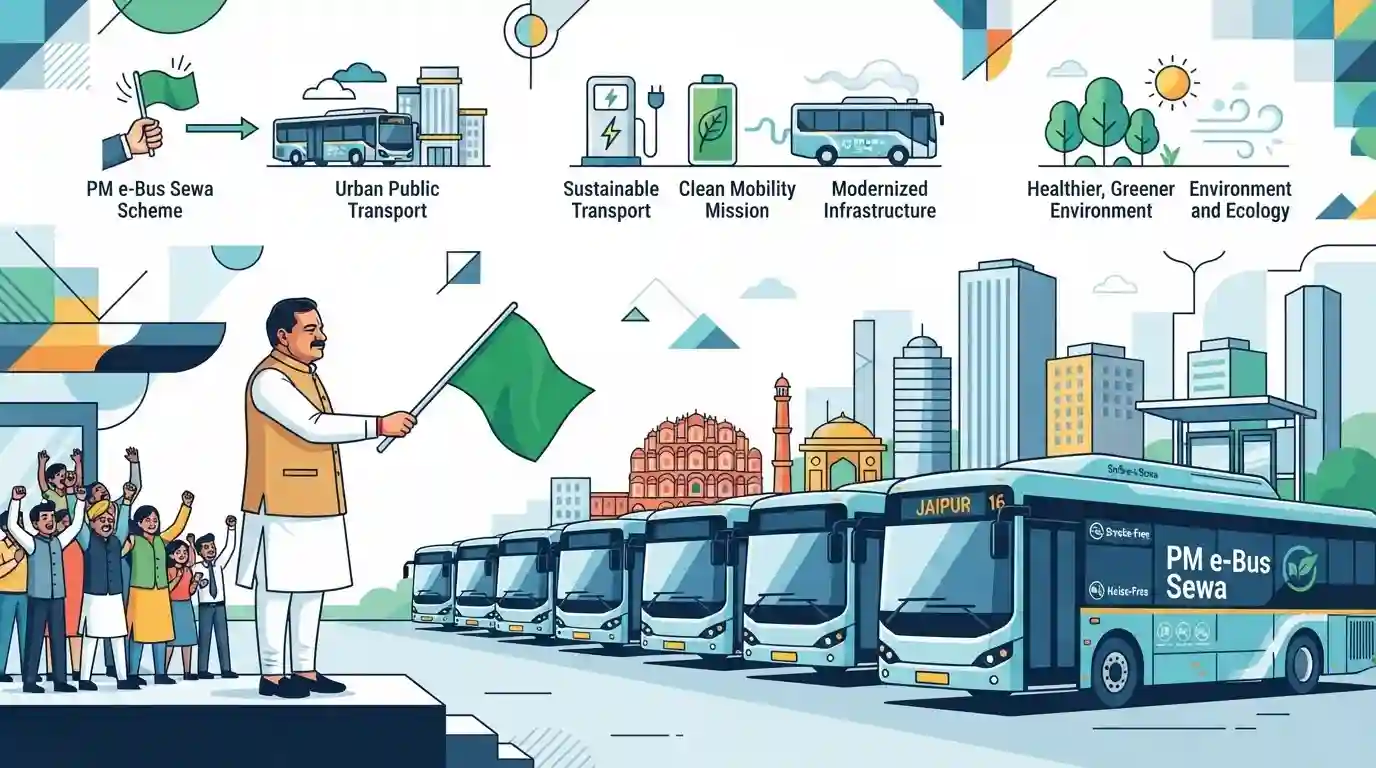
Rajasthan Chief Minister Bhajan Lal Sharma flagged off 110 electric buses across eight cities in the state, including 16 for Jaipur, under the central government's PM e-Bus Sewa scheme. The deployment of these smoke-free and noise-free buses is part of a broader clean mobility mission aimed at modernizing urban public transport and ensuring a healthier, greener environment.
Key Points
- Rajasthan CM Bhajan Lal Sharma launched 110 electric buses across eight cities in the state.
- 16 of these e-buses were specifically flagged off for Jaipur.
- The buses were launched under the central government's PM e-Bus Sewa scheme.
- The initiative aligns with the national clean mobility mission, aiming to provide smoke-free and noise-free public transport for a healthier environment.
Important Terms
PM e-Bus Sewa Scheme

A central scheme deploying 10,000 electric buses in eligible cities via a Public-Private Partnership model to improve urban public transport and reduce vehicular emissions.
UPSC context
Tests GS-2 and GS-3. Highlights clean mobility interventions, urban infrastructure development, and India's transition to sustainable public transport.
Gross Cost Contract (GCC)
A PPP framework where a private operator procures and maintains buses while the public authority pays a fixed per-kilometer rate, mitigating upfront capital burdens.
UPSC context
Relevant for GS-3 (Investment Models). It tests understanding of how financial and operational risks are distributed in infrastructure projects.
Payment Security Mechanism (PSM)
A dedicated government fund acting as a financial backstop, ensuring timely payments to private operators if city transport authorities default on their monthly dues.
UPSC context
Vital for GS-3 (Infrastructure). Demonstrates administrative methods used to de-risk private sector investments and improve public transport bankability.
Clean Mobility
Sustainable transport solutions, such as deploying electric vehicles, designed to minimize greenhouse gas emissions, combat urban air pollution, and reduce fossil fuel dependency.
UPSC context
Core to GS-3 (Environment). Links directly to India's climate change commitments, the Panchamrit strategy, and achieving Net Zero.
Prelims Trap
Under PM e-Bus Sewa, the Central Government covers all operational costs and directly runs the buses.
The Centre only provides a per-km subsidy for up to 10 years. States and City administrations bear full responsibility for operations and paying PPP operators.
Static Concepts Connected
What are the core implementation pillars of the PM-eBus Sewa scheme?
- PPP Model: Targets cities with 3L+ population via a Public-Private Partnership; the Centre provides per-km subsidies.
- State Responsibility: State and city administrations manage routes, run services, and pay private operators.
- Green Infra: Funds 'behind-the-meter' power infrastructure and National Common Mobility Card automated fare systems.
What schemes drive India’s electric vehicle (EV) manufacturing and adoption ecosystem?
- PM E-DRIVE: The successor to FAME-II, aimed at accelerating domestic EV demand and public charging infrastructure.
- PLI for ACC: Production-Linked Incentive for Advanced Chemistry Cells to localize and boost battery manufacturing.
- KABIL JV: Strategic procurement of critical minerals like lithium and cobalt to secure EV supply chains.
Cross-Topic Patterns
EV adoption & Critical Minerals
Scaling public EVs under PM e-Bus Sewa directly tests India's supply chain security for lithium and cobalt, bringing strategic bodies like KABIL into the mobility discourse.
ULB Finances & PPP viability
Since operational payments fall on city administrations, this scheme exposes the weak revenue streams of Urban Local Bodies (ULBs) and tests municipal PPP frameworks.

Expect a multi-statement question interlinking PM e-Bus Sewa's PPP model, PM E-DRIVE, and India's critical mineral supply chains in 2026.
Linked PYQs · 3
Linked PYQs · 3
- 2025RPSC_PRELIMSGS1
What is the main objective of the “Rajasthan Urban Area Development Program (Phase-III)”?
- 2024RPSC_PRELIMSGS1
Which sanitation related initiative of the Government of Rajasthan was launched in 2022-23? A. Jaipur 301, B. Jaipur 301 Select the correct answer using the codes given below:
- 2021RPSC_PRELIMSGS1
In which year was the Rajasthan Solar Energy Policy announced?
