Bengaluru Land Sought for Rajasthan Cultural Center by Chief Minister
Source:timesofindia ↗
Why It Matters
The initiative underscores the state government's efforts to foster cultural ties, provide logistical support, and maintain engagement with its migrant population (Non-Resident Rajasthanis) across India. Knowledge of bodies like the Rajasthan Foundation and state-level diaspora policies is crucial for RPSC exams covering state governance and cultural promotion.
Summary
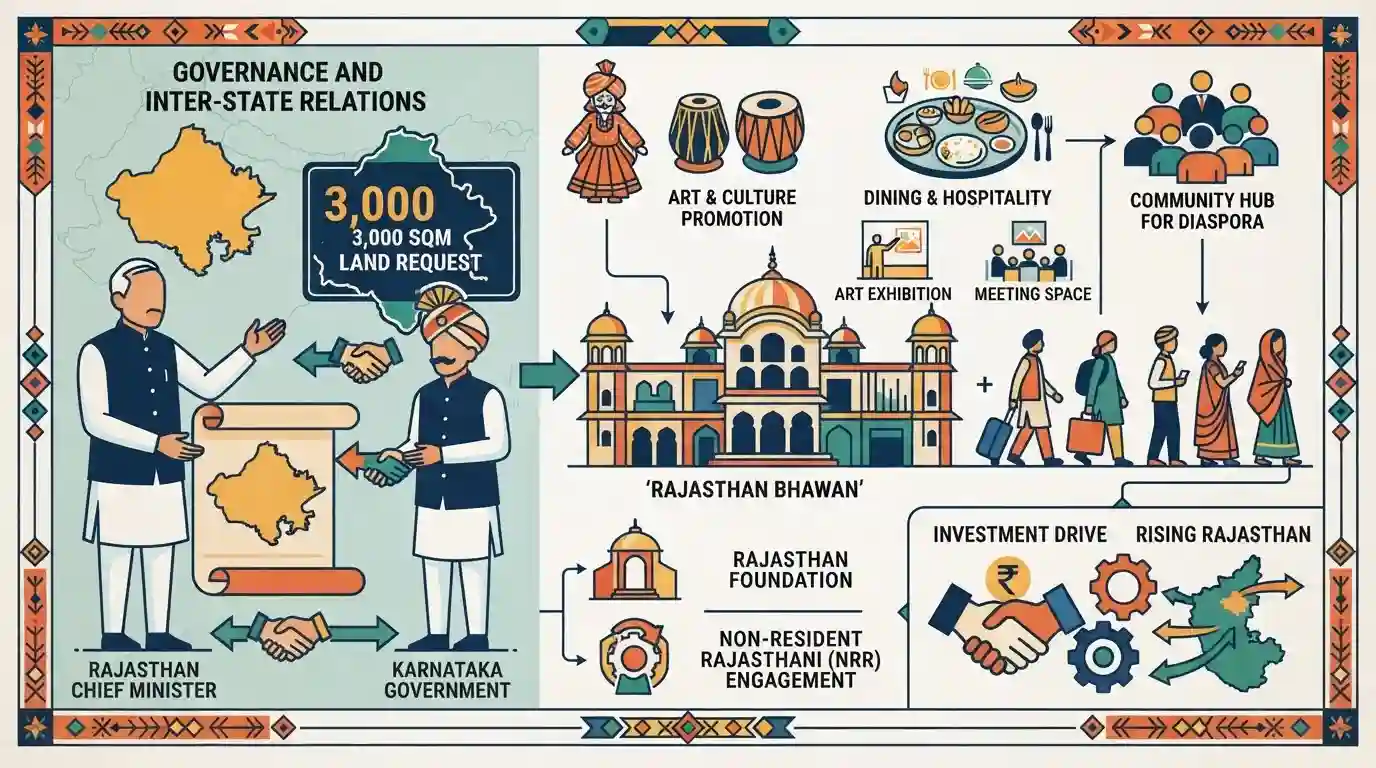
Rajasthan Chief Minister Bhajan Lal Sharma has urged the Karnataka government to allocate 3,000 square metres of land in Bengaluru for the construction of a 'Rajasthan Bhawan'. This proposed cultural and community center is intended to support the Rajasthani diaspora in Karnataka, serving as a hub for cultural exchange, art exhibitions, and traditional hospitality. The Rajasthan Foundation, the state's nodal agency for engaging with Non-Resident Rajasthanis (NRRs), will oversee the project's execution. This initiative follows the establishment of similar Rajasthan Bhawans in various other Indian states and coincides with efforts to woo investors from Karnataka through the 'Rising Rajasthan' summit.
Key Points
- Rajasthan Chief Minister Bhajan Lal Sharma requested Karnataka Chief Minister Siddaramaiah to allocate 3,000 square meters of land in Bengaluru for a proposed 'Rajasthan Bhawan'.
- The facility aims to cater to the significant Rajasthani diaspora residing in Karnataka by providing cultural, hospitality, and residential amenities, as well as an exhibition hall for Rajasthani art.
- The project will be executed by the Rajasthan Foundation, the nodal agency for Non-Resident Rajasthanis (NRRs), ensuring connectivity between the diaspora and their home state.
- Rajasthan has previously established similar cultural centers (Rajasthan Bhawans) in states like Maharashtra, New Delhi, Chandigarh, Telangana, and Uttar Pradesh.
- The request occurred alongside the 'Rising Rajasthan' investor meet held in Bengaluru to attract investment to Rajasthan.
Important Terms
Rising Rajasthan Summit

A major global investment summit organized by the Rajasthan government to attract domestic and international private sector capital, aiming to drive unprecedented and inclusive socio-economic development.
UPSC context
Relevant for GS Paper 3 (Economic Development) and GS Paper 2, showcasing competitive federalism and sub-national investment mobilization.
Rajasthan Foundation
The official nodal agency established by the Rajasthan government to strengthen bonds with the global and domestic Rajasthani diaspora, facilitating their participation in the state's socio-economic and cultural development.
UPSC context
Important for GS Paper 2 (Governance, Diaspora Policies). It highlights state-level institutional frameworks for diaspora engagement and development.
Rajasthan Bhawan
State-sponsored cultural and community centers located in major host cities (like Bengaluru) to support internal migrants, serving as hubs for traditional hospitality, networking, and inter-state cultural exchange.
UPSC context
Explores GS Paper 1 and 2 topics regarding internal migration, preservation of regional culture, and cooperative inter-state relations.
Non-Resident Rajasthanis (NRR)
The Rajasthani diaspora living outside the state or abroad, formally recognized by state policy to encourage their continued cultural engagement, philanthropic contributions, and investment in their home state.
UPSC context
Ties into GS Paper 2 (Government Policies). Illustrates how sub-national governments actively utilize diaspora networks for regional economic growth.
Prelims Trap
"State diaspora foundations exclusively engage with Overseas Citizens of India and NRIs residing abroad."
UPSC usually frames "diaspora" internationally. However, state agencies like the Rajasthan Foundation cater heavily to the "internal diaspora"—Non-Resident Rajasthanis living in other Indian states.
Static Concepts Connected
What constitutional provisions protect the rights of internal migrants in India?
- Article 19(1)(d): Guarantees the fundamental right of all citizens to move freely throughout the territory of India, facilitating internal mobility.
- Article 19(1)(e): Protects the right to reside and settle in any part of the Indian territory, allowing communities to establish themselves outside their home states.
- Article 15(1): Prohibits discrimination by the State against any citizen on grounds exclusively including place of birth.
How do state investor summits demonstrate competitive federalism?
- Capital Attraction: States actively compete with one another across borders to attract domestic and foreign private investment by hosting tailored summits in rival economic hubs.
- Policy Innovation: States reform labour laws, provide single-window clearances, and offer customized tax incentives to out-perform peer states in the ease of doing business.
- Diaspora Leveraging: States systematically target their own affluent internal migrants living in wealthier states to channel investments back to their home regions.
Cross-Topic Patterns
Competitive Federalism & Internal Diaspora
While internal migration is often studied via a distress lens (unskilled labour), this highlights the organized mobilisation of an affluent internal diaspora for state economic growth and capital investment.
Ek Bharat Shreshtha Bharat Ethos
Establishing State Bhawans in various commercial capitals aligns with the ethos of fostering inter-state cultural understanding and showcasing regional heritage, art, and traditional hospitality across India.

Mains 2026 could test how competitive federalism is evolving from passive policy tweaks to active "internal paradiplomacy" between states.
