Rajasthan caste panchayat smartphone ban on women triggers protests
Source:Indian Express ↗
Why It Matters
The issue perfectly illustrates the ongoing tension between traditional societal structures (caste panchayats) and modern constitutional rights. It is highly relevant for GS-1 (Society and Women Empowerment) and GS-2 (Governance, Extra-constitutional bodies, and Fundamental Rights) regarding the role of informal justice delivery systems and human rights violations.
Summary
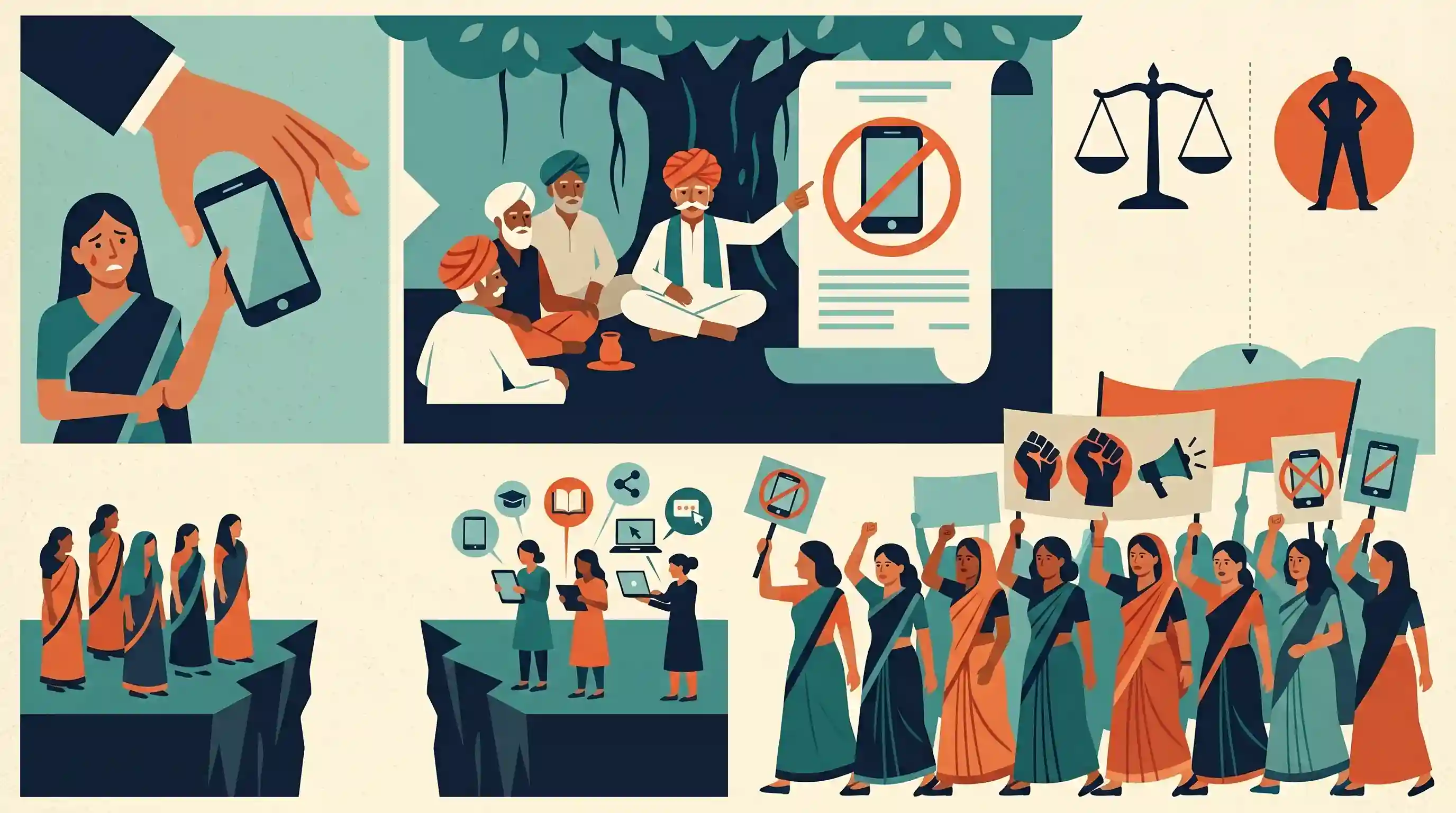
A caste panchayat in Rajasthan has issued a diktat banning women from using smartphones, sparking protests among the local community. The move represents a stark example of patriarchal control, seeking to restrict women's autonomy, communication, and access to the digital world. Such extra-constitutional pronouncements by caste or khap panchayats routinely violate fundamental rights, such as the Right to Equality (Article 14) and Right to Life and Personal Liberty (Article 21). The ensuing protests signal an increasing awareness and pushback against archaic traditions that impede women's empowerment and perpetuate the digital gender divide.
Key Points
- A caste panchayat in Rajasthan has issued a regressive diktat prohibiting women from using smartphones.
- The ban has triggered local protests, reflecting growing resistance against patriarchal decrees and extra-constitutional bodies attempting to control women's autonomy.
- Restricting access to technology exacerbates the digital gender divide and hampers women's empowerment, education, and access to modern economic opportunities.
- The incident highlights the conflict between traditional informal justice systems (caste panchayats) and constitutional morality which guarantees fundamental rights to equality, freedom, and personal liberty.
Important Terms
Caste Panchayat

Traditional community-specific councils (also called Jati Panchayats) that enforce social norms, resolve internal disputes, and maintain caste hierarchies through social sanctions or boycotts.
UPSC context
GS Paper 1 (Indian Society/Social Empowerment) and GS Paper 2 (Governance). Tests understanding of traditional vs. formal governance systems.
Khap Panchayat
Clan-based councils prevalent in North India (Haryana, UP, Rajasthan) that operate as extra-constitutional authorities, often issuing regressive diktats regarding marriage, dress, or technology use.
UPSC context
GS Paper 2 (Indian Polity/Social Justice). High relevance for questions on honor killings and parallel judicial systems.
Extra-constitutional Bodies
Bodies or organizations that exercise power, issue directives, or adjudicate disputes without any legal sanction or recognition under the Indian Constitution.
UPSC context
GS Paper 2. Concerns the rule of law and the conflict between traditional authority and constitutional rights.
Digital Gender Divide
The gap between men and women in terms of access to, use of, and skills in information and communication technologies (ICTs), often exacerbated by patriarchal norms.
UPSC context
GS Paper 2 (Social Justice) and GS Paper 3 (IT). Relevant for essays on women's empowerment and modern developmental challenges.
Article 21
A Fundamental Right in the Indian Constitution guaranteeing that 'no person shall be deprived of his life or personal liberty except according to procedure established by law.'
UPSC context
GS Paper 2 (Fundamental Rights). Frequently invoked in cases involving individual autonomy against community diktats (e.g., Shakti Vahini case).
Prelims Trap
"Khap Panchayats possess customary legal recognition and protection under the 73rd Constitutional Amendment or PESA Act."
Khaps are entirely extra-constitutional bodies with zero legal or statutory backing. The Supreme Court explicitly termed their coercive diktats illegal and a violation of Fundamental Rights.
Static Concepts Connected
What is the legal status of Khap Panchayats under Indian Law?
- Extra-constitutional: They lack statutory backing and operate outside the formal justice system as extra-constitutional authorities.
- Shakti Vahini (2018): The SC ruled that any attempt by Khaps to interfere with individual liberties or issue coercive decrees is illegal.
- Rights violated: Their unilateral diktats routinely violate the Right to Life, Liberty (Art 21), and Equality (Art 14).
Under which Fundamental Rights is internet access protected?
- Faheema Shirin (2019): The Kerala HC recognized the right to internet access as part of the Right to Education and Privacy under Article 21.
- Anuradha Bhasin (2020): The SC ruled freedom of speech and trade via the internet is constitutionally protected under Article 19(1)(a) and 19(1)(g).
Cross-Topic Patterns
Digital Divide & Financial Inclusion
Restricting mobile access directly impedes women's ability to use UPI, microcredit apps, and gig-economy platforms, actively undermining broader macroeconomic financial inclusion initiatives like PMJDY.
Customary Practices vs. Constitutional Morality
This clash highlights a recurring GS1/GS2 Mains theme: traditional societal norms and informal justice systems directly conflicting with Dr. Ambedkar's vision of Constitutional Morality and individual autonomy.

Expect a multi-statement Prelims Q linking Article 21/19 to internet access, alongside the legal status of extra-constitutional bodies.
Linked PYQs · 3
Linked PYQs · 3
- 2015MainsGS2
Khap Panchayats have been in the news for functioning as extra-constitutional authorities, often delivering pronouncements amounting to human rights violations. Discuss critically the actions taken by the legislative, executive and the judiciary to set the things right in this regard.
- 2024MainsGS1
Distinguish between gender equality, gender equity and women's empowerment. Why is it important to take gender concerns into account in programme design and implementation?
- 2018MainsGS1
Caste system is assuming new identities and associational forms. Hence, caste system cannot be eradicated in India." Comment.
