Rajasthan Cabinet Approves Wage Code and Local Body Poll Reforms
Source:socialnews.xyz ↗
Why It Matters
These sweeping cabinet decisions represent major governance, electoral, and economic reforms in Rajasthan. The 'One State One Election' for local bodies and the new Wage Code are highly relevant for the RPSC RAS Prelims syllabus covering state polity, public administration, and economic development.
Summary
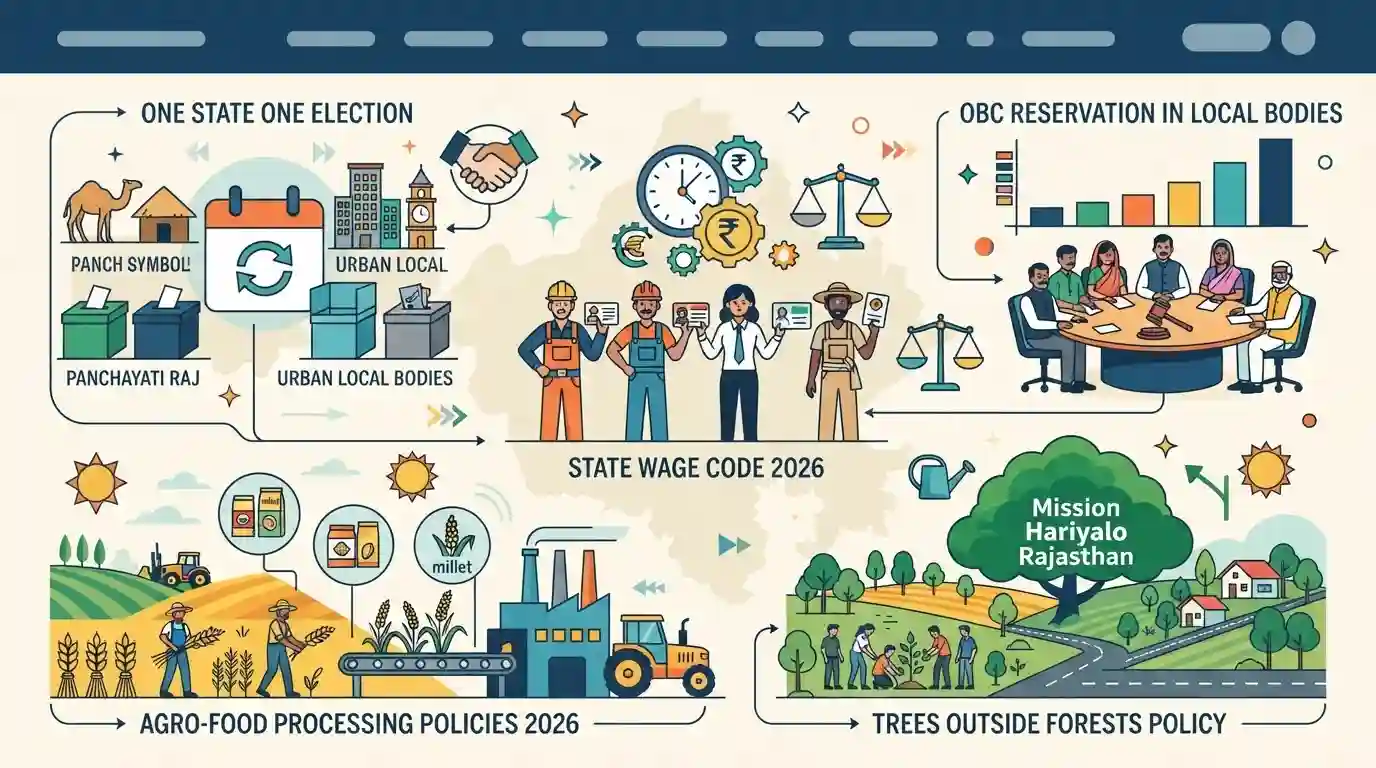
The Rajasthan Cabinet has approved a slew of major administrative and economic policies, prominently featuring the 'One State One Election' model to synchronize Panchayati Raj and Urban Local Body polls. It also introduced the State Wage Code 2026 to regulate minimum wages and working hours, and approved proportional reservation for OBCs in local bodies. On the economic and environmental fronts, the cabinet cleared the Agro-Food Processing and Food Park Development Policies 2026 to promote food processing and millet cultivation, alongside the Trees Outside Forests Policy aiming to expand the state's green cover under Mission Hariyalo Rajasthan.
Key Points
- Introduction of 'One State One Election' in Rajasthan for conducting simultaneous Panchayati Raj Institution (PRI) and Urban Local Body (ULB) elections.
- Implementation of the State Wage Code 2026, which establishes bi-annual minimum wage revisions, mandatory salary slips, and a 48-hour maximum workweek.
- Approval of proportional reservation for Other Backward Classes (OBCs) in local body elections, based on the OBC Political Representation Commission's recommendations.
- Clearance of the Agro-Food Processing and Food Park Development Policies 2026 to boost agricultural value chains, featuring up to 60% capital subsidies and the creation of a Shri-Anna (millet) Promotion Agency.
- Launch of the Trees Outside Forests Policy under Mission Hariyalo Rajasthan, targeting the plantation of 10 crore saplings annually.
Important Terms
One State One Election

A Rajasthan framework to hold Panchayati Raj and Urban Local Body elections simultaneously. It aims to reduce administrative and financial burdens, minimize policy paralysis during polls, and ensure continuous local development.
UPSC context
Important for GS Paper 2 (Polity). Highlights state-level electoral reforms and local governance efficiency, mirroring the national "One Nation, One Election" debate.
State Wage Code 2026
A labor welfare framework by Rajasthan capping working hours at 48 per week and mandating bi-annual wage revisions. It requires employers to provide salary slips and mandatory rest breaks after five consecutive working hours.
UPSC context
Relevant for GS Paper 2 and 3. Tests knowledge of state-specific labor reforms, minimum wage enforcement, and worker protection mechanisms.
Mission Hariyalo Rajasthan
An ambitious environmental initiative by Rajasthan aiming to plant 50 crore saplings over five years. It focuses on afforestation, combating desertification, and promoting ecological balance through public participation and modern technology.
UPSC context
Crucial for GS Paper 3 (Environment). Tests state-led climate action, combating desertification, and participatory afforestation strategies in India's arid regions.
Trees Outside Forests Policy
A Rajasthan policy expanding green cover in non-forest areas. It mandates widespread plantation drives along riverbanks, roadsides, and drains to improve environmental sustainability and carbon sinks outside traditional forest boundaries.
UPSC context
Important for GS Paper 3 (Environment). Highlights innovative afforestation models beyond notified forests, relevant for expanding carbon sinks and urban forestry.
Agro-Food Processing Policy 2026
A Rajasthan policy offering capital subsidies to accelerate investment in agriculture processing. It seeks to strengthen rural entrepreneurship, develop infrastructure like cold storages, and boost farmer incomes through supply chain value addition.
UPSC context
Relevant for GS Paper 3 (Agriculture). Covers downstream agricultural infrastructure, supply chain improvements, and state incentives for rural entrepreneurship.
Prelims Trap
"The Constitution mandates proportional reservation for OBCs in Panchayati Raj Institutions."
Articles 243D and 243T mandate reservation for SCs, STs, and women. Provisioning reservations for backward classes (OBCs) is entirely at the discretion of State Legislatures.
Static Concepts Connected
How does the Constitution regulate reservations in Local Self-Government?
- Mandatory SC/ST: Articles 243D and 243T mandate proportional reservation for Scheduled Castes and Scheduled Tribes.
- Women's Quota: At least one-third of total seats must be reserved for women, including within the SC/ST quotas.
- Discretionary OBC Quota: State Legislatures are empowered, but not constitutionally mandated, to enact reservations for backward classes.
What is the constitutional status of Labour and Wages in India?
- Concurrent List: Labour welfare, minimum wages, and trade unions fall under the Concurrent List (Schedule VII).
- Repugnancy Rule: Under Article 254(2), a state labour law conflicting with Central codes requires Presidential assent to prevail.
Cross-Topic Patterns
Simultaneous Polls & SEC Mandates
Rajasthan's synchronization of local polls underscores the independent role of State Election Commissions (Arts 243K/243ZA), distinct from the ECI's mandate for Lok Sabha and Assemblies.
Millets + Food Processing Subsidies
Integrating 'Shri-Anna' with 60% capital subsidies bridges two GS3 agriculture topics: promoting climate-resilient cropping (millets) and building downstream value-addition via agro-processing parks.

Expect Prelims statements testing the discretionary nature of OBC local reservations or confusing ECI/SEC jurisdictions on simultaneous polls.
Linked PYQs · 2
Linked PYQs · 2
- 2018RPSC_PRELIMSGS1
Which of the following Act/Rule provides for joint meetings of Gram Sabhas in Rajasthan?
- 2025RPSC_PRELIMSGS1
The Rajasthan government has announced the M-Sand Policy in the year 2024. It will remain effective
