Rajasthan Cabinet Clears New Policies on Clean Energy and Labour
Source:economic-times ↗
Why It Matters
This is highly relevant for the RPSC RAS Prelims as it covers massive state-level policy announcements that touch upon core syllabus areas: the economy (agriculture, industry, energy), polity (local body elections), and social welfare (labor rules, rural employment). Questions on specific policy targets (like the 125 GW energy goal or the 10% plantation rule) are highly probable.
Summary
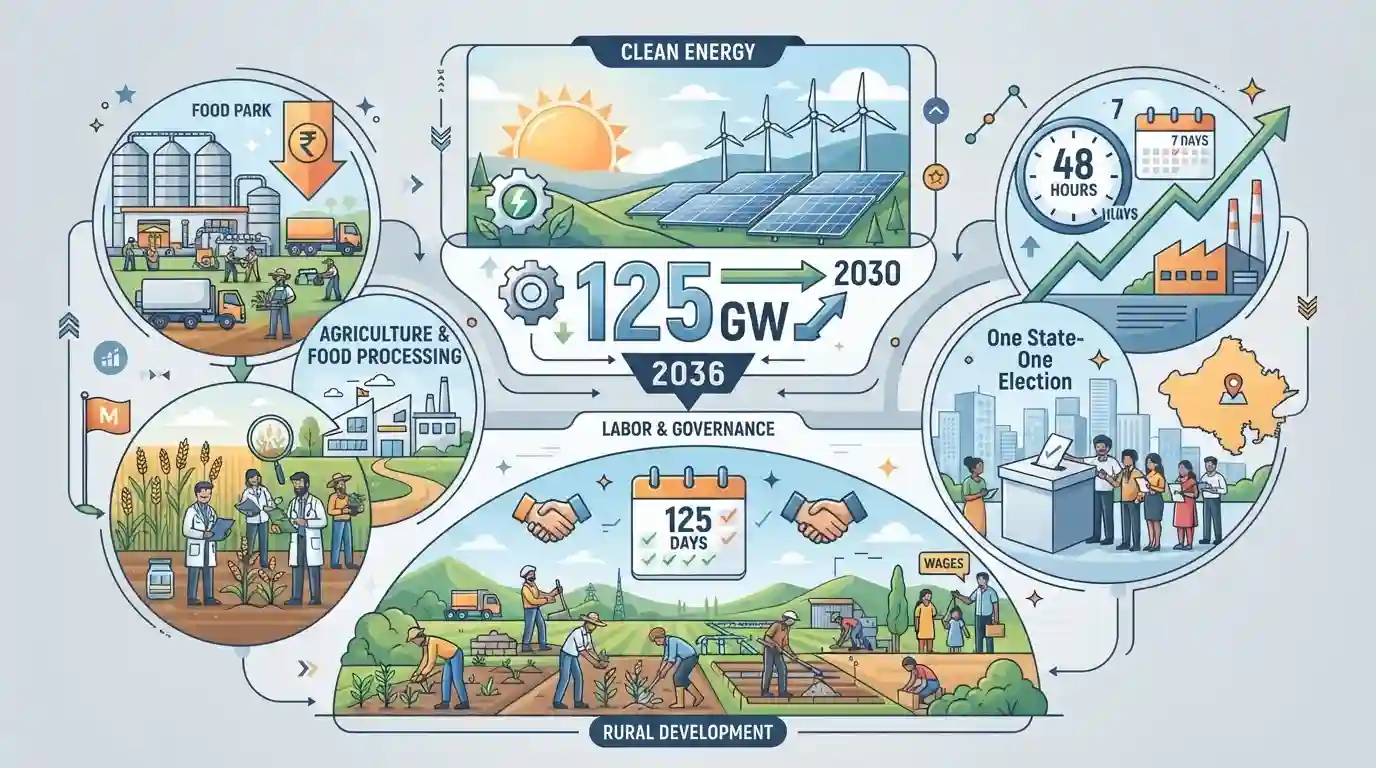
The Rajasthan Cabinet has approved a comprehensive suite of policies slated for 2026, overhauling the state's approach to clean energy, agriculture, labor, and local governance. Key highlights include setting an ambitious 125 GW clean energy target by 2030, establishing food parks with substantial subsidies, forming an agency to promote millets, and enforcing a 48-hour workweek limit. Additionally, the state will implement a 'One State-One Election' framework for local bodies and provide 125 days of guaranteed rural employment, aligning state development with broader national welfare and infrastructure goals.
Key Points
- The Rajasthan Cabinet approved a slew of long-term policies (effective 2026) focusing on agriculture, clean energy, labour reforms, and local governance.
- Under the Clean Energy Policy, the state aims to achieve a generation capacity of 125 GW by 2030 through solar, wind, and biomass, supplemented by the Tree Outside Forest Policy which requires renewable energy projects to designate 10% of their land for tree plantation.
- To boost the agricultural sector, the government cleared the Food Processing and Food Park Development Policies, providing capital subsidies of up to ₹3 crore and establishing a 'Shri Anna' promotion agency specifically for millets.
- Labour reforms through the newly cleared Wage Code and Industrial Relations Rules mandate a maximum 48-hour workweek and link minimum wages to the Consumer Price Index (CPI).
- In a significant governance shift, Rajasthan will adopt a 'One State-One Election' model, synchronizing elections for all Panchayati Raj institutions and urban local bodies.
- The cabinet also sanctioned the Viksit Bharat-Guarantee for Employment scheme in rural areas to guarantee 125 days of employment.
Important Terms
Rajasthan Clean Energy Policy (2026 Amendments)

A state framework aiming for 125 GW of renewable capacity by 2030. The 2026 amendments accelerate transition by dropping registration fees for large-scale battery storage and cutting project transmission timelines.
UPSC context
GS3 (Energy/Environment): Vital for tracking state-level execution of India's 500 GW non-fossil fuel and 2070 net-zero targets.
Viksit Bharat-Guarantee for Employment and Livelihood Mission (Rural)
A new statutory rural employment scheme replacing MGNREGA. Implemented in Rajasthan to guarantee 125 days of manual wage work per household annually, featuring weekly direct benefit transfers and digital monitoring.
UPSC context
GS2 (Social Justice): Highly relevant for tracing the policy shift from MGNREGA to the new VB-GRAM G rural welfare framework.
Shri Anna Promotion Agency
A specialized state agency established to promote millet-based industries. It provides capital subsidies to primary processing units, FPOs, and rural entrepreneurs to drive value addition and rural income.
UPSC context
GS3 (Agriculture): Essential for topics on crop diversification, climate-resilient farming, and the commercialization of millets (Shri Anna).
Rajasthan Agriculture and Food Processing Policy 2026
A policy offering up to 60% capital subsidies for agro-processing ventures. It focuses on strengthening supply chains, empowering Farmer Producer Organizations (FPOs), and creating non-farm jobs in rural/tribal areas.
UPSC context
GS3 (Food Processing): Crucial for answers on rural industrialization, reducing post-harvest losses, and doubling farmers' income.
Code on Wages (Rajasthan) Rules 2026
State-level labor rules establishing a strict 48-hour workweek and capping daily shifts at 10.5 hours. It legally ties bi-annual Dearness Allowance revisions directly to the Consumer Price Index.
UPSC context
GS2/GS3 (Governance/Economy): Key example of cooperative federalism in implementing the Union Labour Codes and ensuring worker welfare.
Tree Outside Forest Policy
An environmental mandate requiring developers of solar, wind, and biomass energy projects to reserve 10% of their allotted land specifically for tree plantation to offset ecological impacts.
UPSC context
GS3 (Environment): Highlights the integration of green energy infrastructure with mandatory carbon sink and afforestation goals.
Prelims Trap
"Rajasthan's 'One State-One Election' synchronises the state assembly elections with Panchayati Raj and urban local body polls."
The policy strictly synchronises elections across local bodies (Panchayats and Municipalities) with each other. It does not integrate them with State Assembly or Lok Sabha elections.
Static Concepts Connected
What distinguishes the State Election Commission from the ECI?
- Constitutional Mandate: SECs conduct elections for Panchayats (Art 243K) and Municipalities (Art 243ZA). The ECI handles Parliament and State Assemblies.
- Appointment: The State Election Commissioner is appointed by the Governor, not the President.
- Removal: Removed only in the same manner and on the same grounds as a Judge of a High Court, ensuring autonomy.
How are minimum wages protected against inflation in India?
- CPI Indexation: Minimum wages are indexed to the Consumer Price Index (such as CPI-IW for industrial workers or CPI-AL for agricultural labourers).
- Variable Dearness Allowance: A Variable Dearness Allowance (VDA) is revised periodically (usually bi-annually) based on CPI fluctuations to protect workers' real wages.
Cross-Topic Patterns
Local ONOE & SEC Authority
Synchronizing local body polls highlights the independent domain of State Election Commissions (Articles 243K/243ZA), presenting a parallel logistical challenge to the national 'One Nation-One Election' discourse.
Solar Expansion vs Ecology
Mandating 10% tree cover for renewable projects addresses the growing ecological friction (like the Great Indian Bustard habitat loss) caused by massive utility-scale solar parks in arid regions.
Competitive Federalism in Welfare
Expanding rural employment to 125 days (beyond MGNREGA's 100 days) and dedicated 'Shri Anna' agencies showcase states using their own budgets to outpace central welfare benchmarks.

State-level deviations (125-day MGNREGA extensions, local ONOE, 48-hr workweeks) will heavily feature in 2026 GS2 federalism questions.
Linked PYQs · 2
Linked PYQs · 2
- 2021RPSC_PRELIMSGS1
In which year was the Rajasthan Solar Energy Policy announced?
- 2016RPSC_PRELIMSGS1
The State Election Commission of Rajasthan is
