Rajasthan Cabinet approves Uniform Civil Code legislative bill
Source:newsonair ↗
Why It Matters
State-level initiatives regarding the Uniform Civil Code have profound implications for federalism, personal laws, and constitutional interpretation of Directive Principles of State Policy (Article 44).
Summary
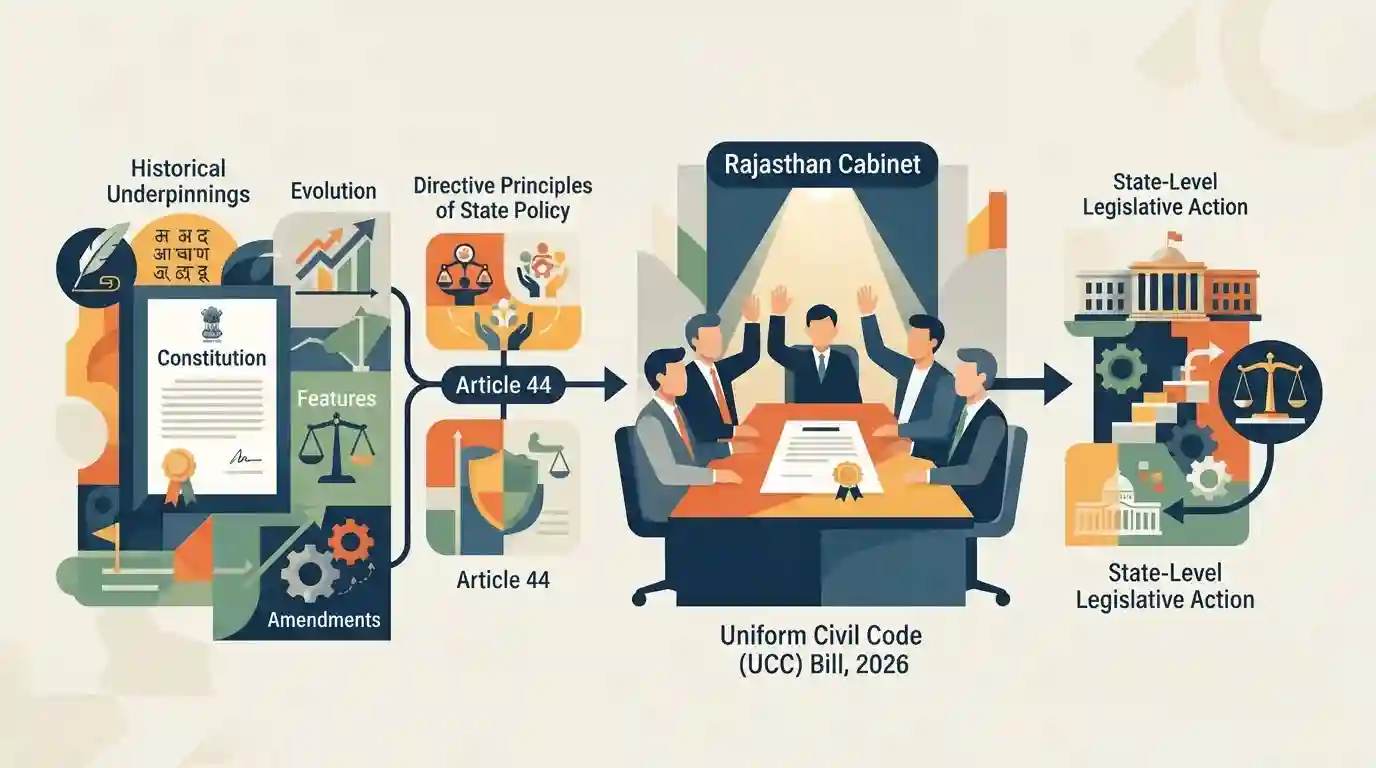
The Rajasthan Cabinet approved the Uniform Civil Code (UCC) Bill, 2026, steering state-level legislative action in alignment with the Directive Principles of State Policy under Article 44 of the Indian Constitution.
Key Points
- The Rajasthan Cabinet has approved the Uniform Civil Code (UCC) Bill, 2026, marking a major state-level legislative push.
- The Uniform Civil Code is tied directly to Article 44 under the Directive Principles of State Policy (DPSP) of the Indian Constitution.
- The proposed bill seeks to replace disparate personal laws based on religion with a uniform set of rules covering marriage, divorce, inheritance, and adoption for all citizens within the state.
Important Terms
Uniform Civil Code Bill 2026

A legislative proposal approved by the Rajasthan cabinet in 2026 to establish uniform civil laws governing marriage, divorce, inheritance, and live-in relationships for all citizens, excluding Scheduled Tribes.
UPSC context
Tested in RPSC RAS Indian Polity under state-level legislative initiatives and fundamental socio-legal policies.
Article 44 of the Constitution
A Directive Principle of State Policy under Part IV of the Indian Constitution that mandates the State to secure for citizens a Uniform Civil Code throughout the territory of India.
UPSC context
Crucial topic in RPSC RAS Polity syllabus under Directive Principles of State Policy (DPSP) and constitutional provisions.
Rajasthan Cabinet
The collective body of executive ministers in Rajasthan headed by the Chief Minister, responsible for executive policy-making and approving state legislation like the UCC Bill.
UPSC context
Important for RPSC RAS Indian Polity and Rajasthan Governance covering the structure, powers, and functioning of the State Executive.
Prelims Trap
Article 44 of the Indian Constitution makes the implementation of a Uniform Civil Code legally mandatory and judicially enforceable across all states.
Aspirants often confuse Article 44 as a justiciable Fundamental Right enforceable by courts, whereas it is a non-justiciable Directive Principle of State Policy.
Static Concepts Connected
What are the key constitutional provisions and historical context regarding the Uniform Civil Code in India?
- Article 44 DPSP: Constitutional basis under Part IV, Article 44 of the Directive Principles of State Policy directs the State to endeavour to secure a UCC.
- Goa Precedent: Goa stands as the only Indian state with a unified civil code derived historically from the Portuguese Civil Code of 1867.
- Legislative Competence: Personal laws traditionally fall under the Concurrent List (Entry 5) of the Seventh Schedule, enabling both Parliament and state legislatures to legislate.
Cross-Topic Patterns
UCC vs Freedom of Religion (Art 25)
Article 44 sits in Part IV as a non-justiciable directive principle, contrasting with justiciable fundamental rights under Part III like Article 25 freedom of religion.
Goa Civil Code vs State UCC Bills
Goa's Portuguese Civil Code of 1867 makes it the historical pioneer, while Uttarakhand and Rajasthan represent contemporary state-led legislative momentum.

Expect statements on whether UCC is a Fundamental Right or DPSP, and which state pioneered or legislated it first in independent India.
Linked PYQs · 2
Linked PYQs · 2
- 2023RPSC_PRELIMSGS1
Match the following list – P (Directive Principles) with list – R (Article): List – P List – R A. Equal justice and free legal aid I. Article 48 A B. Protection of the environment II. Article 39 A C. Right to work III. Article 41 D. Preservation of monuments IV. Article 49 Choose the correct option: . A B C D
- 2021RPSC_PRELIMSGS1
Which of the following pairs of Directive Principles of State Policy as described in the Constitution of India is correctly matched?
