Rajasthan Cabinet Approval For Uniform Civil Code Legislation
Source:newsonair ↗
Why It Matters
Important for understanding the implementation of Directive Principles of State Policy at the state level and state-specific legislative initiatives concerning personal laws in India.
Summary
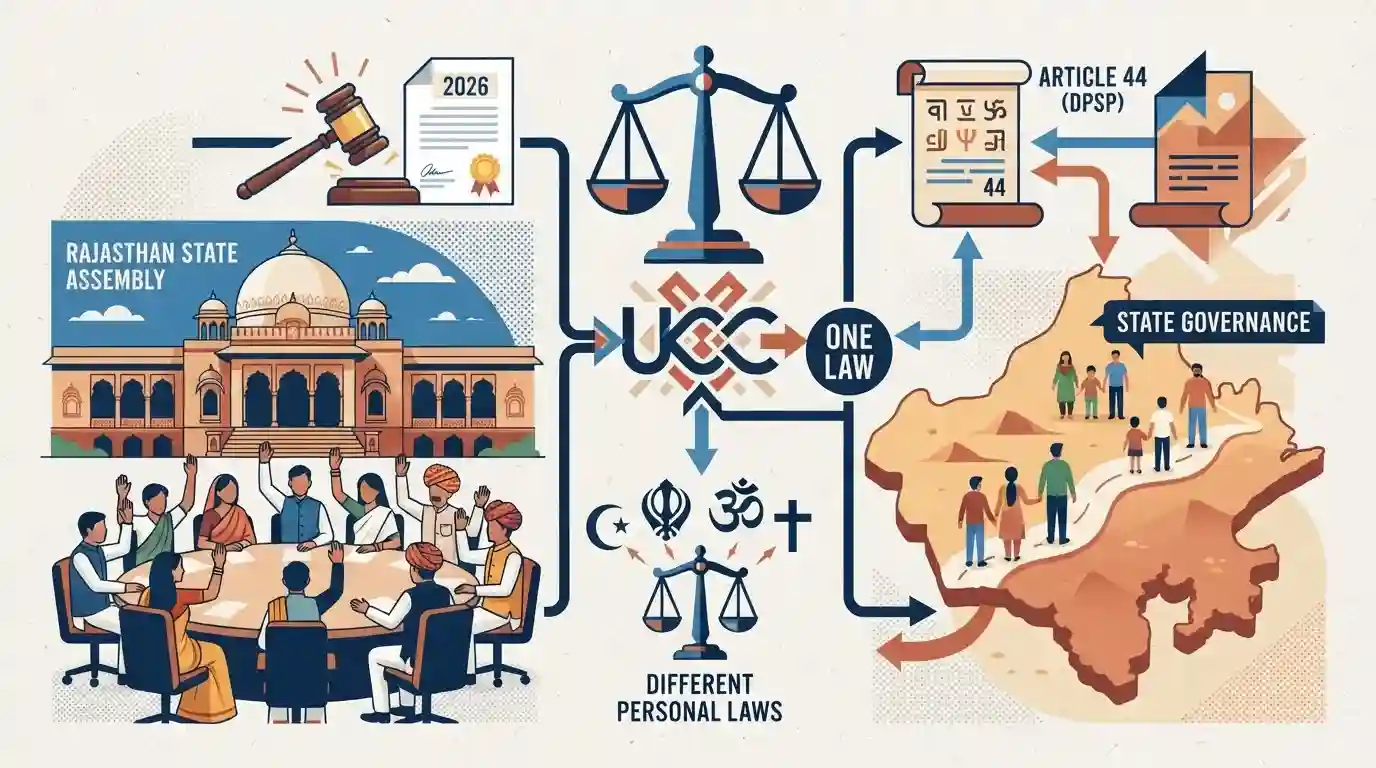
The Rajasthan Cabinet has approved the Uniform Civil Code (UCC) Bill 2026, marking a significant legislative step toward implementing uniform personal laws across the state under the framework of Article 44 of the Directive Principles of State Policy.
Key Points
- The Rajasthan Cabinet has approved the Uniform Civil Code (UCC) Bill 2026.
- The bill seeks to establish uniform personal laws for all citizens in the state, superseding religion-specific personal laws on matters like marriage, divorce, inheritance, and adoption.
- Uniform Civil Code is rooted in Article 44 of the Directive Principles of State Policy (DPSP) under the Constitution of India.
Important Terms
Uniform Civil Code Bill 2026

A proposed legislative enactment by the Rajasthan government to replace personal religious laws with common rules governing marriage, divorce, inheritance, and live-in relationships for all citizens, excluding Scheduled Tribes.
UPSC context
RPSC Paper II (Indian Polity & Governance) - Tests understanding of state-level legislative initiatives regarding personal laws and federal dynamics.
Article 44 of the Constitution
A Directive Principle of State Policy (Part IV) that states the State shall endeavor to secure for citizens a Uniform Civil Code throughout the territory of India.
UPSC context
RPSC Paper II (Directive Principles of State Policy) - Evaluates knowledge of non-justiciable constitutional directives and their implementation.
Rajasthan Cabinet
The executive body comprising the Chief Minister and ministers of Rajasthan, responsible for formulating state policies and approving legislative bills before table presentation.
UPSC context
RPSC Paper II (State Governance & Administration) - Examines the role and executive decision-making powers of the state cabinet.
Rajasthan Legislative Assembly
The unicameral state legislature of Rajasthan empowered to debate, amend, and enact laws on subjects listed under the State List and Concurrent List.
UPSC context
RPSC Paper II (Rajasthan Polity) - Focuses on the law-making process and legislative functions within Rajasthan.
Prelims Trap
The Uniform Civil Code under Article 44 is a justiciable fundamental right enforceable by writ jurisdiction in the Supreme Court.
Aspirants often assume DPSPs are legally enforceable by the courts, but Article 37 explicitly states they are non-justiciable despite being fundamental in governance.
Static Concepts Connected
What are the key constitutional provisions and judicial landmarks related to the Uniform Civil Code in India?
- Constitutional Basis: Enshrined in Part IV under Article 44, stating the State shall endeavor to secure a UCC throughout India's territory.
- DPSP Nature: Non-justiciable in courts, yet fundamental in governance under Article 37.
- Judicial Precedents: Supreme Court repeatedly urged Parliament and states to enact a UCC, famously highlighted in the Shah Bano case (1985).
Cross-Topic Patterns
UCC Bill and Federal Jurisprudence
UCC implementation under Article 44 intersects with Centre-State legislative competence under the Concurrent List (Seventh Schedule) and judicial precedents on religious freedom under Article 25.

Article 44 DPSP enforcement vs Fundamental Rights (Art 25/26) will feature in Polity statements or descriptive 10-markers.
Linked PYQs · 2
Linked PYQs · 2
- 2023RPSC_PRELIMSGS1
Match the following list – P (Directive Principles) with list – R (Article): List – P List – R A. Equal justice and free legal aid I. Article 48 A B. Protection of the environment II. Article 39 A C. Right to work III. Article 41 D. Preservation of monuments IV. Article 49 Choose the correct option: . A B C D
- 2021RPSC_PRELIMSGS1
Which of the following pairs of Directive Principles of State Policy as described in the Constitution of India is correctly matched?
