Rajasthan Cabinet Clears Civil Code and Native Tree Protection Bills
Source:theprint ↗
Why It Matters
This article is crucial for the RPSC RAS exam as it covers major state-level policy shifts. The UCC touches upon constitutional provisions (Article 44) and legislative federalism. The environmental initiatives directly relate to the state's flora (Khejri, Rohida) which are frequent topics in the exam. Decentralized water management and renewable energy expansion in the Thar region are also key components of Rajasthan's administrative and economic geography.
Summary
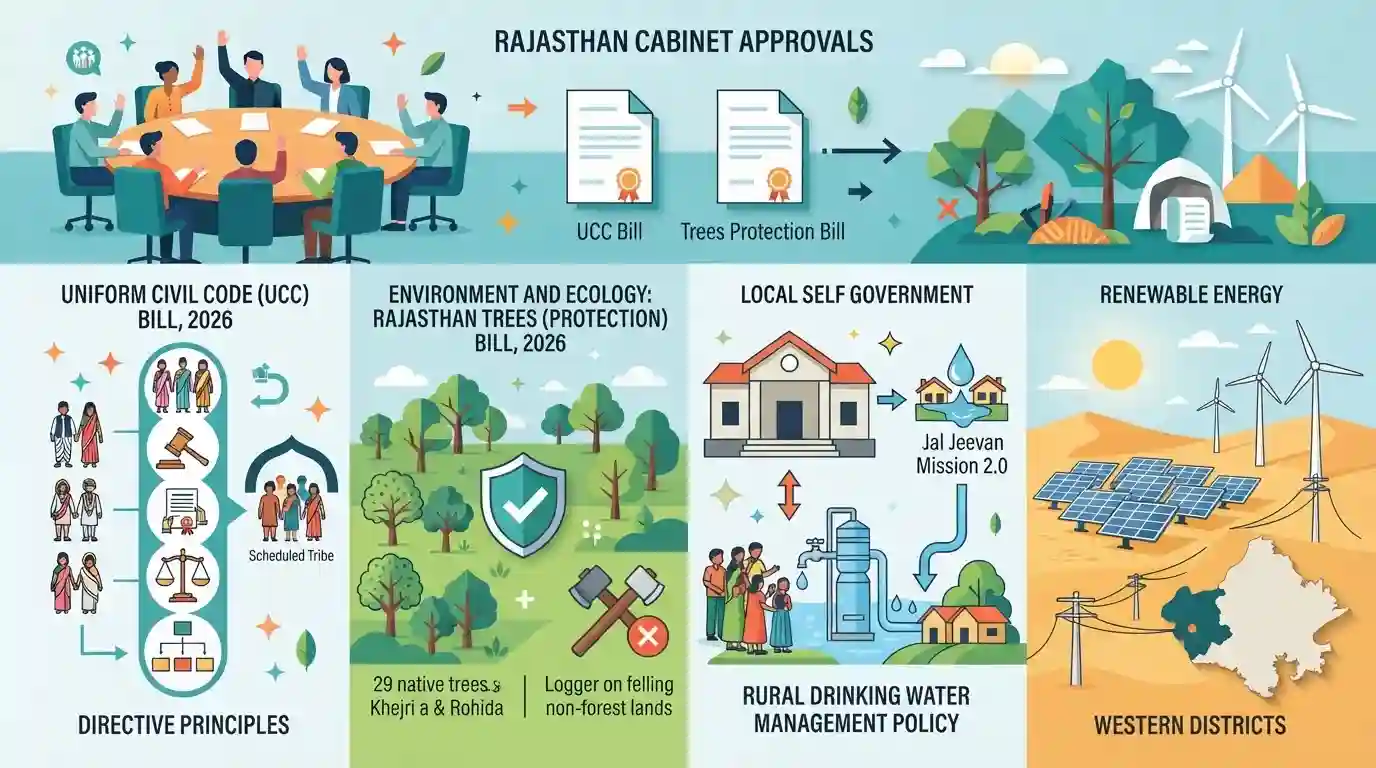
The Rajasthan Cabinet has approved the drafts of two major legislative bills: the Rajasthan Uniform Civil Code (UCC) Bill, 2026, and the Rajasthan Trees (Protection) Bill, 2026. The UCC Bill aims to standardize laws regarding marriage, divorce, and inheritance across communities, explicitly exempting Scheduled Tribes. The Tree Protection Bill seeks to conserve 29 native and culturally significant tree species, such as Khejri and Rohida, by regulating their felling on non-forest lands. Furthermore, the cabinet cleared a new rural drinking water management policy empowering local Panchayats under Jal Jeevan Mission 2.0, and sanctioned land for extensive renewable energy projects in the state's western districts.
Key Points
- The Rajasthan Cabinet approved the draft Uniform Civil Code (UCC) Bill, 2026, prepared by a committee led by former Supreme Court Justice Ranjana Prakash Desai.
- The UCC mandates equal inheritance for sons and daughters, prohibits polygamy, requires marriage registration within 60 days, and exempts Scheduled Tribes.
- The Rajasthan Trees (Protection) Bill, 2026, was approved to protect 29 significant tree species, including the state tree (Khejri) and state flower (Rohida), imposing strict penalties for unauthorized felling on non-forest lands.
- A new operations and maintenance policy for rural drinking water was introduced under Jal Jeevan Mission 2.0, decentralizing control to Gram Panchayats and Village Water and Sanitation Committees.
- The cabinet also approved land allotments for renewable energy projects in Bikaner, Jaisalmer, and Barmer, aiming to boost the state's solar and wind power capacity.
Important Terms
Rajasthan Uniform Civil Code Bill, 2026

A proposed state law standardizing marriage, divorce, succession, and live-in relationships across communities. It prohibits polygamy and mandates marriage registration while explicitly exempting Scheduled Tribes to protect their constitutionally guaranteed customary rights.
UPSC context
GS-2 (Polity). Tests understanding of Article 44 (UCC), state-level legal uniformity, and balancing uniform civil laws with constitutional tribal rights.
Rajasthan Trees (Protection) Bill, 2026
A legislative bill regulating the felling of 29 culturally and ecologically significant tree species, like Khejri, on non-forest lands. It mandates prior permission for cutting and enforces compensatory plantation to balance rural development with ecology.
UPSC context
GS-3 (Environment). Highlights state-led biodiversity conservation, non-forest land regulations, and compensatory afforestation for sustainable development.
Jal Jeevan Mission 2.0
An extended phase of the national rural tap water scheme running until 2028. It emphasizes decentralized governance, source sustainability, and structural reforms by handing over completed water supply systems to local Gram Panchayats.
UPSC context
GS-2 (Governance). Essential for understanding rural water security policies, decentralized local administration, and community-led resource management.
Prelims Trap
"State-enacted Uniform Civil Codes apply universally to all resident citizens without any exceptions."
Recent state-level Uniform Civil Codes (like those in Uttarakhand and Rajasthan) explicitly exempt Scheduled Tribes to protect their distinct customary laws.
Static Concepts Connected
Can state governments enact their own Uniform Civil Code?
- Concurrent List: Personal laws governing marriage, divorce, and succession fall under Entry 5 of the Concurrent List, allowing both the Centre and States to legislate.
- Presidential Assent: Because a state UCC alters existing central laws (like the Hindu Marriage Act), it requires the President's assent under Article 254(2) to be valid.
- DPSP Mandate: Article 44 directs the "State" to secure a UCC. Under Article 12, the "State" includes both Union and State governments, granting states the mandate to act.
Why is the Khejri tree vital for the Thar Desert ecosystem?
- Drought Resilience: Khejri (Prosopis cineraria) is a xerophyte with a deep taproot system that reaches deep groundwater, allowing it to survive extreme arid conditions.
- Nitrogen Fixation: As a leguminous tree, it fixes atmospheric nitrogen, enriching nutrient-poor desert soils and supporting agroforestry.
- Anti-desertification: Its deep roots bind the soil, acting as a natural windbreak and a critical biological barrier against advancing desertification.
Cross-Topic Patterns
UCC exemptions and Tribal Autonomy
State UCCs exempt STs to avoid friction with constitutional safeguards (like PESA and Fifth/Sixth Schedules) that protect tribal customary laws and administrative autonomy.
Jal Jeevan and 73rd Amendment devolution
Empowering Village Water and Sanitation Committees under JJM reflects the 73rd Amendment's mandate of devolving drinking water management (11th Schedule) directly to Gram Panchayats.
Green energy vs Desert ecology
Massive land allotments for solar and wind power in western Rajasthan (Thar) frequently clash with the conservation of local ecology and critically endangered species like the Great Indian Bustard.

Expect a 2026 prelims statement mixing state legislative competence on UCC (Concurrent List) with explicit exemptions for Scheduled Tribes.
Linked PYQs · 3
Linked PYQs · 3
- 2021RPSC_PRELIMSGS1
The state flower of Rajasthan is
- 1999RPSC_PRELIMSGS1
The solar energy project is related to the following districts:
- 2023RPSC_PRELIMSGS1
Match the following list – P (Directive Principles) with list – R (Article): List – P List – R A. Equal justice and free legal aid I. Article 48 A B. Protection of the environment II. Article 39 A C. Right to work III. Article 41 D. Preservation of monuments IV. Article 49 Choose the correct option: . A B C D
