Rajasthan Industrial Policy Emphasizes Talent Economy and MSMEs
Source:The Hindu ↗
Why It Matters
Crucial for RPSC RAS aspirants tracking major state policy updates, industrial growth initiatives, and economic planning frameworks in Rajasthan.
Summary
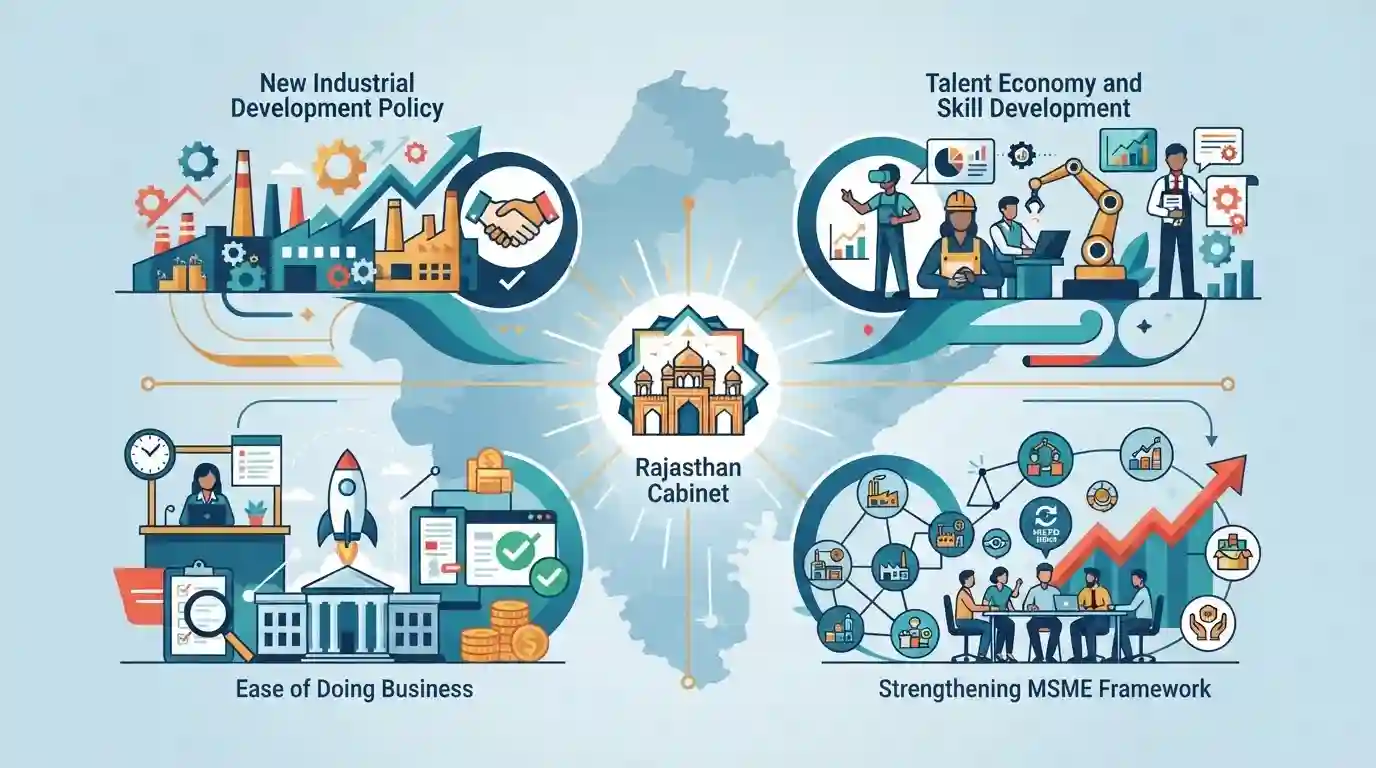
The Rajasthan Cabinet recently approved a new Industrial Development Policy with a strategic focus on the 'talent economy', skill development, ease of doing business, and strengthening the industrial and MSME framework within the state.
Key Points
- The Rajasthan Cabinet has approved a new Industrial Development Policy emphasizing a talent economy, skill enhancement, and employment generation.
- The policy focuses on boosting manufacturing, MSMEs, ease of doing business, and attracting sustainable investments to drive the state's economic growth towards regional industrial competitiveness.
- It aligns with the broader roadmap for Rajasthan's industrial expansion and economic development initiatives.
Important Terms
Industrial Development Policy

A strategic policy framework approved by the Rajasthan Cabinet to transform the state into a global industrial hub, focusing on advanced manufacturing, the talent economy, and technology-intensive sectors like semiconductors and data centers.
UPSC context
RPSC Paper III / Economic Development of Rajasthan: Important for questions on state industrial policies, targets, and economic growth strategies.
Rajasthan MSME Policy 2024
A state policy framework enacted to foster a globally competitive micro, small, and medium enterprise ecosystem, offering financial incentives, SGST reimbursements, interest subsidies, and market access provisions.
UPSC context
RPSC Paper III / MSME sector in Rajasthan: Tests knowledge of state enterprise promotion, financial incentives, and employment generation schemes.
Rajasthan Mineral Policy 2024
A comprehensive state policy aimed at boosting the mining sector's GSDP contribution through technological advancement, exploration of critical minerals like lithium, zero-waste mining, and eco-friendly practices.
UPSC context
RPSC Paper III / Mineral Resources of Rajasthan: Essential for questions on state mineral governance, economic contributions, and sustainable mining.
Rajasthan Cabinet
The executive decision-making body of the state government, headed by the Chief Minister, responsible for formulating and approving major policy initiatives, financial outlays, and administrative reforms in Rajasthan.
UPSC context
RPSC Paper II / Indian Constitution and Rajasthan Polity: Tests understanding of state executive powers, governance structures, and policy approvals.
Static Concepts Connected
What are the key institutional bodies responsible for industrial promotion and investment in Rajasthan?
- RIICO role: Apex agency promoting large-scale industries and facilitating single-window clearances for investors in Rajasthan.
- BIP & Directorate: Dedicated body for MSME growth, export promotion, and implementation of industrial policies in the state.
- Single Window System: Unified portal providing transparent, time-bound approvals across departments under Ease of Doing Business.
Cross-Topic Patterns
ODOP & District Export Hubs in Rajasthan
Rajasthan's industrial policies increasingly integrate ODOP with export infrastructure, connecting district-level rural manufacturing to global value chains under state export promotion frameworks.

Expect matching questions on Rajasthan Industrial Policy targets (e.g., $350B by 2028-29) and focus sectors like semiconductors or defense.
Linked PYQs · 3
Linked PYQs · 3
- 2025RPSC_PRELIMSGS1
For how long will the ‘Rajasthan ‘MSME Policy 2024’ remain in effect?
- 2023RPSC_PRELIMSGS1
Which of the following facts about the Rajasthan Chief Minister Small Industry Promotion Scheme is not correct?
- 2025RPSC_PRELIMSGS1
Consider the following statements with reference to the goals of the Rajasthan Mineral Policy – 2024: A. To provide employment to 1 crore direct and indirect persons by 2046-47 and 50 lakh persons by 2029-30. B. To increase the contribution of the mineral sector to the state’s Gross State Domestic Product from 3.4 percent in 2023-24 to 5 percent by 2029-30 and 8 percent by 2046-47. C. To increase the number of minerals covered under mining to 70 from 58 by 2047. Which of the statements are correct?
