Rajasthan Industrial Development Policy 2026 Semiconductor Focus
Source:thestatesman ↗
Why It Matters
Crucial for RPSC aspirants tracking Rajasthan's economic updates, industrial growth initiatives, and policy shifts toward high-tech manufacturing sectors like semiconductors and data centres.
Summary
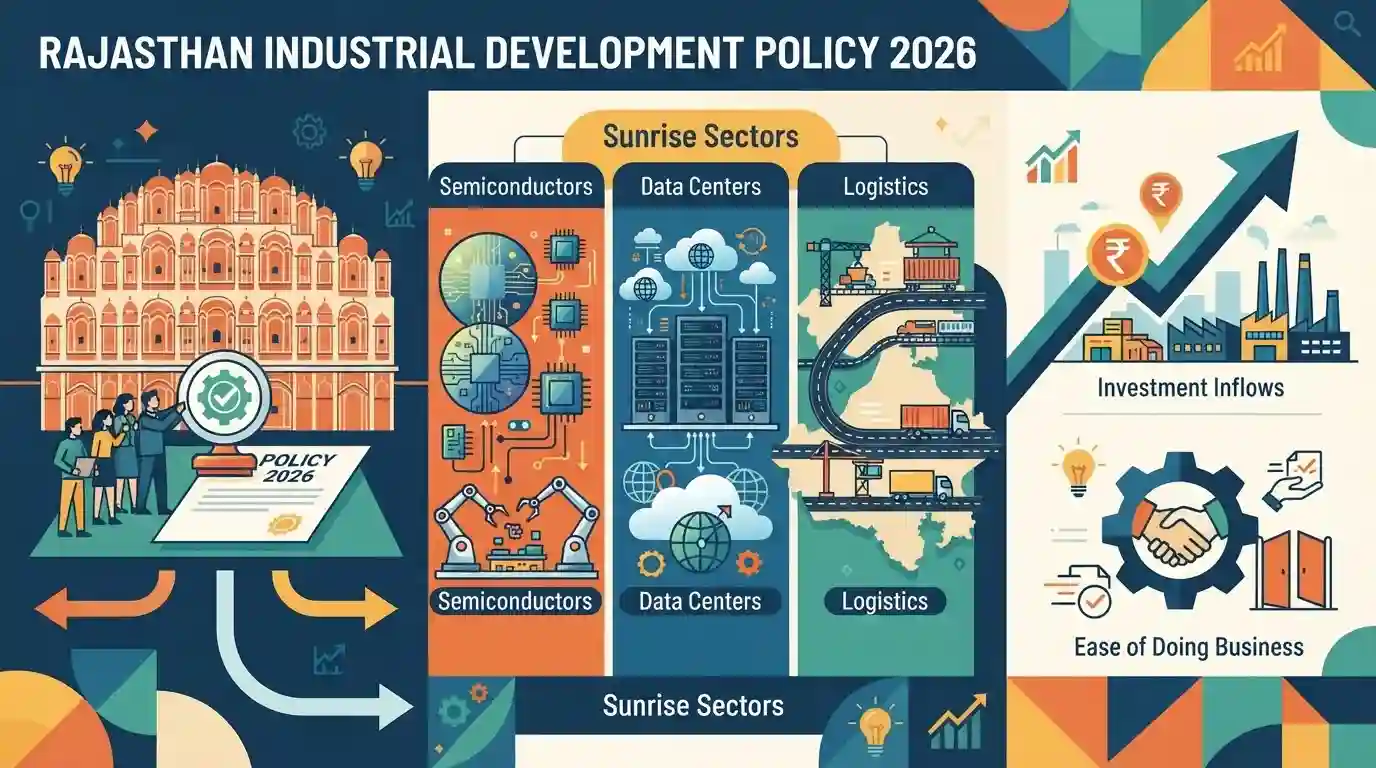
The Rajasthan Cabinet has approved the new Industrial Development Policy 2026, focusing heavily on sunrise sectors like semiconductors, data centres, and logistics, alongside enhancing the ease of doing business and investment inflows in the state.
Key Points
- The Rajasthan Cabinet approved the new Industrial Development Policy 2026, aiming to transform the state into a leading manufacturing and industrial hub.
- The policy puts special emphasis on sunrise sectors including semiconductors, data centres, and advanced logistics infrastructure.
- It aligns with the state's broader goals of attracting large-scale investments, easing regulatory frameworks, and generating employment opportunities under single-window facilitation.
Important Terms
Industrial Development Policy 2026

A state-level policy formulated to transform Rajasthan into a global industrial hub by 2047, focusing on sunrise sectors like semiconductors, data centres, and logistics while expanding the economy to $350 billion.
UPSC context
RPSC RAS Paper III (Economy of Rajasthan - Industrial Development, Policies, and Infrastructure). Tests knowledge of state economic strategies.
Raj Nivesh Portal
Rajasthan’s unified single-window online portal (One Stop Shop) that consolidates services across multiple departments to streamline investor approvals, licenses, and clearances efficiently.
UPSC context
RPSC RAS Paper III (Ease of Doing Business, Governance, and Industrial Promotion in Rajasthan). Tests awareness of digital governance initiatives.
Bureau of Investment Promotion
The nodal investment promotion agency of the Government of Rajasthan that facilitates large-scale investments, coordinates single-window clearances, and implements state industrial policies.
UPSC context
RPSC RAS Paper III (Institutional Framework for Industrial Development in Rajasthan). Tests statutory and institutional bodies promoting state investments.
Rajasthan Cabinet
The supreme executive decision-making body in the state headed by the Chief Minister, responsible for approving state policies, industrial packages, and legislative proposals.
UPSC context
RPSC RAS Paper II (Indian Government and Politics - Executive and Governance in Rajasthan). Tests working knowledge of state-level policy formulation.
Static Concepts Connected
What are the key institutional mechanisms and portals for single-window clearances in Rajasthan?
- Nodal Agency: The Bureau of Investment Promotion (BIP) acts as the nodal agency for single-window clearance and investment promotion in Rajasthan.
- Digital Portal: Raj-Nivesh (Single Window Clearance System) serves as the unified digital portal for industrial approvals and clearances in the state.
- Apex Board: Enterprise Promotion Board (EPB) chaired by the Chief Minister decides on high-value investment proposals and special policy packages.
Cross-Topic Patterns
Industrial Policy & National Semiconductor Mission
Rajasthan's shift toward sunrise tech sectors like semiconductors parallels national initiatives like the India Semiconductor Mission (ISM), linking state industrial policy with central high-tech manufacturing push.
State Industrial Policy & PM Gati Shakti
The emphasis on logistics parks and data centres connects state manufacturing policy with national infrastructure frameworks like PM Gati Shakti and National Logistics Policy.

Rajasthan's Industrial Policy 2026 focus areas (semiconductors, data centres) likely to be tested in RPSC RAS prelims matching lists.
Linked PYQs · 3
Linked PYQs · 3
- 2025RPSC_PRELIMSGS1
Which of the following statements regarding the Raj Nivesh Portal of Rajasthan is incorrect?
- 2025RPSC_PRELIMSGS1
The correct order of decreasing contribution of different sectors in Rajasthan’s Gross Fixed Capital Formation is
- 2023RPSC_PRELIMSGS1
Which of the following facts about the Rajasthan Chief Minister Small Industry Promotion Scheme is not correct?
