Rajasthan Cabinet Approves Draft Bill Regulating Tree Felling
Source:drishtiias ↗
Why It Matters
Crucial for RPSC RAS aspirants tracking state-level legal frameworks, environmental policy updates, and biodiversity preservation initiatives in non-forest regions of Rajasthan.
Summary
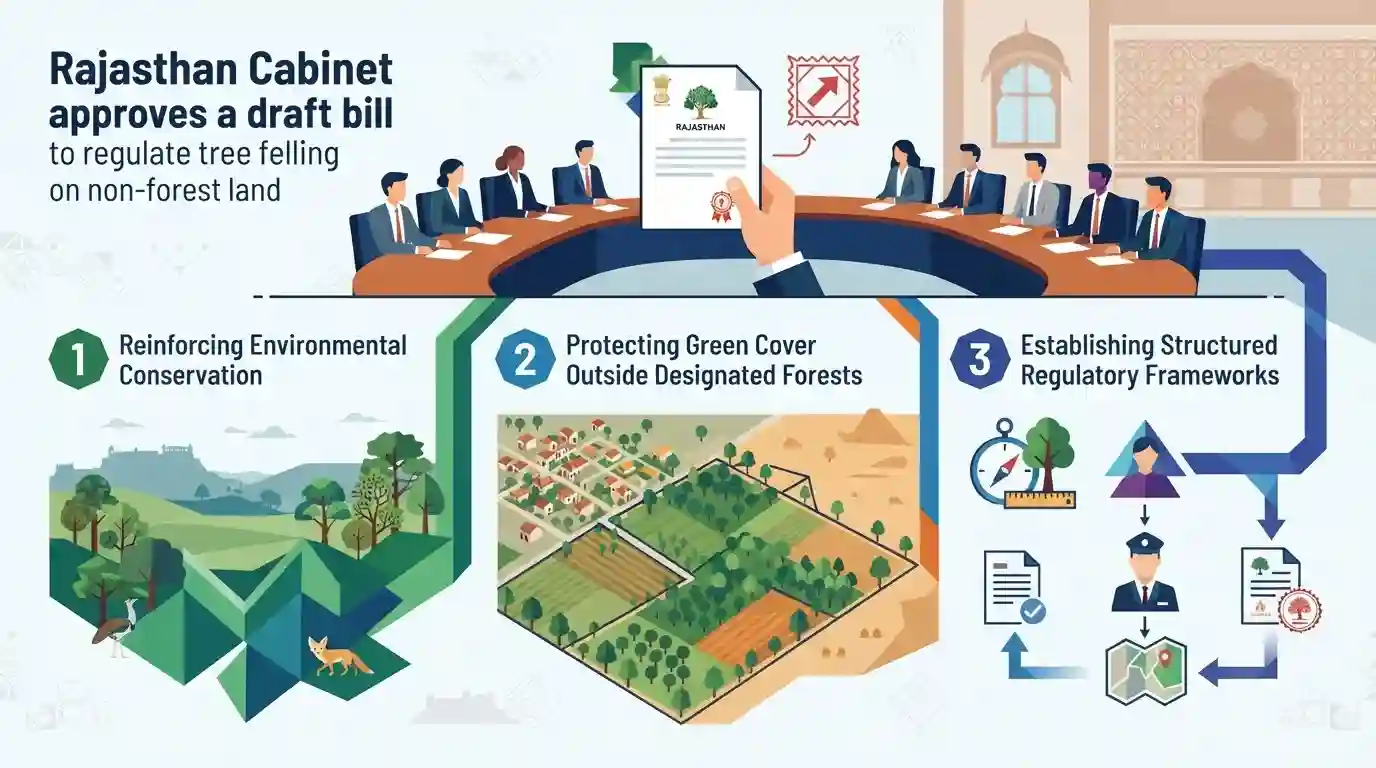
The Rajasthan Cabinet approved a draft bill to regulate tree felling on non-forest land, reinforcing environmental conservation, protecting green cover outside designated forests, and establishing structured regulatory frameworks for sustainable resource management in the state.
Key Points
- The Rajasthan Cabinet approved a draft bill aimed at regulating tree felling on non-forest lands in the state.
- The initiative is designed to protect green cover, balance ecological development, and check indiscriminate felling of trees outside reserved and protected forest areas.
- It provides a legal and administrative framework for landowners and industries to manage tree harvesting sustainably while ensuring environmental safeguards.
Important Terms
Draft Bill to Regulate Tree Felling on Non-Forest Land

A proposed legislation approved by the Rajasthan Cabinet to regulate tree felling on non-forest lands, protecting 29 key species like Khejri and Rohida and mandating compensatory plantation.
UPSC context
Crucial for RPSC exams under Rajasthan environment, ecology, and state governance, testing knowledge of recent legislative policy changes.
Rajasthan Cabinet
The core executive body of the Rajasthan state government comprising ministers headed by the Chief Minister, responsible for policy formulation and approving legislative bills.
UPSC context
Important for RPSC Polity and Administration syllabus, testing functions of the executive and cabinet decision-making processes.
Prelims Trap
The bill regulates tree felling exclusively within reserved and protected forest areas across Rajasthan.
Aspirants often assume forest conservation laws apply uniformly across all land. This bill specifically targets non-forest land and protects designated native species like Khejri and Rohida.
Static Concepts Connected
What are the key state symbols and ecologically significant native tree species protected under Rajasthan's environmental framework?
- State Tree: Khejri (Prosopis cineraria) is designated as the State Tree of Rajasthan, holding immense cultural, religious, and ecological value in the Thar Desert.
- State Flower: Rohida (Tecomella undulata), known as the Marwar teak, is the State Flower of Rajasthan and valued for its timber and arid adaptation.
- Agroforestry Value: Traditional agroforestry in Rajasthan heavily integrates Khejri trees with crop cultivation as they enrich soil nitrogen and provide fodder during droughts.
Cross-Topic Patterns
State Tree Protection Laws & Compensatory Afforestation
The Rajasthan Trees (Protection) Bill links state-level regulatory mechanisms with national environmental jurisprudence, specifically the evolution of compensatory afforestation principles under the Forest Conservation Act and judiciary directives.
Decentralized Green Cover Governance in Rajasthan
State environmental legislation interacts directly with local governance bodies like Panchayati Raj Institutions, mirroring Schedule XI responsibilities for social forestry and minor forest produce management.

State environment bills like the Rajasthan Trees Protection Bill often feature in RPSC papers testing specific penalties, species, and non-forest land rules.
Linked PYQs · 3
Linked PYQs · 3
- 2025RPSC_PRELIMSGS1
Choose the incorrect statement with respect to the Rajasthan Forestry and Biodiversity Project (Phase-2).
- 2023RPSC_PRELIMSGS1
According to the India State Forest Report 2021, the forest area, in terms of forest cover, is 16,654 sq km, which is ___ percent of Rajasthan's geographical area.
- 2024RPSC_PRELIMSGS1
Select the most correct statement regarding the Rajasthan State Biological Park (Phase-II): A. It covers 9 districts and is an initiative of the Rajasthan State Biodiversity Authority (RSBA). B. Achada, Merta and Machala Biological Park have been included in phase-II. C. In phase-II, Bio-Diversity Council, Water Conservation has also been incorporated in its list.
