Rajasthan Cabinet Removes Two Child Norm for Local Body Elections
Source:hindustantimes ↗
Why It Matters
Crucial for RPSC RAS aspirants tracking major amendments to Rajasthan's Panchayati Raj Act and Municipalities Act, directly impacting local governance and electoral criteria.
Summary
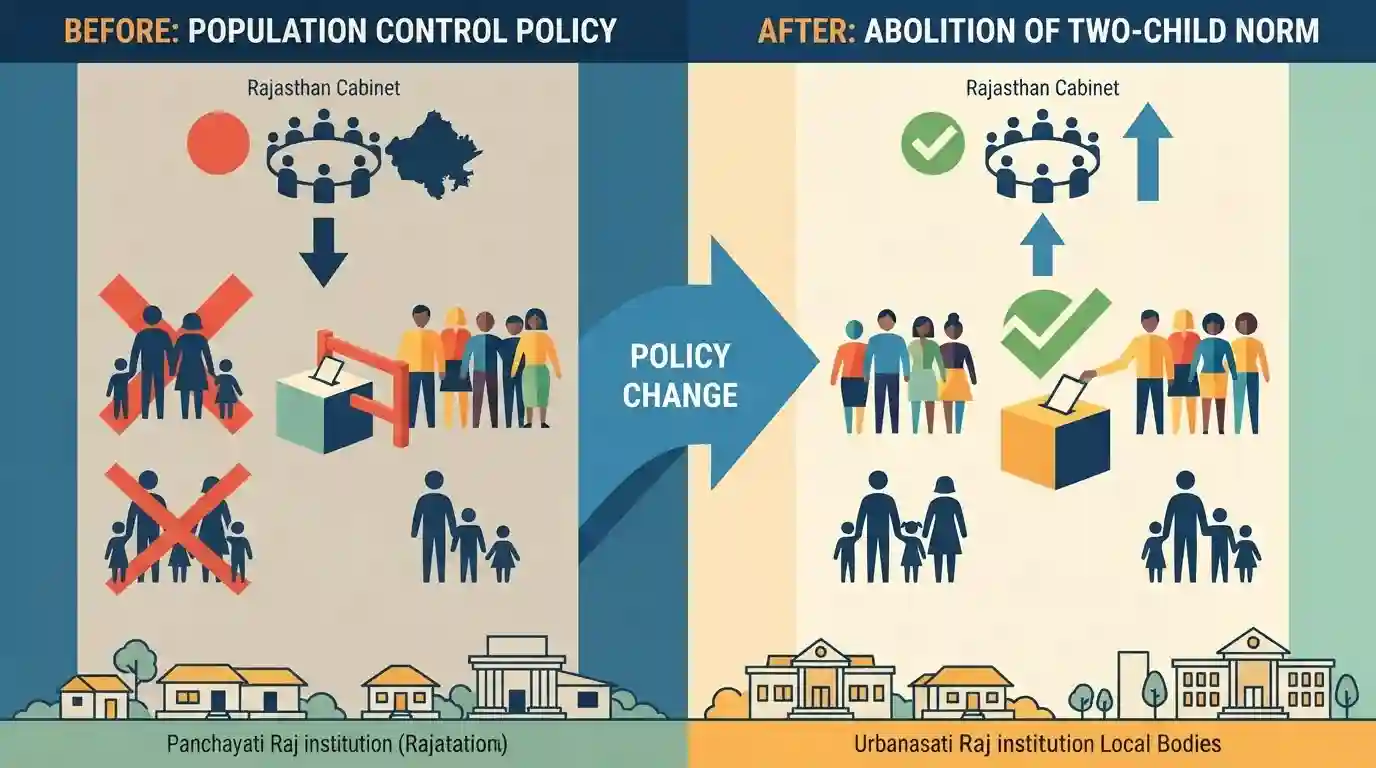
The Rajasthan Cabinet has approved legislative changes to abolish the two-child norm qualification requirement for contesting local self-government elections, including Panchayati Raj institutions and urban local bodies, reversing a long-standing eligibility criterion previously meant to promote population control.
Key Points
- The Rajasthan Cabinet approved amendments to remove the controversial two-child restriction rule for contesting local body polls (Panchayati Raj and urban local body elections).
- Previously, having more than two children after a specific cut-off date served as a statutory disqualification for candidates contesting local elections in Rajasthan.
- The move aims to address demographic shifts, declining fertility rates, and concerns regarding potential exclusion of capable candidates.
Important Terms
Rajasthan Panchayati Raj Act

The principal legislation governing the constitution, powers, and functions of village, intermediate, and district-level panchayats in Rajasthan. It includes provisions for election qualifications and disqualifications.
UPSC context
RPSC Paper II (Polity and Governance): Tests knowledge of grassroots democracy, local administration, and statutory amendments like the two-child norm removal.
Rajasthan Municipalities Act
The foundational law regulating urban local bodies (municipal councils, boards, and corporations) in Rajasthan, outlining municipal governance, electoral rules, and candidate criteria.
UPSC context
RPSC Paper II (Polity & Governance - Urban Local Government): Essential for understanding urban governance structures and recent legislative reforms in Rajasthan.
Rajasthan Cabinet
The highest executive decision-making body in Rajasthan, headed by the Chief Minister, responsible for policy formulation, administrative oversight, and approving state legislative bills.
UPSC context
RPSC Paper II (State Executive & Polity): Important for questions on executive decision-making, policy formulation, and governance mechanisms in Rajasthan.
Static Concepts Connected
What are the key constitutional provisions and Acts governing Panchayati Raj institutions in Rajasthan?
- Constitutional Basis: Added via the 73rd Constitutional Amendment Act, 1992, mandating a three-tier system of Panchayats.
- Rajasthan Act 1994: Enacted in 1994, it provides the statutory framework for Gram Panchayats, Panchayat Samitis, and Zila Parishads.
- Historical Origin: Rajasthan was a pioneer in establishing democratic decentralization, inaugurated in Nagaur district on October 2, 1959.
Cross-Topic Patterns
Local Electoral Reforms vs. National TFR Trends
The removal of the two-child norm in local polls mirrors broader demographic debates around India's declining Total Fertility Rate (TFR) below the replacement level of 2.1.

Expect statement-based questions on the origin of the 2-child norm in 1995 and its continued application in state jobs despite local poll repeal.
Linked PYQs · 2
Linked PYQs · 2
- 2023RPSC_PRELIMSGS1
By which amendment Act was 'Gram Sevak' replaced by 'Gram Vikas Adhikari'?
- 2018RPSC_PRELIMSGS1
Which of the following Act/Rule provides for joint meetings of Gram Sabhas in Rajasthan?
