Rajasthan Budget 2026-27 Fiscal Indicators and Deficit Analysis
Source:prsindia ↗
Why It Matters
Essential for understanding Rajasthan's fiscal health, resource allocation patterns, revenue generation, and deficit management targets as reflected in the state budget.
Summary
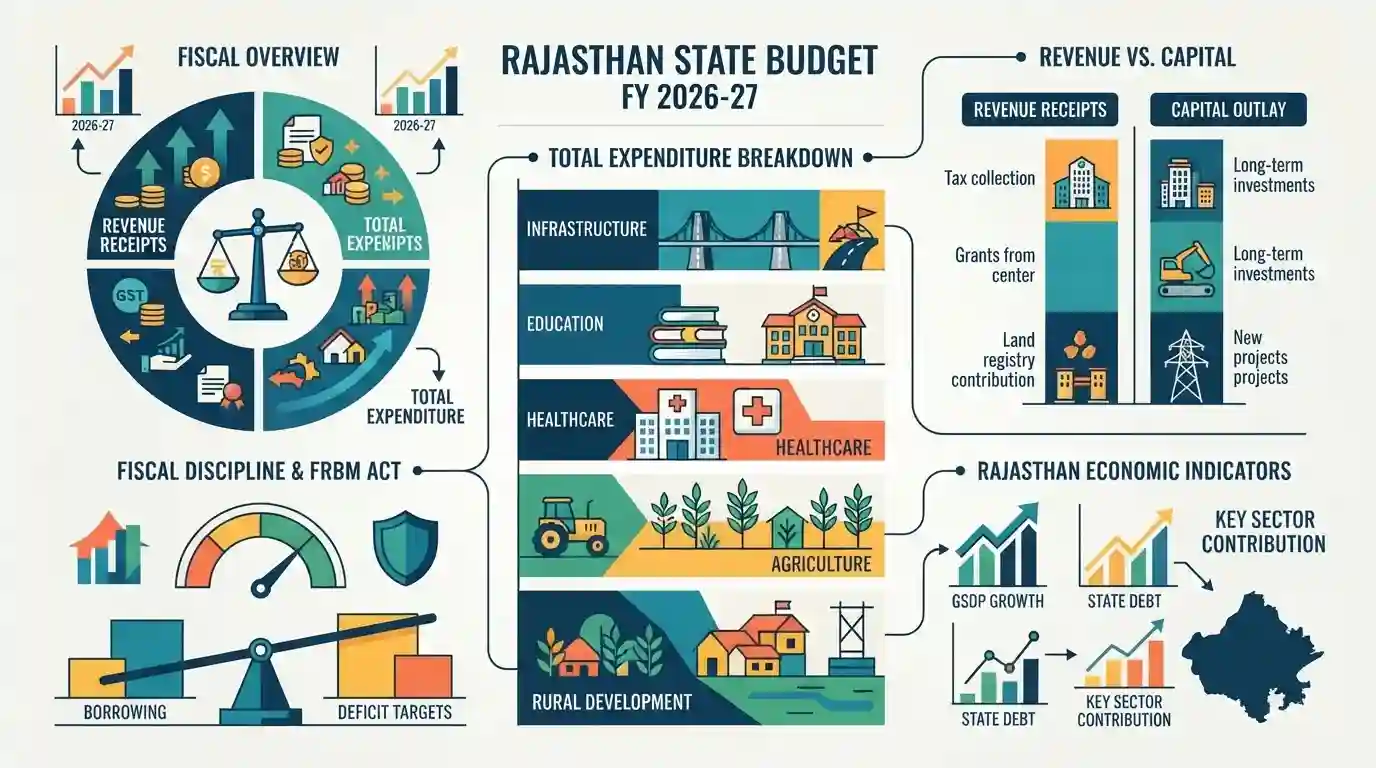
This article provides a comprehensive budget analysis of Rajasthan for the financial year 2026-27, examining key fiscal indicators such as total expenditure, revenue receipts, capital outlay, fiscal deficit limits, and sectoral spending priorities crucial for state economic governance.
Key Points
- Analysis of Rajasthan Budget 2026-27 focusing on state revenue receipts, capital expenditure, and sectoral allocations.
- Evaluation of fiscal indicators including fiscal deficit relative to GSDP targets under the FRBM framework.
- Assessment of state tax revenues, non-tax revenues, and central devolution components in Rajasthan's fiscal policy.
Important Terms
Rajasthan Fiscal Responsibility and Budgetary Management Act, 2005

A state legislation enacted to ensure fiscal discipline, long-term macroeconomic stability, and transparency by reducing revenue deficits and capping fiscal deficits relative to the Gross State Domestic Product.
UPSC context
Crucial for RPSC RAS (Paper III - Economy of Rajasthan and Public Finance). Tests understanding of fiscal policy, deficit limits, and state budget governance.
PRS Legislative Research
An independent research organization that provides policy research, legislative tracking, and comprehensive analytical reviews of union and state government budgets in India.
UPSC context
Relevant for RPSC Public Administration and Economics. Frequently tested for institutional data sources on state finances, capital outlays, and fiscal indicators.
Rajasthan State Government
The executive authority responsible for formulating state economic policies, preparing the annual financial statement (budget), and managing public finances under constitutional provisions.
UPSC context
Core to RPSC RAS (Polity and Governance / Economy). Tests the administrative and financial framework of the state executive in budgetary execution.
Prelims Trap
the fiscal deficit for FY 2026-27 is targeted at around 3.7% of the Gross State Domestic Product
Aspirants often assume Rajasthan's FRBM fiscal deficit is strictly capped at 3% of GSDP, missing permissible enhanced borrowing limits for power and capital reforms.
Static Concepts Connected
What are the key components of Rajasthan's own tax revenue under the state budget?
- SGST Share: SGST constitutes the largest single component of the state's own tax revenue.
- Sales Tax/VAT: Sales Tax or VAT on petroleum products remains a high-yielding revenue head.
- Excise & Stamps: State excise, stamp duty, and registration fees contribute significantly to non-GST tax revenues.
Cross-Topic Patterns
FRBM Norms & State Fiscal Deficits
Rajasthan's fiscal deficit target exceeding the standard 3% norm connects state budgeting with macroeconomic stabilization rules under the 15th Finance Commission guidelines.
Committed Expenditure vs Social Sector Outlays
High committed expenditures in state budgets restrict discretionary social sector spending, linking public finance directly with human development index outcomes.

Expect match-the-following or statement questions on Rajasthan FRBM fiscal deficit targets and own-tax revenue components.
Linked PYQs · 3
Linked PYQs · 3
- 2025RPSC_PRELIMSGS1
Consider the following statements regarding Rajasthan’s fiscal deficit: A. The actual fiscal deficit in 2022-23 was 3.76 percent of the state’s Gross Domestic Product. B. This is less than the limit approved by the F.R.B.M. Act, 2005. C. The fiscal deficit in 2022-23 was higher than in 2021-22. Choose the correct option:
- 2024RPSC_PRELIMSGS1
Consider the following statements regarding fiscal deficit in 2022-23 of Rajasthan: A. Rajasthan fiscal deficit in the year 2022-23 has been 3.76 percent of GDP estimation. B. The recommended fiscal deficit presented by the F.R.B.M. Act, 2003.
- 2018RPSC_PRELIMSGS1
In recent years, which of the following items has contributed the most to the state's revenue in Rajasthan's budget?
