Rajasthan Budget 2026 27 Fiscal Parameters And Sector Allocations
Source:prsindia ↗
Why It Matters
Crucial for RPSC RAS aspirants to understand Rajasthan's state finances, budgetary allocations, revenue sources, and fiscal discipline indicators as reflected in the annual budget analysis.
Summary
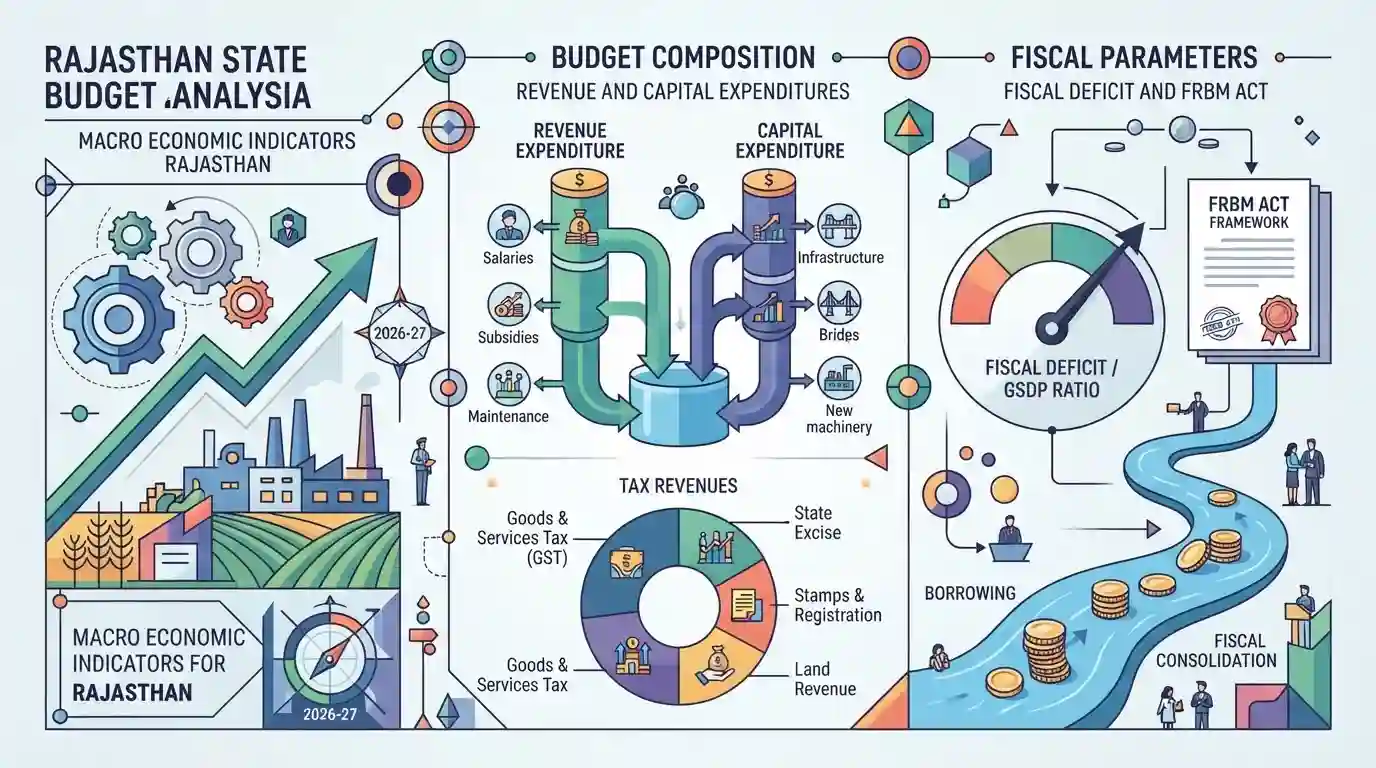
The article provides a detailed budget analysis of Rajasthan for the financial year 2026-27, detailing economic indicators, revenue and capital expenditures, tax revenues, and fiscal parameters like fiscal deficit relative to GSDP under the state FRBM framework.
Key Points
- The Rajasthan Budget Analysis for 2026-27 provides a comprehensive breakdown of the state's estimated receipts, expenditures, fiscal deficit, and revenue deficit.
- It examines sector-wise allocations (such as education, health, agriculture, and infrastructure) and capital versus revenue expenditure patterns for the state.
- It outlines Rajasthan's adherence to the targets set by the state FRBM Act regarding borrowing limits and debt-to-GSDP ratios.
Important Terms
Rajasthan Fiscal Responsibility and Budget Management (FRBM) Act

A legislative framework enacted to ensure fiscal discipline, reduce public debt, and manage revenue and fiscal deficits sustainably relative to the Gross State Domestic Product (GSDP).
UPSC context
RPSC Paper III (Indian & Rajasthan Economy - State Public Finance, Budgetary Trends, and Fiscal Policy). Tests knowledge of fiscal rules and deficit targets.
PRS Legislative Research
An independent research organization that provides non-partisan legislative and budget tracking, policy analysis, and detailed analytical reports on union and state government budgets in India.
UPSC context
RPSC Paper III (Economy and Public Administration). Useful reference source for understanding legislative processes, state budget structures, and public expenditure analysis.
Static Concepts Connected
What are the key parameters and targets stipulated under the Rajasthan FRBM Act?
- Deficit Targets: Statutory limits set by the state to curb fiscal deficit and manage total outstanding debt relative to GSDP.
- Borrowing Ceilings: Mandates capping the fiscal deficit within prescribed percentage limits of the Gross State Domestic Product (GSDP).
- Debt Sustainability: Ensures long-term debt sustainability by targeting a declining or stable debt-to-GSDP ratio over successive fiscal cycles.
What is the distinction between Revenue Expenditure and Capital Expenditure in state budgets?
- Revenue Exp: Expenditure incurred for day-to-day running of government departments and maintenance services, creating no physical assets.
- Capital Outlay: Spending directed toward creating durable assets like roads, buildings, and infrastructure, boosting long-term productive capacity.
Cross-Topic Patterns
State FRBM and National Fiscal Rules
State FRBM targets mirror central Fiscal Responsibility norms, creating a dual-layered accountability framework for public debt management.
Capital Outlay vs Federal Infrastructure Schemes
Capital outlay trends in state budgets directly influence infrastructure velocity and industrial corridor integration under federal schemes like PM Gati Shakti.

Expect a statement-based RPSC question combining Rajasthan FRBM debt-to-GSDP limits with capital expenditure growth rates.
Linked PYQs · 2
Linked PYQs · 2
- 2024RPSC_PRELIMSGS1
Consider the following statements regarding fiscal deficit in 2022-23 of Rajasthan: A. Rajasthan fiscal deficit in the year 2022-23 has been 3.76 percent of GDP estimation. B. The recommended fiscal deficit presented by the F.R.B.M. Act, 2003.
- 2025RPSC_PRELIMSGS1
Consider the following statements regarding Rajasthan’s fiscal deficit: A. The actual fiscal deficit in 2022-23 was 3.76 percent of the state’s Gross Domestic Product. B. This is less than the limit approved by the F.R.B.M. Act, 2005. C. The fiscal deficit in 2022-23 was higher than in 2021-22. Choose the correct option:
